

There are shows that entertain… and shows that pull the soul forward so hard it forgets to blink. This was the second kind — packed with secrets that most viewers didn’t catch until social media started rewinding the night. Because while the cameras caught the fireworks, a second story was unfolding in the details — hidden in plain sight — the kind of coded storytelling that only reveals itself after the noise fades.
On February 8, 2026, at Levi’s Stadium, Bad Bunny turned 13 minutes into a living neighborhood — equal parts street party, family album, protest mural, and love letter. It was big enough for the gossip lovers (and yes, we’ll get to that), but built with a kind of cultural intelligence that artists recognize immediately: this wasn’t a setlist. It was a narrative.
And I’ll say this plainly, from the heart: as a Latin immigrant, this didn’t land on me like “content.” It landed like recognition. The show carried the tenderness of home and the ache of displacement at the same time — the way our communities do. It held the joy we dance for, and the pain we endure, and it refused to separate the two.
The gossip that became instant Super Bowl mythology: the real wedding
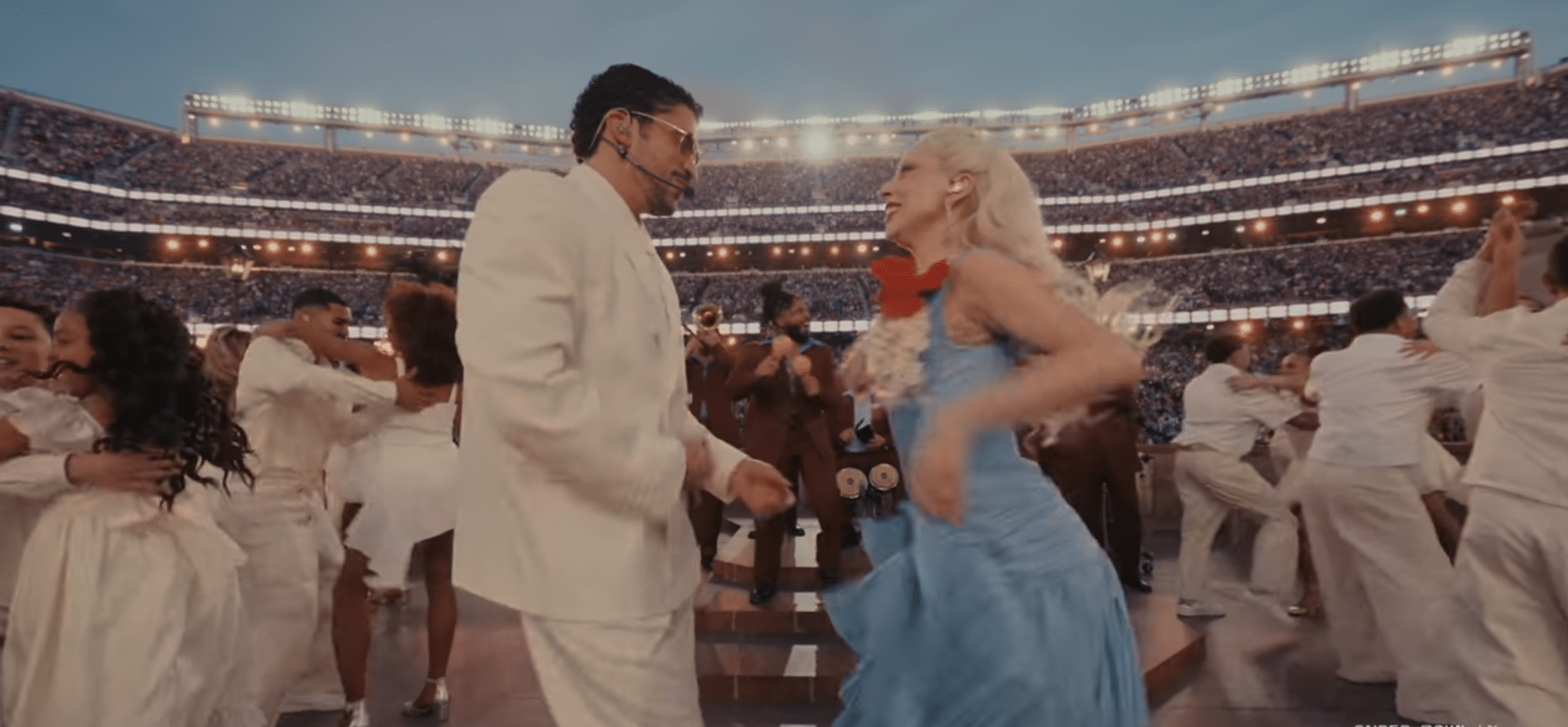
About five minutes into the performance, the cameras landed on a plaza scene where a couple in white completed an actual ceremony — kiss and all — surrounded by dancers and musicians like a community celebration. It wasn’t a skit. It was real. A representative confirmed Bad Bunny served as a witness and signed the marriage certificate, and yes, there was even wedding cake.
That choice was more than viral bait. A wedding is one of the last rituals modern life still treats as sacred — and placing it inside the biggest entertainment stage on Earth turned halftime into something intimate: a communal plaza, not a pop concert.
And it set the tone for everything that followed: this performance wasn’t trying to look expensive. It was trying to feel true.
The field became a neighborhood — and the neighborhood carried history
The opening image looked like a dream: towering sugarcane rising out of a football field as he launched into “Tití Me Preguntó.” But the sugarcane wasn’t just pretty staging. It was roots. Labor. The story of what gets harvested — and who gets overlooked.
Then came one of the most quietly brilliant production secrets of the night: those “plants” weren’t plants. Because NFL grass restrictions limited what could be rolled onto the field, the solution was simple and genius — human bodies became landscape. Hundreds of performers were costumed to create the illusion of vegetation, turning the land into living bodies.
That’s not just clever. That’s metaphor you can feel: the land is alive because the people are alive.
And the details kept speaking: jíbaro imagery, pavas, domino tables, piragua energy — everyday life scaled to stadium size without losing its soul.
The quiet detail that broke my heart in the best way
In one party scene — almost a blink — there was a child asleep on a chair while the adults kept dancing.
If that sounds small, it’s because the deepest cultural truths rarely arrive with fireworks. They arrive as recognition. That image is so familiar to Latin families it can trigger memory instantly: children brought into celebration, learning rhythm before they learn explanations, and when they finally collapse into sleep, the night doesn’t end — it simply keeps moving around them with tenderness.
Even for viewers who don’t share that exact memory, the emotion reads clearly: this is not a staged fantasy of culture. This is culture breathing.
The stage placement felt like generosity
One of the most human details wasn’t printed on a screen — it was spatial. Watching live, it was striking how much of the action hugged the lower bowl, close to the field, close to the “regular” seats. The show didn’t feel framed for distant luxury suites; it felt physically oriented toward the fans in the cheaper sections, the ones who saved up, the ones who scream until they’re hoarse.
That choice reads as a kind of generosity audiences don’t forget — because it isn’t announced. It’s felt. It says: I’m not performing over you. I’m performing with you.
The celebrity “neighbors” — and yes, they were there
Then the casita turned into a porch-party tableau that sent the internet into detective mode. The camera caught celebrity cameos woven into the scene like locals, not trophies — Pedro Pascal dancing, plus Cardi B, Karol G, Jessica Alba, and Young Miko.
Other reported cameo names folded into the porch-party world included Alix Earle, David Grutman, and Giannina Mourouvin.
This is a subtle but powerful directorial trick: when celebrities don’t interrupt the world, they thicken it. The scene stops being “guest appearances” and becomes a neighborhood.
Gaga, Ricky, and the art of bridging generations
Then came the moment that felt like a door opening mid-song: Lady Gaga emerged into a salsa-inflected “Die With a Smile,” joined by Los Sobrinos, before Bad Bunny slid into “Baile Inolvidable.” The transition was surreal in the best way — romance, rhythm, community — as if the wedding scene itself had conjured the music.
Later, Ricky Martin appeared, creating a cross-generational bridge that felt like continuity rather than nostalgia.
Boxing in the sugarcane — because culture includes the fight
Even “MONACO” carried a surprise: professional boxers Xander Zayas and Emiliano Vargas appeared sparring on the field as part of the on-field theater. It was a quick, kinetic nod to a tradition that runs deep in so many Hispanic communities — discipline, pride, survival, spectacle.
The Liam rumor — why it spread, and what’s true
One of the most emotionally charged moments came when Bad Bunny handed a Grammy to a child onstage near a home-like “Conejo” set. Almost instantly, online speculation tried to connect that child to a real public wound: Liam Conejo Ramos, the 5-year-old whose detention by U.S. Immigration and Customs Enforcement with his father had dominated headlines and ignited outrage.
But reporting clarified the child onstage was not Liam — he was identified as a young actor, Lincoln Fox.
The rumor still reveals something about the cultural temperature: people are searching for signs that someone on the biggest stage is willing to carry the pain of vulnerable families into public light — that pop spectacle might also be witness.
The closing message that made the whole show click into place
As the show ended, the symbolism widened beyond one island into the Americas — a hemisphere roll call, “America” framed as a continent, not a single flag. Reports noted the final line on the stadium screens: “The only thing more powerful than hate is love.”
That’s why this halftime show didn’t just trend. It lingered. Because it wasn’t trying to impress everyone — it was trying to tell the truth beautifully.
And when an artist does that — when spectacle becomes belonging — even the viewers who don’t catch every cultural reference still feel the emotional language.
The joy translates.
The tenderness translates.
The courage translates.
Thirteen minutes. A stadium. And a performance that proved something the entertainment world too often forgets:
Connection is not a bonus. It’s the art.
If this halftime show proved anything, it’s that the artists who change culture aren’t just talented — they’re brave enough to tell the truth in a way people can feel. If you’re hungry for more stories like this — artists who carry identity, history, and heart into their work — explore ArtTour International and discover the creators shaping the soul of our time.