

A shoe becomes a hat. A lobster walks across a dress. Quilted ribs and a spine turn an evening gown into an anatomical joke. Elsa Schiaparelli understood that fashion could be elegant while refusing good behavior.
Schiaparelli: Fashion Becomes Art, at the V&A South Kensington through November 8, 2026, is the first United Kingdom exhibition devoted to the house. It follows Schiaparelli from her radical work between the world wars to the contemporary couture directed by Daniel Roseberry.
Surrealism escaped the frame
In 1920s and 1930s Paris, Schiaparelli worked in proximity to artists and writers who embraced dream logic, chance, disguise and the uncanny. Her collaborations with Salvador Dalí produced the Skeleton dress, Tears dress and shoe hat in 1938. Jean Cocteau’s drawing became embroidered profiles and roses on a 1937 evening coat.
Schiaparelli made the body a place where art could misbehave in public.
A Surrealist object in a gallery may interrupt ordinary logic for the duration of a visit. A garment carries that interruption into dinner, photography, performance and the street. It moves, encounters social rules and changes with the person wearing it.
The exhibition includes 100 ensembles and 50 artworks, alongside jewelry, accessories, perfume, furniture, photographs and archival material. Works by Picasso, Cocteau, Man Ray, Dalí and Eileen Agar establish a network rather than presenting fashion as a passive recipient of “fine art” ideas.
Materials contribute their own sound
Schiaparelli experimented with unexpected textures, including surfaces resembling tree bark and garments incorporating cellophane. For this exhibition, the V&A commissioned an original score from the sound studio Father, which recorded physical materials and used recurring musical motifs to shape the visitor’s journey.
That decision is more than atmosphere. Clothing has sound: beads strike, stiff fabric creases, fringe moves and a train crosses the floor. Museum display necessarily stills garments, so sound can restore a trace of their physical life without pretending the mannequin is moving.
The score also uses recurring notes connected to Debussy, a composer Schiaparelli admired, to create dreamlike déjà vu. Repetition echoes the way motifs return across the house’s history—an eye, a mouth, anatomy, gilded excess—recognizable but never identical.
Roseberry inherits a method, not a costume
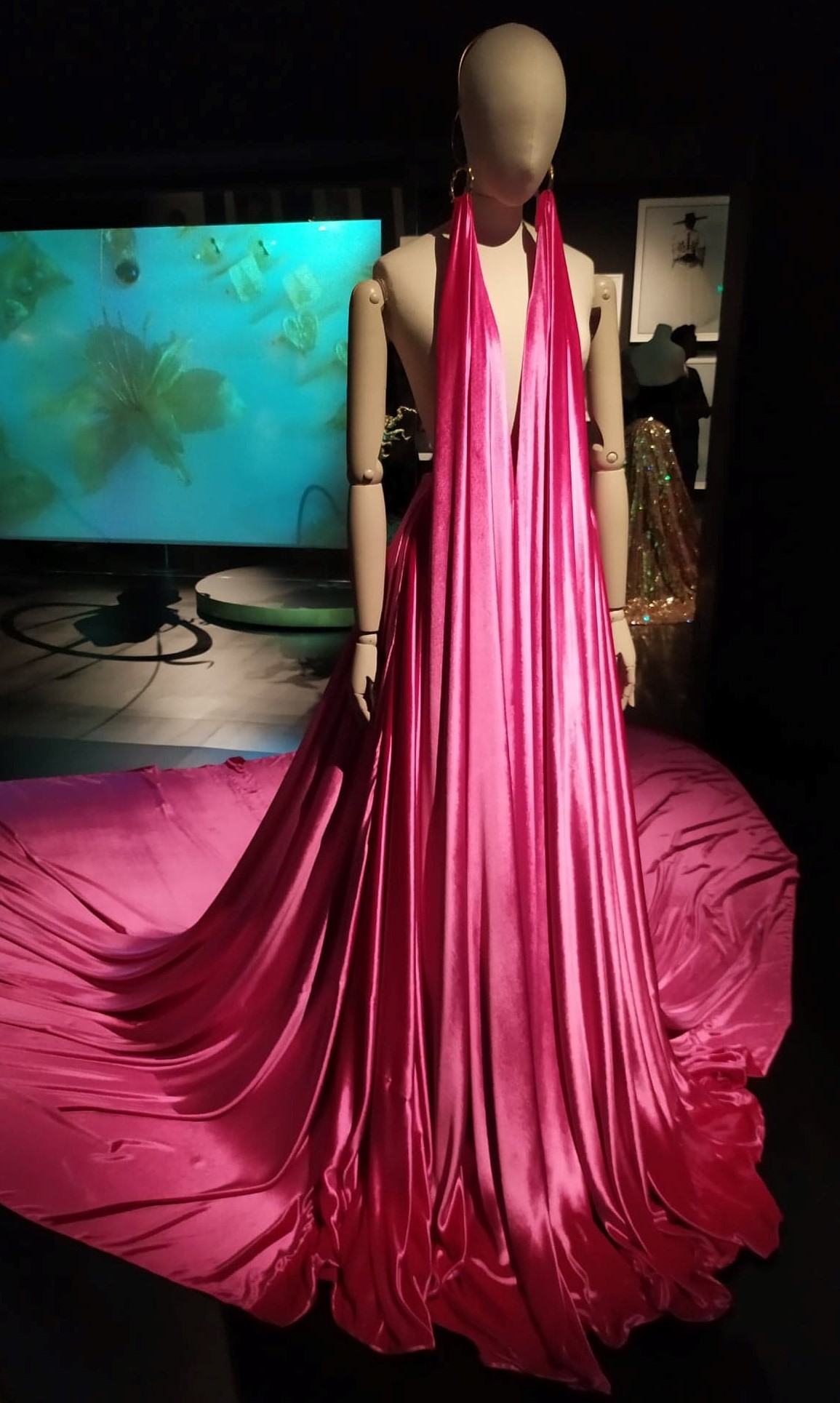
Daniel Roseberry’s contemporary Schiaparelli has revived the house through sculptural couture and high-impact adornment. The exhibition includes present-day work, such as a look worn by model Awar Odhiang from the autumn/winter 2024 haute couture collection.
The useful question is not whether Roseberry copies Elsa accurately. A living house cannot survive as a museum of its founder. What he inherits is permission to make fashion collide with sculpture, anatomy, celebrity image and absurdity.
That continuity also requires critical looking. Surreal shock can become a luxury brand code when repeated too easily. Notice which contemporary pieces turn the body into a genuinely strange proposition and which rely on a familiar symbol enlarged for immediate photography.
Celebrity can amplify this problem. A sculptural dress may be encountered first through a viral arrival rather than through movement, craft or collection context. The museum offers a slower frame, but it should not sterilize the work. Imagine the social risk of wearing an eye, mouth or anatomical ornament before it became recognizable house language.
Elsa’s famous “shocking pink” similarly demonstrates how a color becomes identity. Saturation works across fabric, packaging, print and memory. In the gallery, trace whether the hue behaves as surface, branding or emotional temperature—and how nearby art changes what the same pink can mean.
The V&A’s historic objects help make construction visible beneath spectacle. Examine embroidery, closure, internal support and the relationship between image and cut. A lobster printed on silk is memorable, but its placement becomes fashion only through the moving body and the architecture of the dress.
Tickets are currently listed at £28 on weekdays and £30 on weekends, with advance booking recommended. The exhibition closes November 8. Because sound is integral to the design, visitors sensitive to audio should consult the museum’s access information before arrival.
Schiaparelli remains thrilling because the work refuses the false choice between intellect and delight. A dress can be a joke, a sculpture, a social provocation and an exquisitely made garment at once. The impossible becomes wearable—and walks out looking perfectly, audaciously composed.