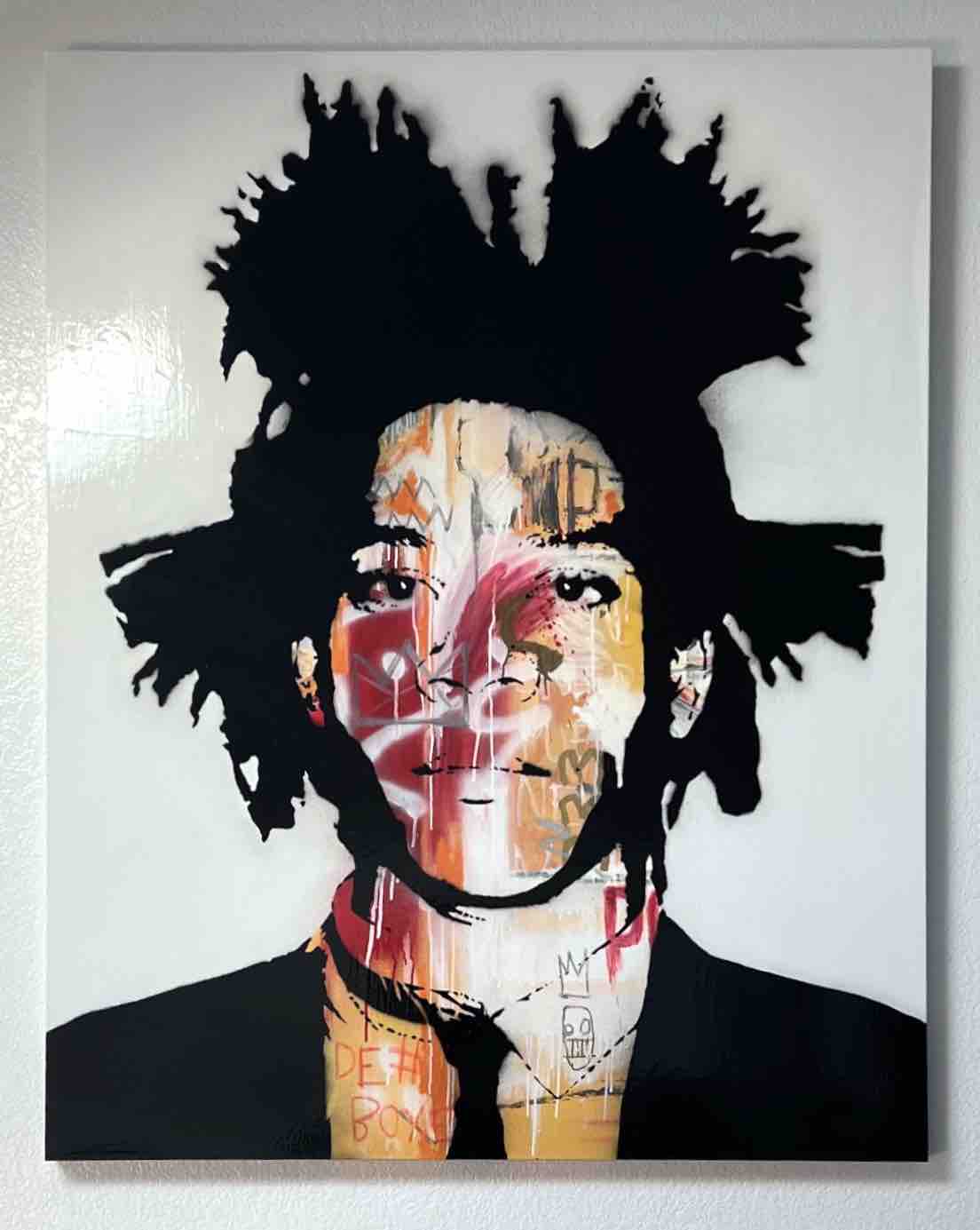

A newly announced Princeton University Art Museum exhibition will place Jean-Michel Basquiat’s “Blue Ribbon” paintings at the center of a larger story about copying, circulation and authorship. Opening October 4, Basquiat, the Blue Ribbon Paintings, and the Art of Reproduction gathers eleven densely layered works from 1984 with nearly all of the artist’s known print projects.
The premise shifts attention from the familiar mythology of Basquiat as an instinctive downtown genius toward a more analytical artist who understood how images acquire authority by being repeated.
The copy was part of Basquiat’s thinking
Basquiat’s paintings teem with diagrams, logos, words, crowns, bodies and fragments that seem to arrive from different information systems at once. Reproductive media—photocopies, prints and transferred images—allowed him to move motifs between works while testing the unstable boundary between an original and its echo.
The eleven Blue Ribbon paintings combine anatomical imagery, film references, crowned figures and textual fragments. Their density rewards slow reading. A repeated image does not necessarily mean the same thing twice; context can turn a borrowed sign into criticism, homage, camouflage or declaration.
That approach belongs to the postmodern debates of the 1980s, when artists challenged stable ideas of authorship and originality. Basquiat’s position was distinctive because reproduction also intersected with race and visibility. Who gets copied into cultural memory, and who remains outside its frame?
For Basquiat, repetition was never merely mechanical. Every return altered the power of the image.
A lineage expands the exhibition beyond one famous name
Curated by scholar Jordana Moore Saggese, the exhibition connects Basquiat with Robert Rauschenberg and with pioneering Black printmakers including Robert Blackburn. This wider lineage matters. It resists presenting Basquiat as a miracle without predecessors and places his experiments within intergenerational conversations about print, collaboration and access.
Printmaking can distribute an image beyond the singular prestige of painting. It is also a technical and social process, often involving shared workshops and specialized collaborators. By assembling Basquiat’s print projects, Princeton can make visible a part of his practice overshadowed by auction records and iconic canvases.
The museum’s framing also asks viewers to reconsider hierarchy. A photocopied fragment may carry as much conceptual weight as a painted gesture. A print is not simply a lesser version of an original; it can be the place where an idea becomes mobile.
Why this exhibition is worth planning for now
Basquiat exhibitions reliably attract large audiences, but recognition can encourage visitors to look only for crowns, skulls and market-famous images. The Blue Ribbon focus offers a more precise route into his thinking.
When the exhibition opens, look for changes across repeated motifs. Notice where the seams of reproduction remain visible and where hand-painted marks interrupt them. Ask how commercial logos and anatomical diagrams behave once removed from their original sources.
The show arrives in a culture saturated with frictionless digital copies and generative images. Basquiat’s work predates that environment, yet its questions feel newly sharp. Reproduction can spread an image, detach it from context, increase its value or empty it into cliché.
By returning attention to the Blue Ribbon paintings and prints, Princeton proposes Basquiat not only as an icon reproduced everywhere, but as an artist who studied reproduction from inside the work. That distinction promises a richer encounter than another celebration of fame.