
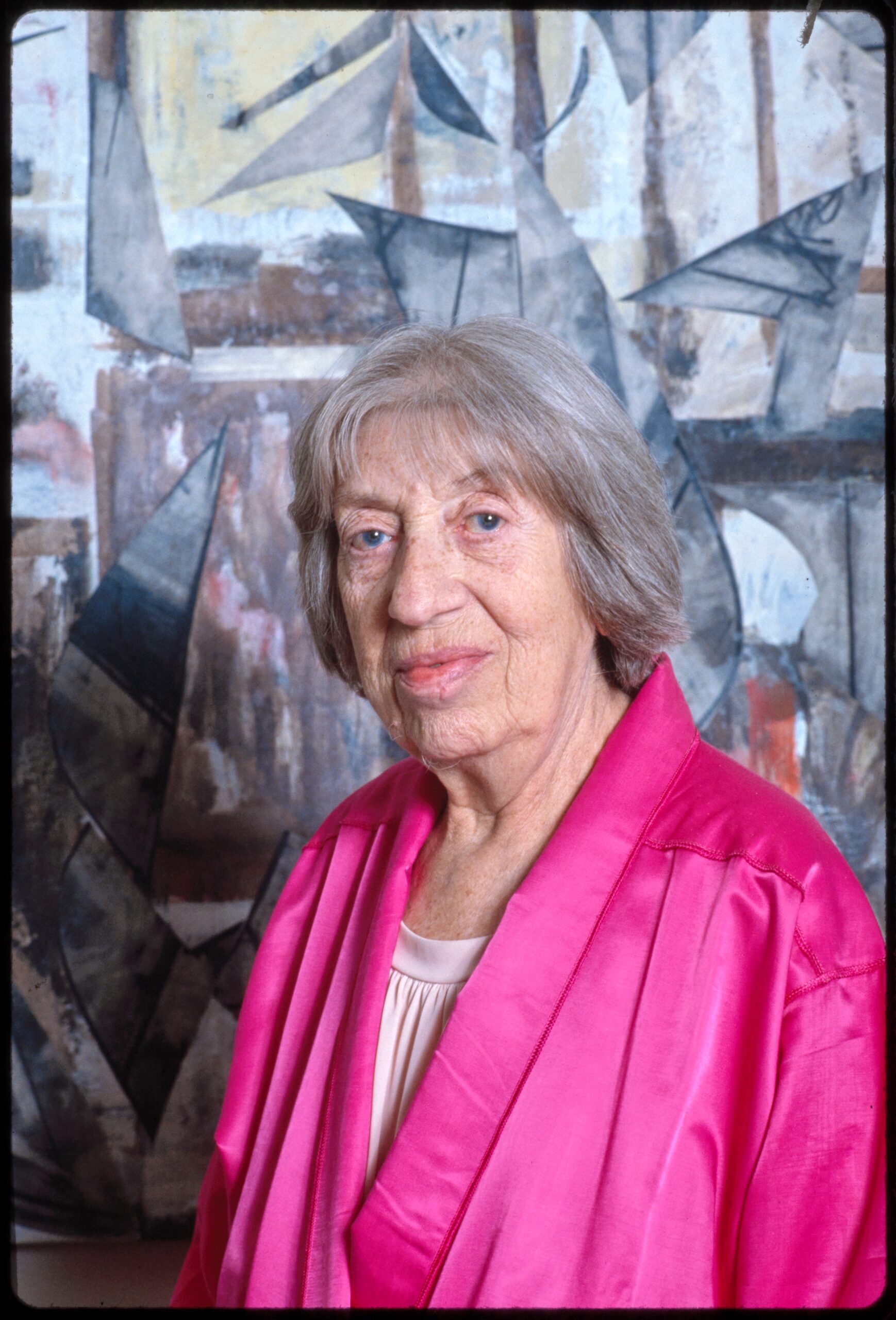

The Metropolitan Museum of Art has opened Krasner and Pollock: Past Continuous, the first exhibition to follow the full arcs of Lee Krasner’s and Jackson Pollock’s careers together. More than 120 works place two central figures of Abstract Expressionism in parallel without reducing either artist to influence, marriage or myth.
That curatorial decision is the event. Exhibitions about artistic couples often become stories of priority: who discovered an idea first, who influenced whom, whose career eclipsed the other. The Met instead gives each practice room to change across time while showing how shared circumstances, conversations and ambitions entered both bodies of work.
Beyond the familiar chronology
Krasner and Pollock met in 1941, married in 1945 and lived and worked in Springs, New York, until Pollock’s death in 1956. Their partnership is essential, but it is not the limit of either career. By beginning before they met and continuing through Krasner’s later work, the exhibition restores the longer timelines that popular biography compresses.
Pollock’s concentrated breakthrough with poured paint remains central to the history of postwar art. Krasner’s practice moved repeatedly through new structures of collage, scale, color and gesture. Her career cannot be read as one sustained response to Pollock. It was an active sequence of revisions in which earlier work could be cut, recombined and made to generate something new.
The exhibition’s title comes from Krasner’s 1976 painting Past Continuous. It offers a useful method for the show: the past does not sit behind the artist as a finished chapter. It is material that returns, changes meaning and enters the future.
What changes when artists are shown as peers
Reframing a canonical relationship does more than correct a historical imbalance. It alters how visitors look. When one artist is presented primarily as spouse, manager or survivor, formal decisions can be mistaken for biographical evidence. Showing Krasner and Pollock on their own terms allows composition, material, scale and repetition to lead the interpretation.
The approach also resists a simplified rescue narrative. Krasner does not need to be made important by diminishing Pollock, and Pollock does not need to remain the fixed center of their story. A more generous history can hold unequal conditions, mutual commitment, conflict and independent achievement at the same time.
A curatorial model for familiar names
For museums and publishers, Past Continuous demonstrates how a major exhibition can make heavily covered artists newly relevant. The answer is not novelty for its own sake. It is a structure that exposes what the standard story excluded.
That model can be applied to archives far beyond Krasner and Pollock. Look for the artist whose labor was described as support rather than authorship. Extend the chronology beyond the celebrated period. Separate comparison from competition. Invite living artists and scholars to test what the older narrative still cannot explain.
The exhibition also arrives as the Met prepares its future Tang Wing for modern and contemporary art. Its method—revisiting a canon through parallel, incomplete histories—signals how institutions may rethink twentieth-century collections without pretending that the canon can be repaired by a single corrective label.
Krasner and Pollock: Past Continuous is on view at The Met Fifth Avenue through January 31, 2027.