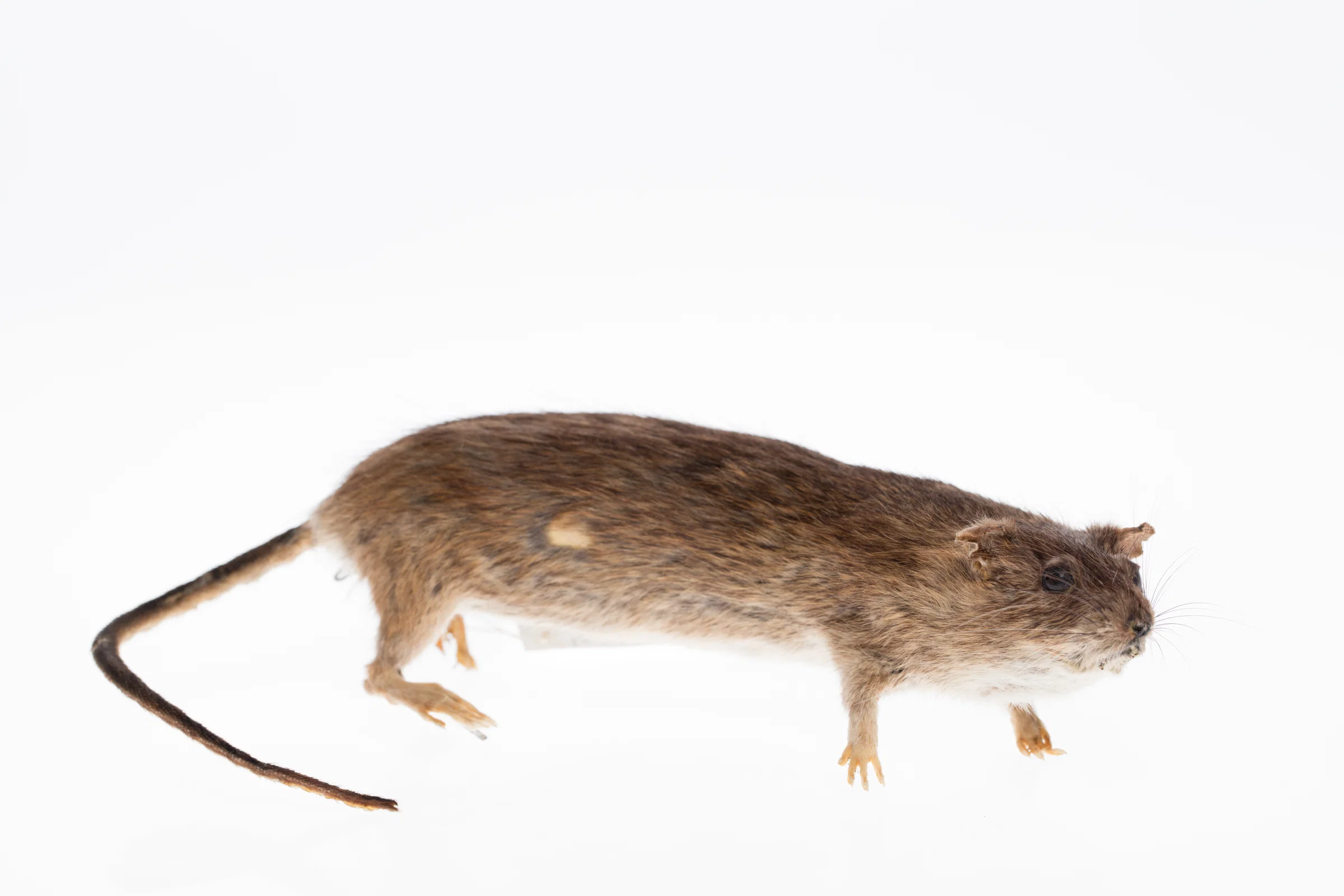

Asad Raza has made a public-art project for an audience that does not read wall labels, follow galleries, or ask whether an object is sculpture. During the summer, the Berlin-based artist and a small team placed more than 20 structures near rat habitats across New York City. The intended viewers—and users—were brown rats.
The resulting exhibition, Thigmotaxis (the rat show), is now on view at the nonprofit space times through December 12. It includes sculptures returned from the streets, video of nocturnal encounters, and a textured wall work that lets human visitors experience the bodily sensation named in the title.
Designing for another species
Thigmotaxis describes the tendency to navigate through contact with surfaces. Rats often move along walls and edges, using touch and smell to compensate for limited vision. Raza worked with animal-behavior researcher Michael Parsons, MIT architects Mara Jovanovic and Zaynab Eltaib, adviser Jaffer Kolb, and artists Devyn Gallindo, Kunning Huang, and Jared Packard to translate that behavior into form.
The structures use concrete, timber, and canvas. They offer irregular passages, rough surfaces, entrances, exits, and places to hide. Trail cameras recorded rats sniffing, crossing, and entering them at night. The marks left behind are not incidental damage. They are evidence of an encounter that the artwork was designed to receive.
This is a significant reversal of normal public-art logic. Artists and institutions typically imagine an ideal human viewer, then consider accessibility, interpretation, and conservation around that figure. Raza began with a nonhuman audience’s sensory preferences. Human visitors arrive later, looking at objects that have already been activated elsewhere.
The artist as convener, not sole author
Raza is known for projects that behave as living situations rather than closed objects. Water, soil, wind, plants, bodies, and collective labor recur across his practice. In this project, the rats are not symbols for urban disorder or human fear. Their independent behavior becomes part of how the work is formed and understood.
That approach changes the role of collaboration. Scientific knowledge does not merely validate an artistic idea after the fact; it helps determine scale, texture, placement, and material. Architecture does not provide a neutral shell; it is recalibrated around another species. Documentation is not simply promotional; it makes an otherwise nocturnal and dispersed audience visible.
What this means for current practice
Artists working with ecology, public space, or participation can take a practical cue from the project: define the audience through observed behavior rather than demographic assumptions. A work for birds, insects, plants, waterways, or microbial systems will demand different materials, time scales, ethics, and evidence than a work for people.
The project also questions the habit of measuring cultural impact only through attendance. Here, the first audience does not buy tickets or post images. Engagement appears as touch, scent, movement, residue, and repeat visits captured by cameras. The measures are modest but closely aligned with the work’s purpose.
For galleries and publishers, the story is visually and conceptually strong because it can be followed across several environments: the street site, the animal encounter, the returned object, the exhibition, and the research behind it. That sequence gives audiences more than an eccentric premise. It reveals how an artist built a method around attention to lives that cities usually manage only as a problem.
Thigmotaxis does not ask viewers to romanticize rats. It asks whether art can recognize another species as a public with preferences of its own. That is a small but consequential shift in who—and what—contemporary art imagines when it says “audience.”