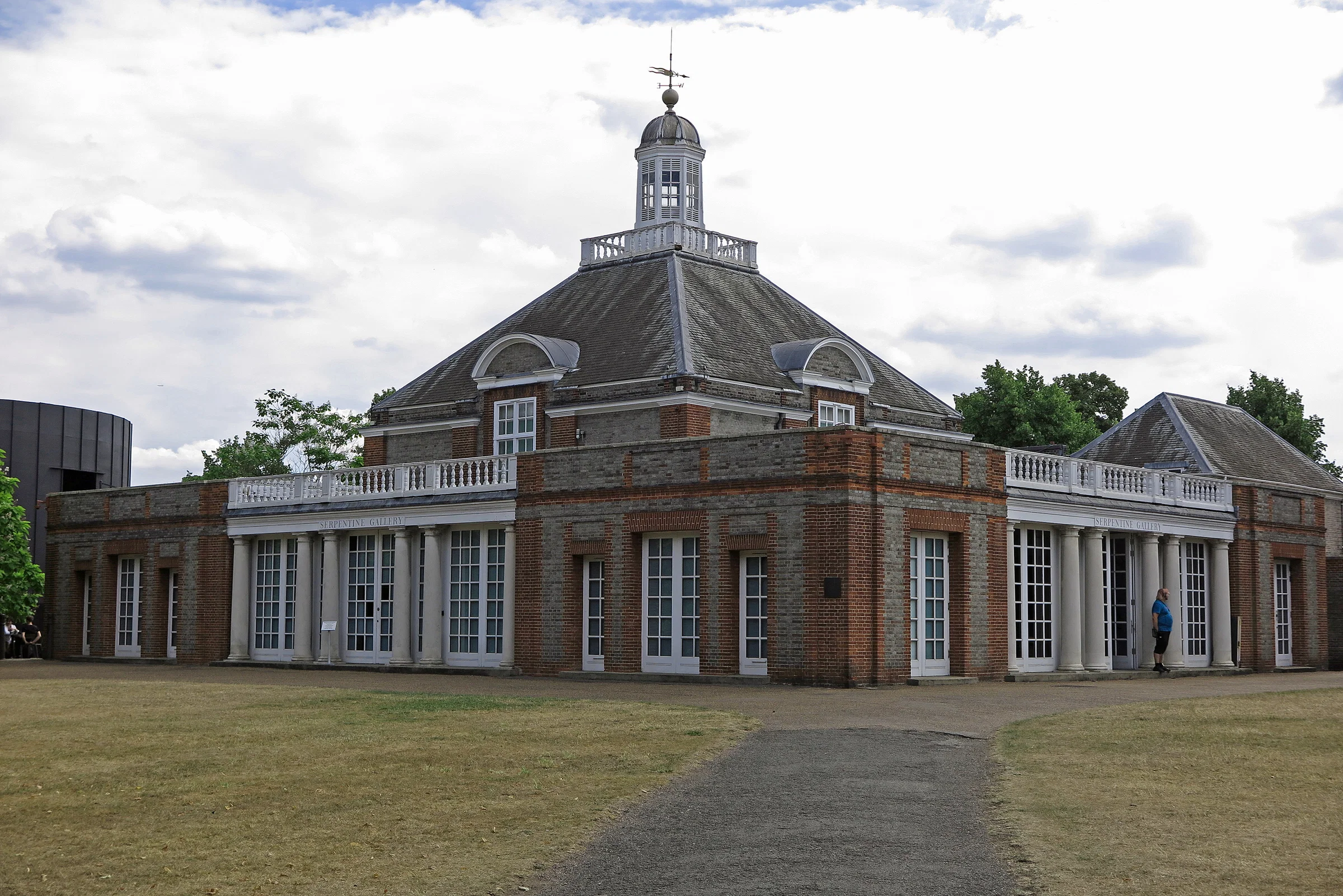

Justin Caguiat’s first institutional exhibition in the United Kingdom does not treat the gallery as a neutral container. In Change Ringing, which opened at Serpentine South on October 8, paintings, sculpture, printmaking, sound, and film are organized through the architecture and working infrastructure of the building itself.
The exhibition’s most immediately changeable works are a new group of thermochromic paintings. Their surfaces respond to heat and light, making environmental conditions part of what the visitor sees. A painting is no longer a fixed image placed inside a stable room; it becomes a sensitive register of that room.
A building becomes part of the medium
Caguiat’s practice connects architecture with spirituality and everyday ritual. At Serpentine, the display extends beyond conventional hanging. The building’s structural and infrastructural features frame the works, allowing circulation, temperature, light, and sound to act alongside pigment and form.
The title refers to a system of bell ringing in which the order of bells changes through a sequence. That idea—transformation produced through structure—offers a way into the exhibition as a whole. The works shift through time, while the visitor’s movement reveals relationships that cannot be reduced to a single frontal view.
The project develops questions Caguiat explored in Zodiac Machine, an earlier work presented across a church, a market, and nearby public spaces in Madrid. That project drew inspiration from Justo Gallego Martínez’s cathedral in Mejorada del Campo, a structure built over decades from recycled and found materials. Across both projects, devotion appears not as a separate subject but as repeated labor embedded in architecture.
What artists can take from the exhibition
Change Ringing demonstrates that site responsiveness can begin with careful attention rather than spectacle. An artist does not need to overwhelm a building to make it active. Temperature, ventilation, windows, thresholds, reverberation, and patterns of movement can all become compositional tools.
The exhibition also offers a useful model for artists working across media. Painting, film, sound, print, and sculpture are not presented as parallel portfolios. They serve one spatial argument. That coherence is valuable when developing proposals for institutions: the strongest multidisciplinary projects explain why each medium is necessary and how the visitor encounters the whole.
Materials can carry this argument further. Thermochromic paint makes change visible without turning technology into a separate attraction. The material’s responsiveness supports the exhibition’s larger ideas about memory, ritual, and transformation. For artists experimenting with responsive media, the lesson is to choose technology for conceptual precision, not novelty.
A practice understood through duration
Because the paintings react to their surroundings, no single installation photograph can fully represent them. That gap is productive. It asks institutions and publishers to document the work through sequences, video, environmental notes, and accounts of how it changes across a day or season.
At Serpentine, Caguiat turns a familiar white gallery into an unstable instrument. The result is a timely example of how contemporary painting can remain materially complex, architecturally alert, and open to time. Change Ringing continues through January 10, 2027.