
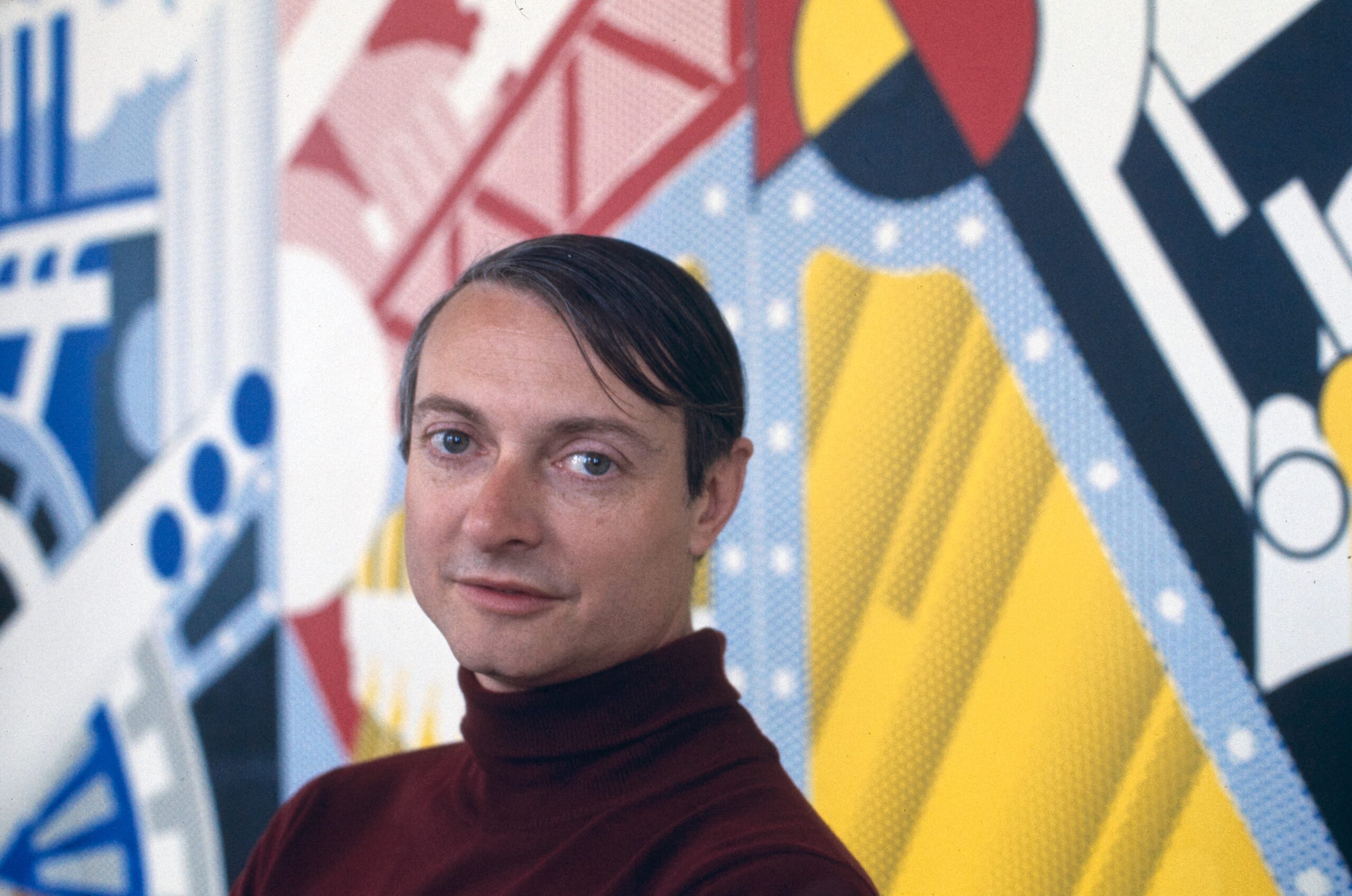

The Whitney Museum of American Art has opened Roy Lichtenstein: Like New, the first New York retrospective devoted to the artist since 1993. More than a familiar parade of Ben-Day dots and comic-book panels, the exhibition uses lesser-known work, source material and four re-created murals to examine how Lichtenstein transformed images across six decades.
The museum describes his paintings as mechanical in appearance but emphatically handmade. That tension gives the exhibition a particularly current edge. Lichtenstein enlarged, redrew and reorganized images from newspapers, comic books and art history long before digital culture made copying, filtering and reposting ordinary visual behavior.
Reconstruction as an argument
One of the exhibition’s most ambitious gestures is the return of the 96-foot Greene Street Mural, originally painted in 1983 and destroyed after six weeks according to the artist’s wishes. The show also reconstructs his landmark 1962 exhibition at Leo Castelli Gallery, the presentation that helped announce Pop art’s arrival in New York.
These are not neutral acts of display. Re-creating a temporary mural or a historic gallery installation asks what a museum can responsibly recover, what remains documentation, and how audiences should understand an experience that no longer survives in its original form. The Whitney turns exhibition design into a form of scholarship: scale, sequence and spatial memory become evidence.
The curatorial framing also resists the idea that Lichtenstein simply lifted a ready-made style. Preparatory drawings, source images and unfinished work make the labor of selection and transformation visible. They do not settle every debate around appropriation, but they make the creative process available for closer examination.
Why the show matters now
Contemporary image culture is saturated with remixes whose sources can disappear as they move. In that environment, Lichtenstein’s practice offers a useful historical case study. His images look reproducible, but their construction depended on slow decisions about cropping, scale, color, line and surface.
For artists, the exhibition suggests the value of preserving the stages between source and finished work. Sketchbooks, test images, rejected versions and studio notes can later explain an artist’s method more powerfully than a finished object alone. For museums and publishers, it shows how archival material can reframe a supposedly overfamiliar figure.
There is also a lesson in audience design. The Whitney is not relying only on canonical paintings; it has built a visitor experience around reconstruction, surprise and the physical contrast between print-like imagery and hand-painted surfaces. That approach creates a reason to encounter the work in person even when its most famous images are already ubiquitous.
A history made “like new”
The strongest retrospective does not simply confirm an artist’s reputation. It changes the questions attached to it. By foregrounding perception, source material, handmade execution and impermanent works, the Whitney positions Lichtenstein less as a fixed emblem of Pop than as an artist who understood that images acquire new meanings each time they move.
Roy Lichtenstein: Like New is on view at the Whitney Museum of American Art in New York through May 10, 2027.