
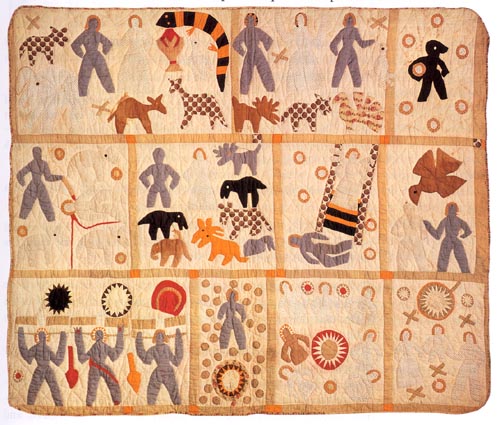

A quilt can be a bedcover, a map, a family archive and a declaration of survival at the same time. Routed West: Twentieth-Century African American Quilts in California, now at the National Museum of Women in the Arts in Washington, brings those meanings together across nearly 80 works by about 70 artists.
Spanning roughly 120 years, the exhibition follows quiltmaking through the Second Great Migration, when millions of Black Americans left the South for cities in the West, Midwest and Northeast. California becomes more than a destination. It is a place where inherited techniques met new materials, communities and possibilities.
What travelled with a family
Migration histories are often told through population figures, railway lines and labour markets. Quilts preserve another scale of evidence: the rhythm of a hand, a saved scrap of clothing, a pattern remembered from a relative, or fabric chosen in a new city.
The works in Routed West make clear that domestic objects are not secondary to history. They record how people carried knowledge across distance and adapted it without severing its roots. A quilt can hold continuity while also absorbing the visual life of a new place.
The exhibition includes makers whose names are known and others whose identities remain unrecorded. That imbalance is part of the story. Textile work—especially work made by women and within homes—has often entered museums without the documentation routinely granted to painting or sculpture. Recovering authorship becomes an act of historical repair.
Individual invention inside a shared form
Quilting is sometimes described as a single folk tradition, but the exhibition resists that flattening. Its range of geometries, colours, materials and construction methods shows distinct artistic decisions. Repetition does not eliminate originality; it provides a structure through which invention becomes visible.
The show also connects utility and beauty without treating one as an obstacle to the other. Many quilts were made to be used, given or kept close. Their physical intimacy is central to their cultural force. Care is not only the subject of the work; it is embedded in how the work was made and circulated.
For contemporary artists, that history offers a powerful reminder that archives are not limited to official records. Material choices, oral histories, family photographs, repair marks and ownership stories can all establish provenance and meaning. Documenting those layers now can prevent future institutions from separating an object from the life that produced it.
A different monument to movement
Routed West is the exhibition’s first East Coast presentation and remains on view through January 17, 2027. Its journey carries a productive reversal: works shaped by westward movement are now being read in the nation’s capital, inside a museum devoted to women artists.
The exhibition’s deepest achievement is to make migration tangible without reducing it to departure and arrival. Each quilt contains movement, but also settling, repetition, repair and transmission. Together they show culture being carried not as an abstract inheritance, but as something cut, pieced, touched and remade by hand.