
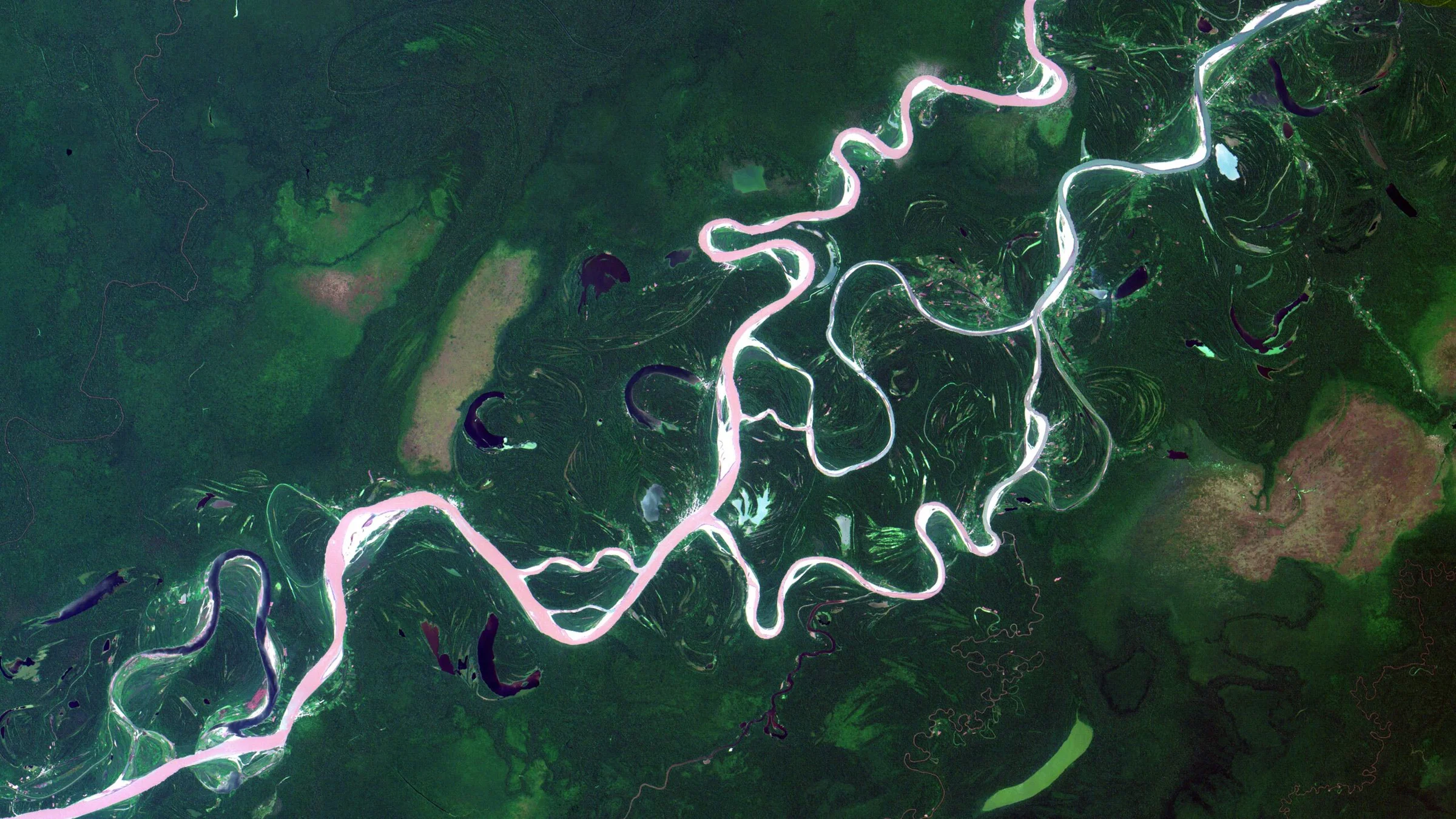

Sara Flores’ paintings begin with the forest, but they do not treat the Amazon as scenery. The Shipibo-Konibo artist works with kené, an ancestral visual language of interlocking geometry, and natural dyes applied to raw cotton. In her hands, pattern becomes a way to express relationships among people, plants, territory and the non-human world.
A new documentary, The Hummingbird Paints Fragrant Songs, is bringing that practice to a wider audience. Directed by Èlia Gasull Balada and Matteo Norzi, the film follows the 75-year-old artist from the Peruvian Amazon into the international art world. It screens at the São Paulo International Film Festival beginning October 19 and is scheduled for a United States premiere at DOC NYC on November 11.
An art career inseparable from territory
Flores is also representing Peru at the 2026 Venice Biennale with From Other Worlds, on view at the Arsenale through November 22. La Biennale describes the exhibition as a bridge between ancestral knowledge and sustainable futures, presenting kené as both a visual system and a political language.
That political dimension is essential. Flores’ work has been connected to Shipibo self-determination, cultural resistance and environmental protection. The exhibition proposes territorial sovereignty not as domination, but as an interdependent relationship. Its message is urgent precisely because the Amazon is often discussed through statistics while the knowledge systems rooted there remain marginalized.
What the documentary changes
The film adds time, labor and consequence to images that might otherwise be encountered only on gallery walls. Its opening follows the preparation of plant-based color and the steady drawing of geometric forms. It also tracks the disorienting passage from community life to art-world visibility, asking what success demands from an artist whose work carries collective meaning.
That tension is not unique to Flores. When Indigenous knowledge enters global exhibitions and markets, institutions must decide whether they are presenting a visual style or supporting the people and territory that sustain it. Accurate naming, cultural context, fair compensation and durable community relationships are not optional additions. They shape the ethical meaning of the presentation.
A model for environmental art
Flores’ practice expands the definition of environmental art. It is not an illustration of ecological crisis added after the fact. Material, language, territory and advocacy are already interconnected. The work asks viewers to understand environmental survival as cultural survival.
For artists, that offers a powerful standard: ecological meaning becomes strongest when it is embedded in process. Where did the material come from? What knowledge made its use possible? Who benefits when the work travels? What obligations continue after an exhibition closes?
The documentary and Venice pavilion give Flores exceptional visibility. Their deeper value will be measured by whether that attention strengthens the cultural and territorial future her paintings insist is shared by everyone.