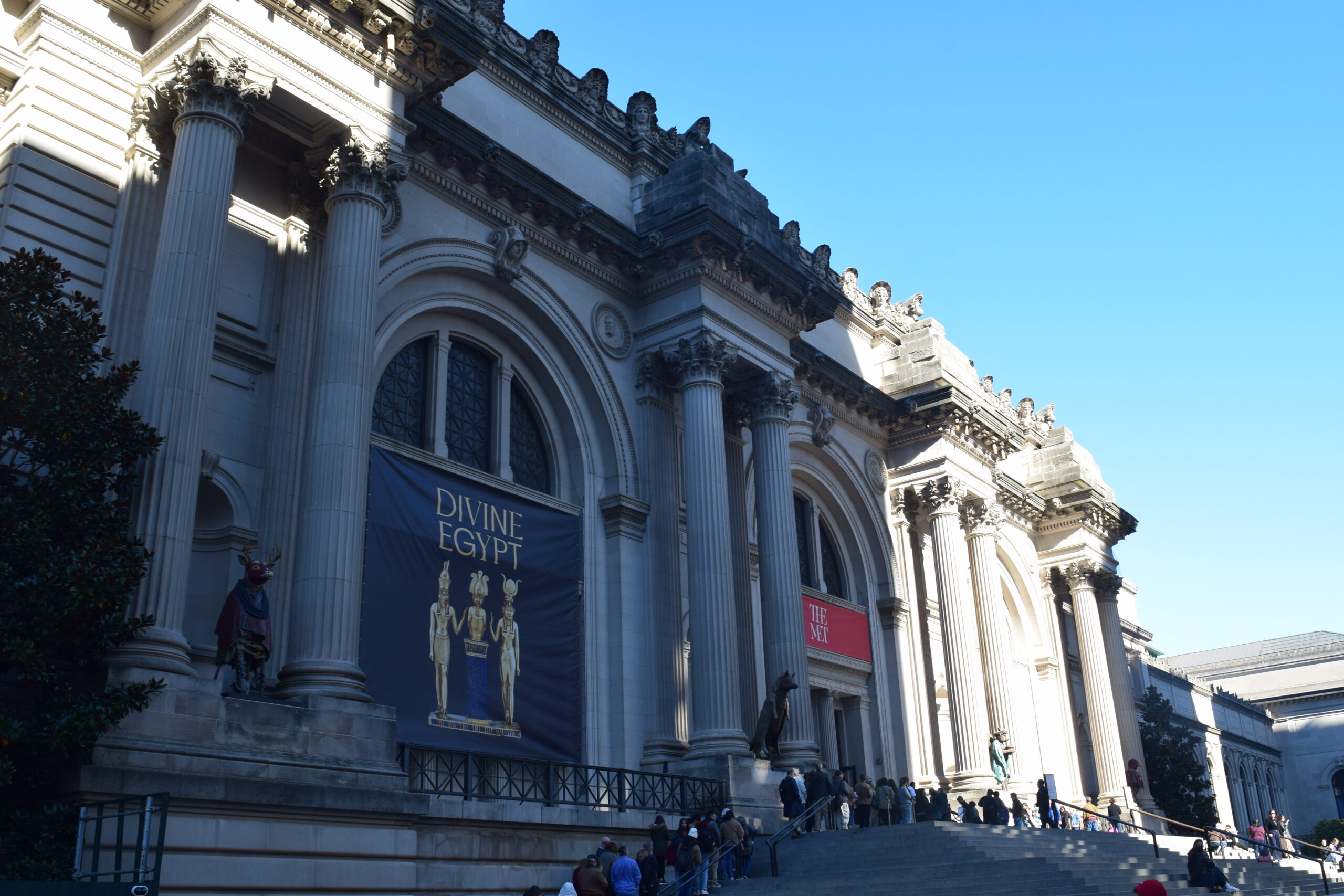

The Metropolitan Museum of Art has chosen Danh Vo and Sandra Mujinga for two of its most visible contemporary commissions in 2027, placing new work on the Fifth Avenue facade and inside the Great Hall. Together, the projects will shape the transition from New York City’s street to the museum’s ceremonial interior.
Vo will create four sculptures for the niches of The Met’s Beaux-Arts facade. His Genesis Facade Commission is scheduled for September 16, 2027, through June 13, 2028. Mujinga will make a site-specific installation for the Great Hall, on view from November 4, 2027, through April 4, 2028.
Two commissions, one sequence of arrival
The pairing is significant because the sites are not neutral galleries. The facade addresses pedestrians before they enter. The Great Hall receives visitors after tickets, security, and the threshold of the doors. One commission meets the city; the other reorganizes the museum’s first interior impression.
Vo’s practice often begins with objects that have accumulated unresolved histories: religious relics, photographs, fragments of antiquity, scraps of material, and things whose meaning changes as they move between owners and institutions. The Met says his four new sculptures will bring the present into conversation with objects spanning thousands of years and with the people who made, handled, and cared for them.
That approach is especially charged on a monumental facade. Architectural niches traditionally promise stable symbols and authoritative figures. Vo’s work tends to make such certainty less comfortable, revealing how intimacy, power, displacement, faith, and cultural value can coexist inside a single object.
Mujinga works across sculpture, video, sound, textiles, and performance. Her installations frequently use scale, shadow, altered bodies, and technological atmospheres to examine visibility. In a hall designed to orient and impress large crowds, an artist concerned with being seen—and with resisting fixed identities—can turn circulation itself into part of the work.
History will not stay behind the visitor
The Met’s announcement links both artists through their treatment of history as active and unsettled. That is more than a curatorial phrase. The museum’s entrance architecture already tells a story about permanence, authority, and who is invited to stand for culture. Contemporary commissions temporarily interrupt that story without pretending the building disappears.
Vo was born in Bà Rịa, Vietnam, in 1975 and lives and works across rural Germany, Mexico City, and Kyoto. His family left Vietnam when he was a child, and questions of migration, possession, translation, and historical power recur throughout his work. He represented Denmark at the Venice Biennale in 2015 and was the subject of a major Guggenheim survey in 2018.
Mujinga was born in Goma, Democratic Republic of the Congo, in 1989 and is associated with Oslo. Her work draws on Afrofuturism, posthumanism, fashion, music, and science fiction while refusing an easy separation between the physical and digital body. Recent solo exhibitions have included presentations at Kunsthalle Basel and the Stedelijk Museum Amsterdam.
What the commissions offer artists
For artists, these projects are reminders that site-specific work begins with behavior, not only dimensions. A facade is seen from moving traffic, across steps, in daylight, in weather, and in photographs taken before a visitor reaches the work. A great hall is crossed quickly by some people and occupied slowly by others. Sound, queues, signage, security, sight lines, and crowd density all become material conditions.
A productive site study therefore asks more than “What fits here?” It asks where attention begins, how long it lasts, what the architecture already claims, and which audiences encounter the work without seeking it out. The strongest proposal may not fill every available volume. It may alter one decisive relationship: street and institution, body and scale, monument and memory, visibility and concealment.
The commissions also show how a museum can let contemporary practice frame historical collections rather than confining it to a specialist wing. Visitors will encounter Vo and Mujinga before choosing a department or period. Their work will influence how the building is read at the moment of entry.
A visible platform with a long horizon
The projects will not open for nearly a year, and neither work has been fully revealed. That distance should temper speculation. Site-specific commissions change through engineering, conservation, fabrication, accessibility review, and the artists’ own development.
What is already clear is the institutional scale of the invitation. Vo’s project will be the eighth annual facade commission. Mujinga’s will be the fourth Great Hall commission. Both series position living artists inside spaces where the museum represents itself most publicly.
In 2027, The Met’s arrival sequence will not present history as something safely contained beyond the entrance. Vo and Mujinga will place questions of memory, movement, embodiment, and power directly in the visitor’s path.