
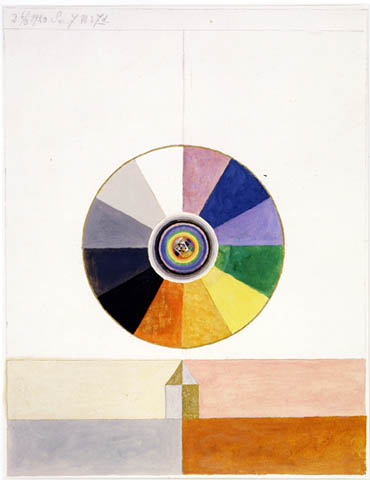

A small abstract painting by Hilma af Klint is about to meet a market that has had remarkably few chances to price her work. Bukowskis will offer Ser III No. 5, dated January 18, 1920, in Stockholm on November 19 with an estimate of SEK 6 million to SEK 8 million, approximately $600,000 to $800,000.
The auction house describes the oil-and-graphite canvas as the first abstract work by af Klint to reach auction in more than three decades. It measures only 38.5 by 29 centimeters, yet its sale carries an outsized question: how does the private market value an artist whose historical importance has been established mainly through museums, scholarship, and public exhibitions rather than a steady auction supply?
A rare object in a transformed reputation
Af Klint developed a nonfigurative visual language around geometry, color, spirituality, and natural science years before abstraction became an established modernist category. Much of that work remained outside public view for decades. Her posthumous recognition accelerated through major institutional exhibitions, creating an unusual gap between cultural visibility and market availability.
Bukowskis says only two of her abstract paintings have previously sold at auction. The work now offered was acquired by a private collector in 1995 after the Hilma af Klint Foundation sold a small number of works in the early 1990s, and it has remained in the same family since then. The scarcity is therefore structural, not a temporary lack of consignments: the foundation administers most of the nonfigurative legacy.
That makes the estimate more than a forecast. It is a public test of how buyers translate museum-led recognition into price when comparable auction records are thin.
Why one result will not define the artist
A strong price could be framed as confirmation that the market has caught up with art history. A weaker result could be misread as a judgment on af Klint’s significance. Neither interpretation would be adequate.
Auction prices respond to the specific work, its size, condition, provenance, timing, estimate, and the bidders present. Ser III No. 5 is not one of the monumental canvases through which many visitors first encountered af Klint. It is an intimate work from a highly productive period. According to The Art Newspaper, she made 85 works in a matter of months in 1920, testing variations of triangles, circles, rectangles, symbols, and signs.
The result may establish a new public benchmark, but it will still be a benchmark for this object in this sale—not a complete measure of a career.
The market follows access
Collectors often encounter an artist’s importance through institutions long before a work becomes available to buy. Af Klint’s case makes that dynamic unusually visible. Museum exhibitions built an audience, scholarship reshaped the account of early abstraction, and the protected concentration of her legacy limited supply. When a work finally enters the market, decades of cultural reassessment converge on a single bidding event.
For artists and estates, there is a useful lesson here. Scarcity can protect the coherence of a body of work, but scarcity alone does not create significance. Af Klint’s market moment rests on sustained curatorial, scholarly, and public engagement. The sale is consequential because the work already has a place in a larger history.
The November auction will produce a number. The more enduring story is how slowly institutions, audiences, and markets can align—and how a small canvas can reveal the distance between recognition and ownership.