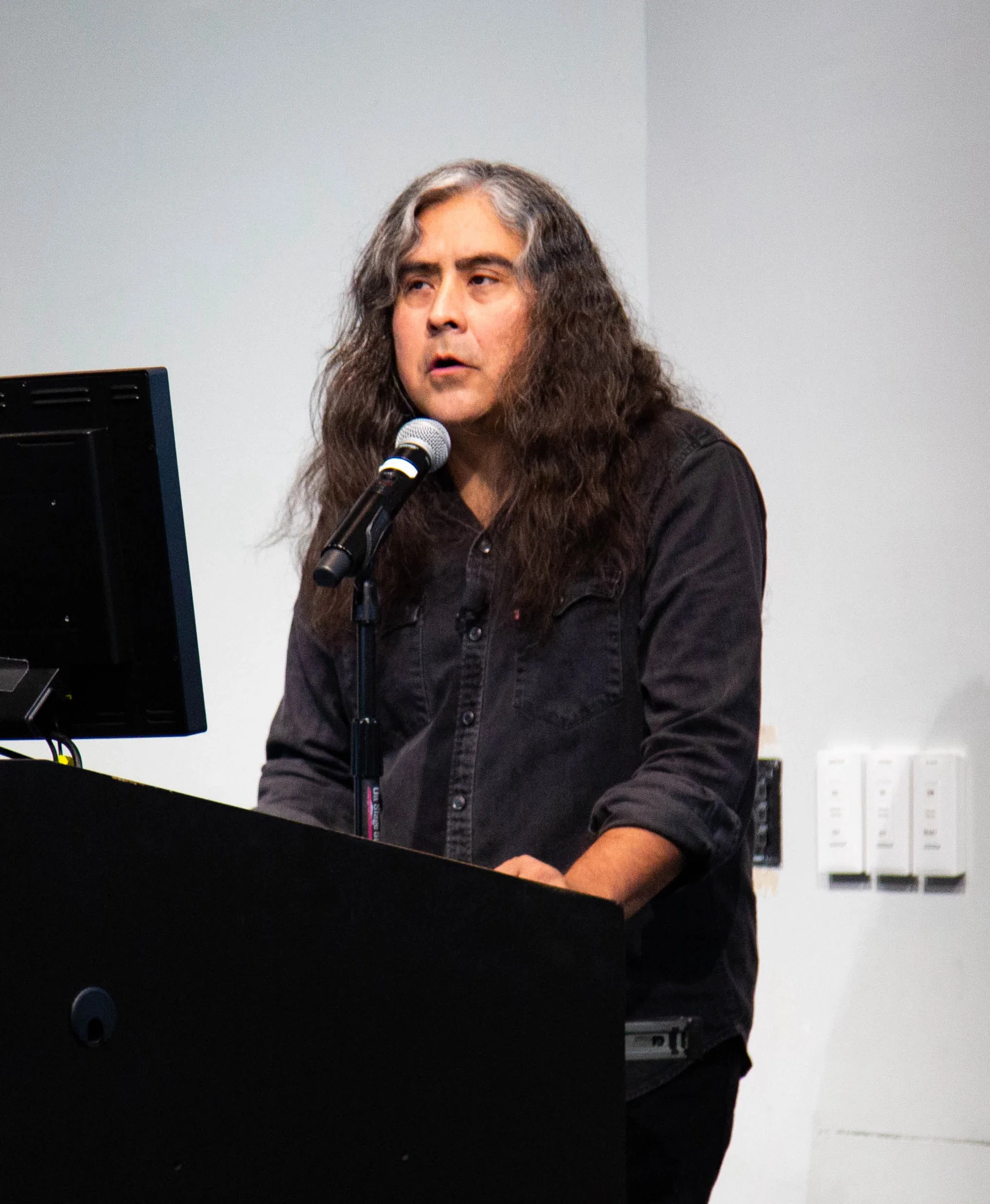

Raven Chacon’s first West Coast solo exhibition opens at the San Francisco Museum of Modern Art on October 24 with a proposition that is both geographic and imaginative: the landscapes of the Navajo Nation can be understood not as remote scenery, but as places where memory, sovereignty and possible futures meet.
At the center of New Work: Raven Chacon is The Naming of Names, a seven-channel video installation that brings Ray Bradbury’s science-fiction narratives into contact with found footage recorded by foreign travelers in the 1950s and 1960s. Topographical drawings connect Tséyiʼ, also known as Canyon de Chelly, with Valles Marineris on Mars. Across those pairings, Chacon collapses distances between Earth and another planet, archive and speculation, observation and possession.
The landscape is not an empty stage
Images of the American Southwest have long been shaped by outsiders: explorers, filmmakers, tourists, photographers and government surveyors. A camera may describe light and terrain with extraordinary clarity while still carrying the assumptions of the person who holds it. Chacon’s use of travelers’ footage does not treat the archive as transparent evidence. It makes the act of looking part of the work.
Science fiction intensifies that question. The genre often imagines deserts and distant planets as available territory—spaces waiting to be discovered, named or transformed. By aligning the canyons of Diné homelands with a Martian canyon system, Chacon interrupts the fantasy of emptiness. The landscape already contains histories, languages and relationships that cannot be reduced to scenery.
The title, The Naming of Names, makes language itself feel consequential. To name can be to recognize, remember and care for. It can also be to claim authority. Chacon’s work holds those possibilities together without resolving them into a simple lesson.
Sound after the image
Chacon is widely known as a composer whose practice moves among scores, performance, installation, video and noise. In 2022 he became the first Native American composer to receive the Pulitzer Prize for Music, honored for Voiceless Mass. That work uses the architecture and history of a cathedral without supplying the voices expected in a mass. Absence becomes a compositional force.
At SFMOMA, the moving image is joined by an ambient soundtrack that draws on drone and the sonic vocabulary of the Western. This is not decoration added to pictures. Sound changes how the archive is inhabited: duration replaces the instant glance, channels overlap, and the visitor must choose where to direct attention.
Chacon’s career has repeatedly tested who controls listening. His graphic scores distribute interpretive responsibility to performers. Site-responsive works attend to the acoustic character of a place. Teaching has also been part of his practice, including years working with young Native composers. These strands make the new installation more than a museum-scale film. It is another experiment in how a work can rearrange authority.
A speculative future grounded in sovereignty
Museums often describe Indigenous art through the past, even when the artist is working with advanced media and urgent contemporary questions. Chacon’s exhibition refuses that temporal enclosure. The Martian comparison looks outward without abandoning the specificity of Diné land and thought.
That balance is crucial. Futurism can become a way of escaping history; Chacon instead uses speculation to reveal how history shapes the future. The archival image is neither discarded nor accepted at face value. It becomes material that can be slowed, multiplied and heard differently.
SFMOMA identifies the exhibition as an effort to amplify Indigenous voices and sovereignty. The more distinctive achievement may be that Chacon does not merely insert a voice into an existing frame. He changes the frame: the desert is no longer empty, the archive is no longer innocent, and another planet is no longer separate from questions of naming and claim on Earth.
New Work: Raven Chacon is presented by the San Francisco Museum of Modern Art from October 24, 2026, through November 7, 2027.