
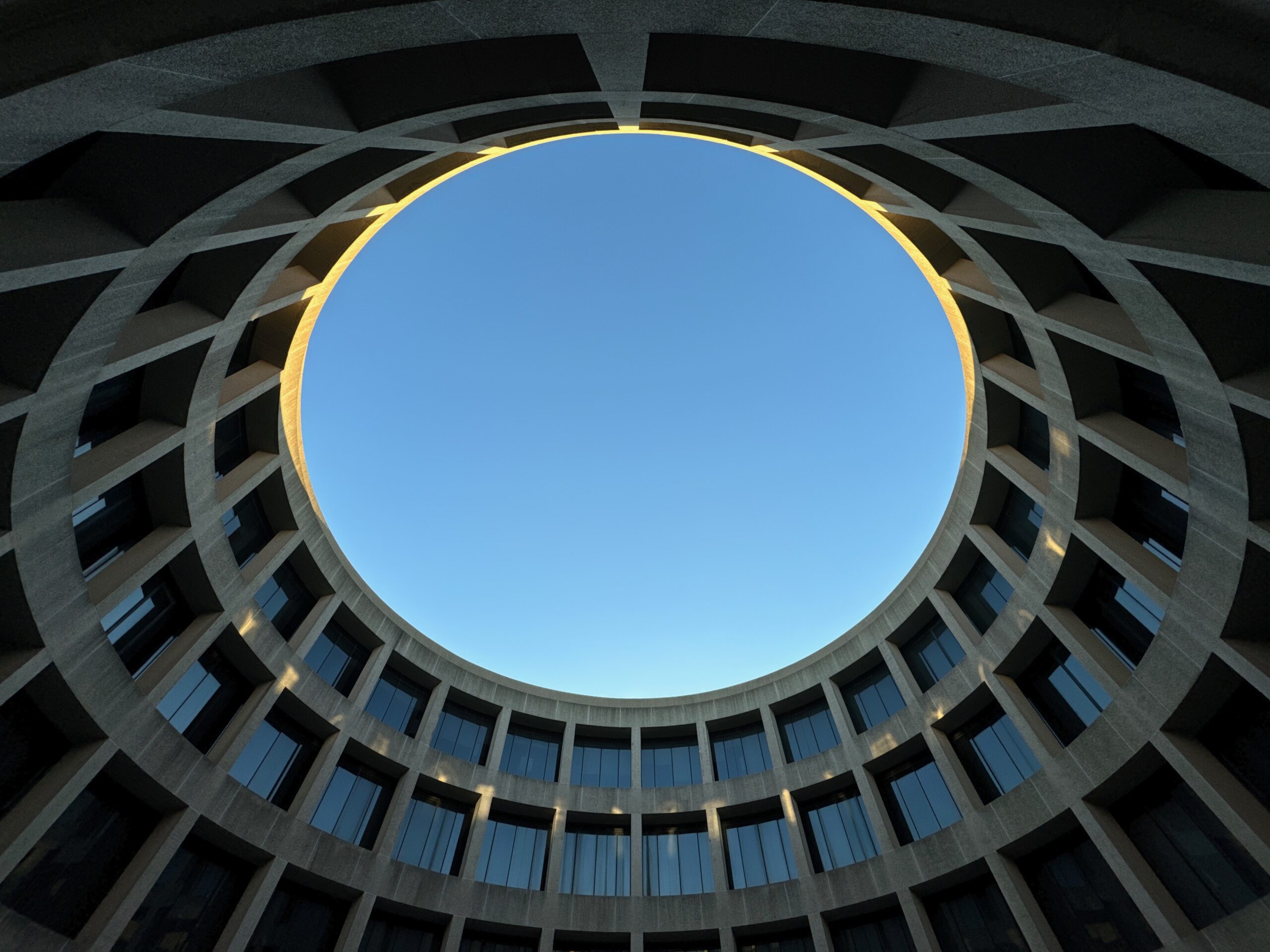
Hiroshi Sugimoto has turned a long-closed underground passage at the Smithsonian’s Hirshhorn Museum and Sculpture Garden into a public artwork that also repairs a missing connection. Passage of Reflectance (2026) is a light-filled pedestrian tunnel between the museum plaza and the newly revitalized Sculpture Garden, opening with the garden on October 31.
The commission is architectural without becoming anonymous. Two parabolic stainless-steel wings, each approximately 90 feet long and eight feet high, face one another along the passage. Their mirrored surfaces repeat and distort visitors, light and movement. What was once a service-like threshold becomes an experience of perception.
A work that must function
Sugimoto’s intervention belongs to a demanding category of public art: it has to succeed as an artwork and as a route. The passage cannot be understood from a single viewpoint, because its subject changes with the people who walk through it. It also has a practical purpose, reconnecting parts of the Hirshhorn campus and broadening access to the national collection.
This double role is consistent with Sugimoto’s long investigation of time, optics and the unstable boundary between appearance and reality. Here, reflection is not an image hanging on a wall. It is a material that redirects attention toward bodies, sky, architecture and other visitors.
The museum as a sequence
The Hirshhorn describes the work as a central element of Sugimoto’s wider Sculpture Garden revitalization. The new garden places more sculpture outdoors, introduces native plantings and addresses shade and accessibility. Passage of Reflectance makes the transition between museum and landscape part of that curatorial experience.
That distinction matters for artists working in civic or institutional space. A commission can be site-responsive without illustrating a site’s history. It can instead change how people move, pause and orient themselves. The most durable interventions often begin with a spatial problem that is already present, then develop a form capable of holding both practical use and imaginative ambiguity.
What artists can learn from the passage
Sugimoto’s commission demonstrates why public work requires collaboration beyond the studio. Engineering, fabrication, circulation, safety, accessibility, maintenance and conservation become part of the artistic medium. None of those concerns automatically diminishes creative authority. When integrated early, they can sharpen the work’s central idea.
The project also resists a familiar hierarchy in which an artwork is considered important only when it remains separate from ordinary use. A passage can be a sculpture; walking can be a mode of viewing; access can be part of aesthetic form.
As visitors move between the Hirshhorn’s plaza and garden, they will see themselves made unstable by polished steel. The commission does not merely reconnect two physical points. It makes transition—between inside and outside, object and architecture, observer and reflection—the work itself.