
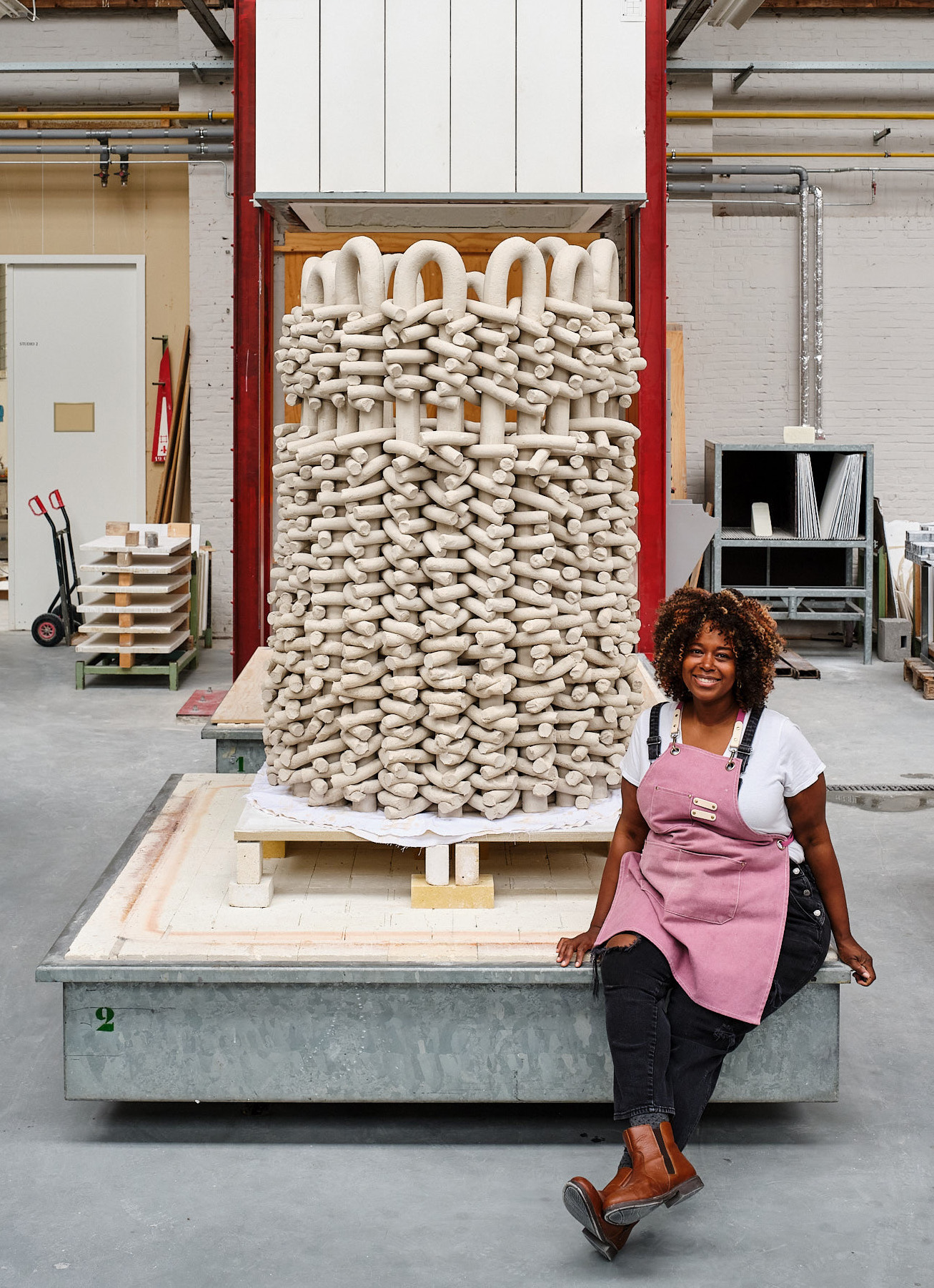

Anina Major’s The Sacred Mangrove begins with a living coastal system and becomes a meditation on culture, protection and collective care. Presented by Pérez Art Museum Miami through August 1, 2027, the exhibition brings the Bahamian artist’s clay sculptures into a museum built at the edge of Biscayne Bay.
The mangrove is not treated as scenery. It is a model of interdependence: roots hold sediment, shelter young marine life and soften the force of storms. Major connects that ecological function to cultural practices that also protect a community by carrying knowledge forward.
Plaiting translated into clay
Major’s practice draws on Bahamian weaving traditions, particularly the plaiting of strips into forms that can be joined and extended. She translates that bodily knowledge into clay, a material that records pressure, repetition and touch.
The move from fiber to ceramic is not a simple substitution. Clay changes the rhythm and risk of the process. It can hold the evidence of the hand, but it must survive drying and firing. The resulting surfaces make labor visible while resisting the expectation that inherited craft should remain fixed in one material or function.
At PAMM, these forms gather into an environment that includes works such as Water Tower, bottle-tree references and materials associated with the Bahamian coast, including crushed conch. The exhibition’s elements connect domestic memory, spiritual protection, infrastructure and marine ecology.
A mangrove as cultural method
Mangroves thrive through density and relationship. No single root explains the system. Major uses that structure to think about how traditions survive: through many acts of transmission, adaptation and return.
That framework avoids turning heritage into nostalgia. The artist is not reconstructing an untouched past. She is asking what ancestral practices can do in the present, especially for people shaped by migration, tourism, environmental pressure and the continuing consequences of colonial economies.
The exhibition’s Miami setting intensifies the point. The Bahamas and South Florida share waters, weather systems and histories of movement. Rising seas and stronger storms are not abstract themes in either place. By bringing plaited clay and mangrove imagery into a waterfront museum, Major links ecological vulnerability with the cultural knowledge required to live through change.
What the work offers artists
The Sacred Mangrove demonstrates how environmental art can begin with a method rather than an illustration. Major does not need to depict a scientific diagram of coastal protection. She builds the logic of protection into the way forms repeat, connect and support one another.
Her work also shows that material research can carry social history. Clay, fiber, shell and found cultural forms are not neutral ingredients; each arrives with places, economies and hands attached. Making those relationships legible gives ecological art greater depth than a general message about nature.
Major’s mangrove is sacred because it shelters more than one kind of life. It protects memory while making room for transformation. In that sense, the exhibition’s most urgent environmental proposition is also an artistic one: resilience is not hardness. It is the capacity to remain connected while adapting to pressure.