

For years, the young man on the right wore the wrong mouth.
The mistake was not made by the Roman-era painter who placed two faces on a thin circular panel nearly two thousand years ago. It entered later, when fragments separated by ancient insect damage were put back in the wrong positions during an earlier restoration.
Now Egyptian and Italian conservators have returned the mouth and chin to their proper arrangement. In doing so, they recovered more than anatomical accuracy. They restored the logic of a gaze.
Two faces on an impossibly fragile circle
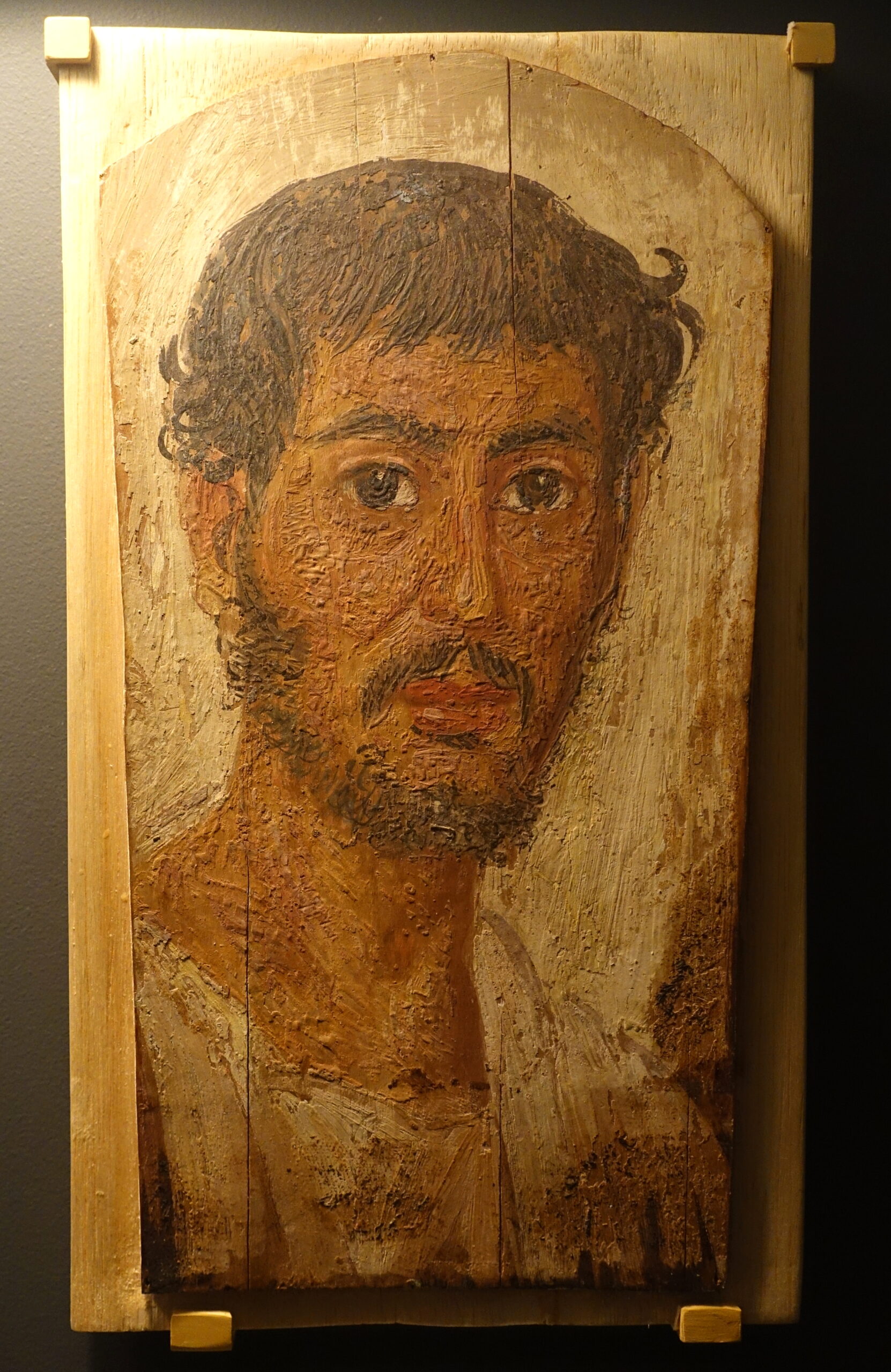
The Tondo of the Two Brothers is exceptional among Fayum portraits. Most surviving examples show one person on a rectangular wooden panel placed over a mummy’s face. This work is circular, approximately 62 centimetres across and less than one centimetre thick. Two young men stand side by side, painted in encaustic—pigments suspended in molten wax.
That thin support survived centuries, but not intact. Wood-boring insects, probably termites, tunneled through it long ago. The damage divided sections of the figures and left the painted surface vulnerable. Later attempts to stabilize the portrait preserved it, yet also introduced the misplaced fragments.
A face is extraordinarily sensitive to small errors. Move a line at the mouth or chin and the expression changes. The viewer may not know why the portrait feels unsettled, only that the person no longer resolves.
Repair without pretending nothing happened
The three-week project joined conservators from the Egyptian Museum in Tahrir with specialists from Rome’s Fabrica Conservazione e Restauro. Their approach was minimal intervention: consolidate fragile paint, support damaged wood and correct the arrangement while retaining evidence of the object’s long history.
That principle is central to contemporary conservation. The aim is not to make an ancient object look newly painted. It is to recover stability and legibility without erasing age, damage or previous care. Every added material must answer a difficult question: how much is enough?
Lightweight fills and balsa supports helped bridge losses without placing heavy new stress on the ancient panel. Ultraviolet examination also revealed what may be traces of a transparent ancient varnish in the hair—an almost invisible layer that survived while whole areas of wood were eaten away.
The portrait looks back
Fayum portraits emerged in Roman Egypt from a meeting of traditions: Egyptian funerary practice, Greek painting and Roman forms of individual representation. They were made for the dead, but their direct gazes feel startlingly alive.
The Tondo intensifies that encounter because it presents a relationship. The two men do not arrive as isolated types; they share one surface. We do not know everything about who they were or why they were painted together. The conservation does not solve that mystery. It gives the mystery a more truthful face.
The work is due to travel outside Egypt for the first time for The Power of the Portrait: Egypt and Rome, Faces of Fayum at Rome’s Ara Pacis Museum, opening November 5. The Ara Pacis is a world-recognized museum and the official host of the exhibition; the portrait’s stabilization was necessary before such a journey could be considered.
A correction measured in millimetres
Extraordinary conservation stories often involve dramatic discoveries beneath paint or objects raised from water. This one turns on something smaller: fragments shifted into the right places.
Yet that small correction changes the ethical relationship between object and viewer. A portrait is a claim that an individual appearance mattered. To conserve it is not only to preserve wax and wood. It is to protect the possibility that, across two millennia, one person may still be encountered as himself.