

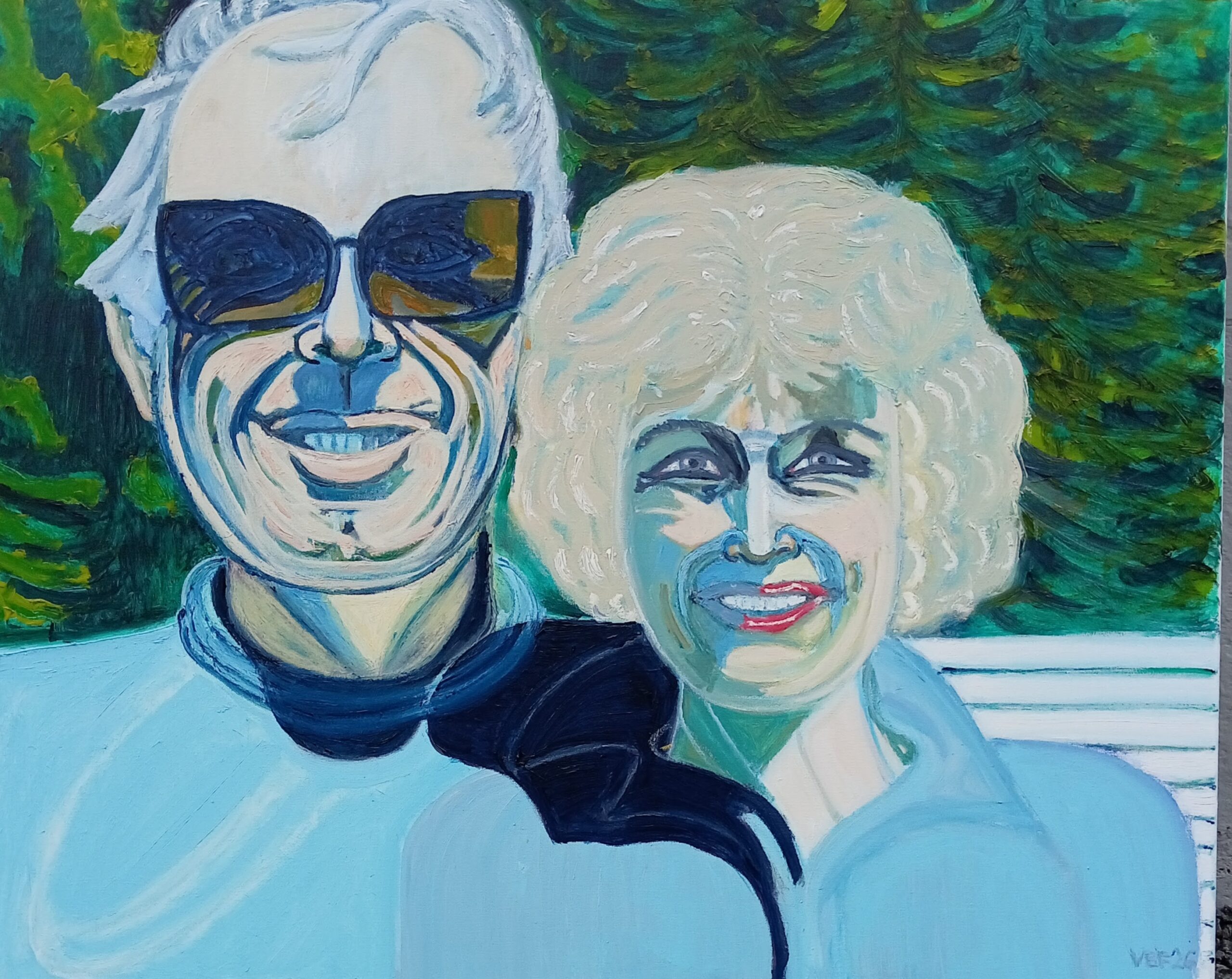
Two faces fill the frame, pressed close together beneath a dark green wall of trees. A man with silver-white hair and wide dark sunglasses grins broadly, while a woman with a halo of pale curls leans into his shoulder, smiling, her face painted in cool tones of blue and lilac. In Vigdis Elisabeth Feldt’s My Sister and her life friend, a simple snapshot of companionship becomes a portrait of shared years, warm and unguarded.
Seeing, Realizing, Communicating
“It is still about seeing, realizing and communicating,” Vigdis writes of her work. Her paintings move between two poles. Most often she chooses to stress the beauty of life, and at times she has depicted violations against human beings. Many of her pictures show communication itself, which she sees as a key to creating understanding and empathy. In her words, showing the hard sides of existence can be a therapy for the individual soul, while depicting the good sides of life “can be a prayer, a comfort, a vision, a dream for a good world to appear.”
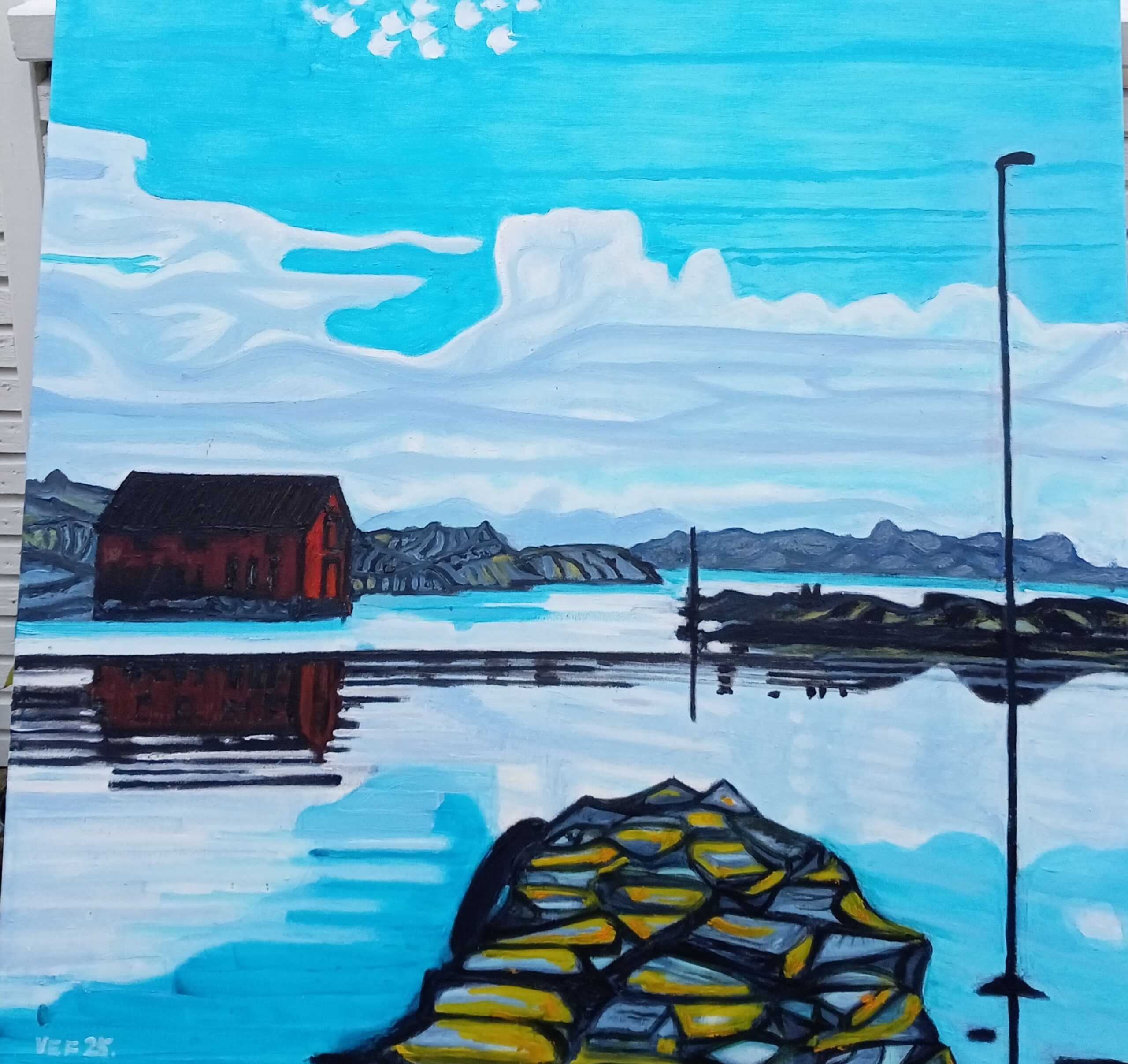
Her painting style serves that clarity. Forms are outlined with confident, dark contours and filled with bold, unblended color. Faces take on unexpected tones of blue and violet, skies are a saturated turquoise, and the paint is laid down in visible strokes that keep every surface alive.
Between Beauty and Witness
Rennesoy is a painting of stillness. A red boathouse sits at the water’s edge on the left, doubled in the calm surface below, while low blue hills stretch across the horizon. White clouds drift through a bright sky, and a tall, thin lamppost stands on the right. In the foreground, a path of dark stones touched with yellow leads us straight toward the water, as if inviting us to walk out and take in the view. Her initials and the year appear in the lower left corner.
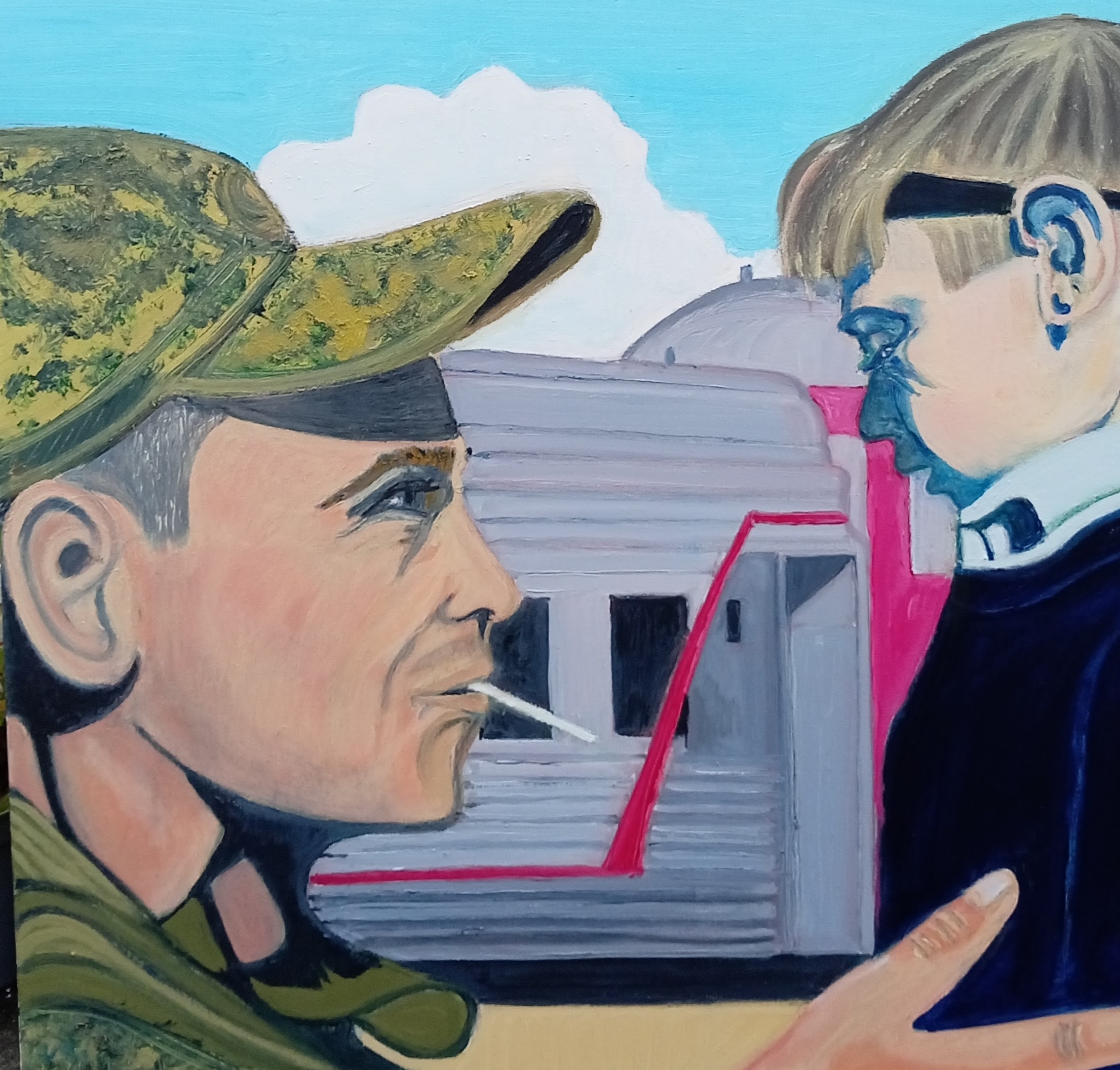
The Russian Tragedy belongs to the other pole of her practice. In the foreground, a soldier in a camouflage cap and green uniform is seen in profile, a cigarette at his lips, his gaze fixed and weary. To the right, a young boy in a dark sweater stands with a band across his head, his face shaded in blue, while a hand reaches toward him from below. Between them rises a gray building marked by a single line of hot pink. Nothing is explained, yet the closeness of the two figures, so different in age and circumstance, carries a quiet weight. We sense a story already in motion, and a question about what one generation passes on to the next.
Whether she paints family, landscape, or the shadows of history, Vigdis keeps returning to the same act of attention. Her work invites us to look honestly, to feel connection, and to hold on to the hope that beauty can still point the way.
Contact the artist: artavita.com
For artists
Would you like to see your work featured by ArtTour International?