

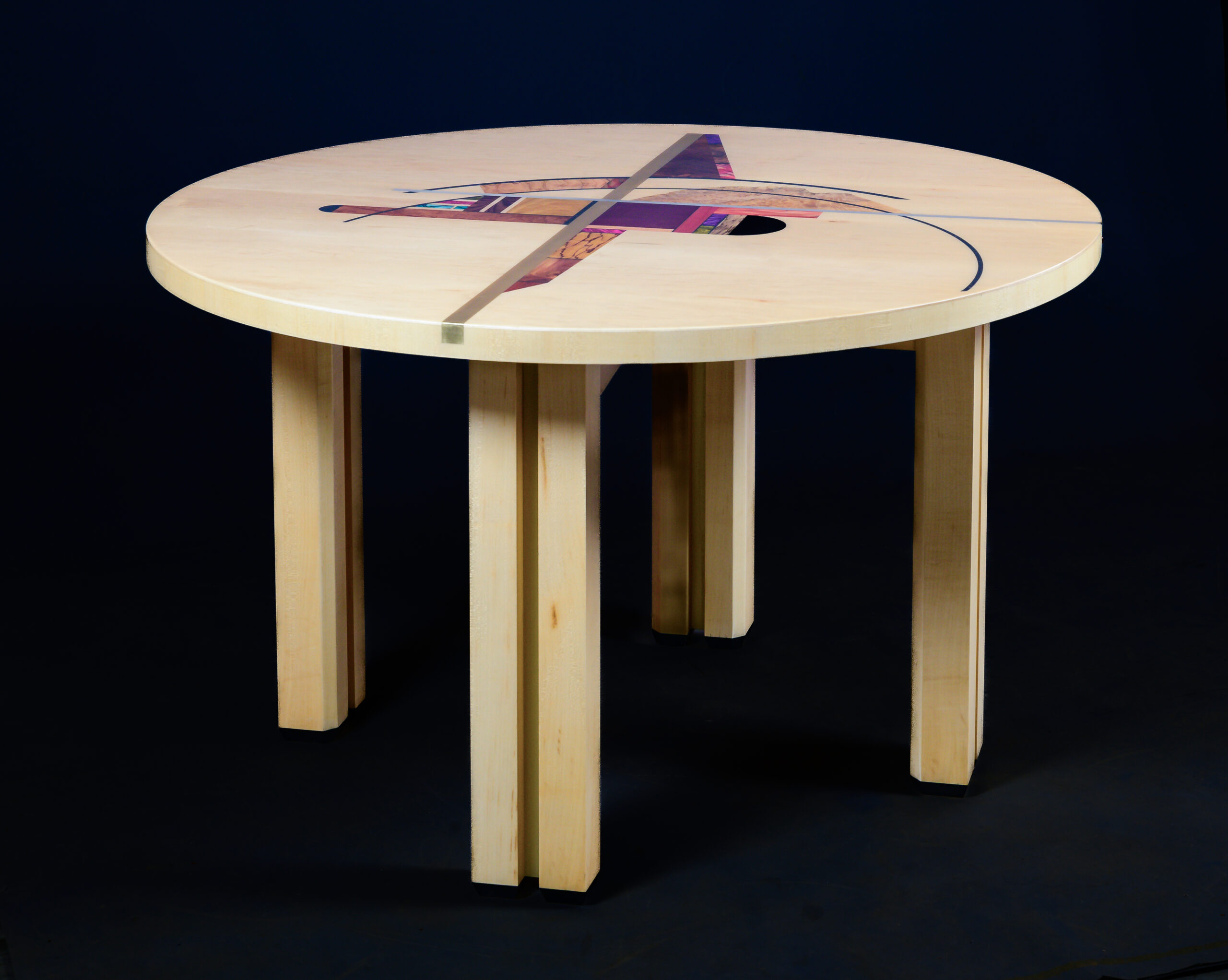
A circle of pale wood rests on four pairs of square legs, and across its surface a quiet drama unfolds. Slivers of violet, rose, and amber wood cross one another like brushstrokes, a slender arc sweeps toward the edge, and a small round opening punctures the top like a note held in silence. In Bruce Schuettinger’s Calder meets Kandinsky, a dining table becomes a composition, and the everyday act of gathering around it becomes an encounter with abstraction.
Furniture as a Living Art Form
Bruce creates his one-of-a-kind pieces through MosArt, the studio where historic preservation, scholarship, and artistic expression meet. His conviction is simple and far-reaching: furniture, like architecture, deserves to be seen as an art form, beautiful to look at and a joy to use. His sources of inspiration span centuries, from Piet Mondrian, Gerrit Rietveld, and Wassily Kandinsky to master craftsmen such as André-Charles Boulle, the Roentgens, Émile-Jacques Ruhlmann, and Wendell Castle. Neo-Plasticism, Constructivism, and Abstract Expressionism all leave their trace.
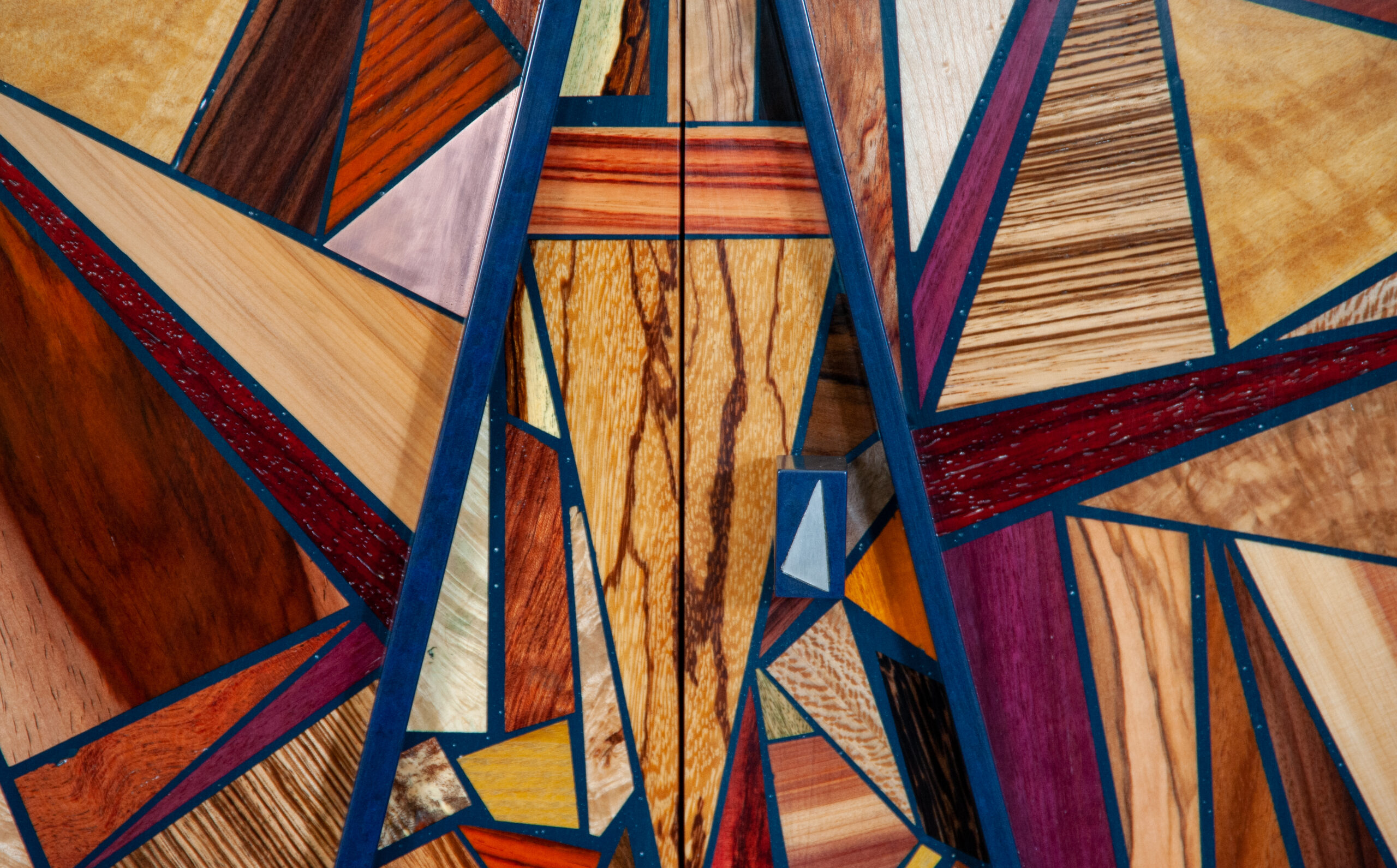
That lineage comes alive in Wild Blue 2. Shards of wood in honey, rust, plum, cream, and deep red interlock across a pair of doors, each grain running in its own direction. Narrow bands of blue outline the shapes and gather into a tall, pointed form at the center, so the surface reads at once as marquetry and as a stained-glass window. We find ourselves tracing the edges, discovering how many kinds of wood can share a single plane.
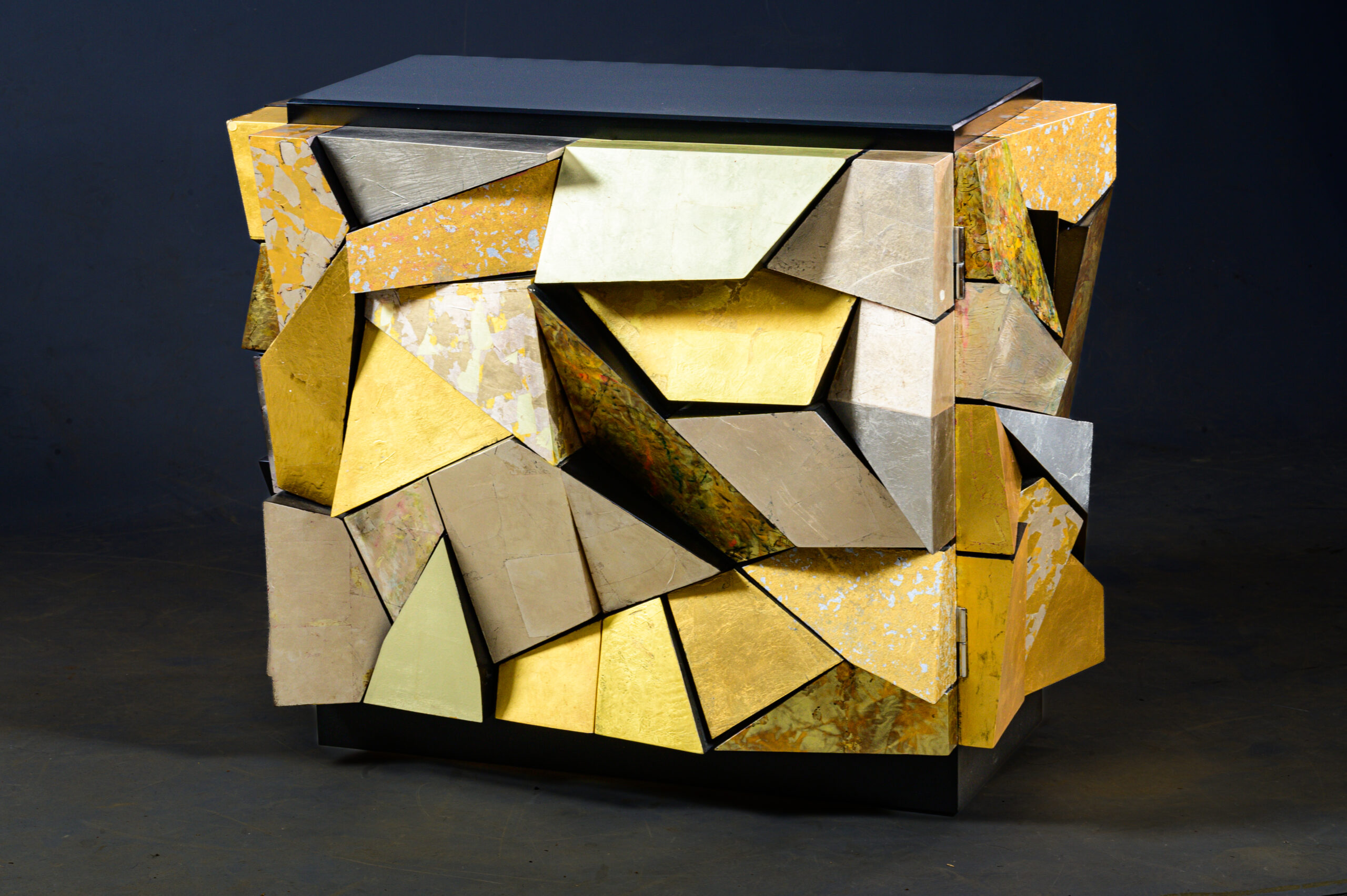
Angular Tension moves from wood toward light. A compact cabinet beneath a dark top is clad in faceted planes of gold and silver, some lying flat, others tilting outward as if the surface were breaking open. The metallic tones shift from warm yellow to pewter, catching the light differently on every angle, and the piece seems to hold a quiet energy within its solid form.
A Lifetime Spent with Wood
Bruce’s love of art began early and flourished in college, where he studied fine art and graduated with honors in 1978. Professors of painting, sculpture, and color theory encouraged him to think beyond convention, and he became fascinated with wood as a sculptural medium. His chair and ottoman, inspired by Wendell Castle and Ludwig Mies van der Rohe, won first place in his senior art show. He went on to study the furniture of the eighteenth and nineteenth centuries, working as a personal property appraiser, restorer, and furniture conservator, and later as a furniture scholar, lecturer, and teacher. After more than thirty years, all of that knowledge now flows into his fine art furniture.
Care for the earth is part of the practice. MosArt works with old-stock lumber, wood from naturally downed trees, and reclaimed materials, and the studio runs entirely on solar power.
In Bruce’s hands, a table or a cabinet becomes a place where history and invention sit side by side, inviting us to live with art rather than simply stand before it.
Contact the artist: mosartfurniture.com
For artists
Would you like to see your work featured by ArtTour International?