
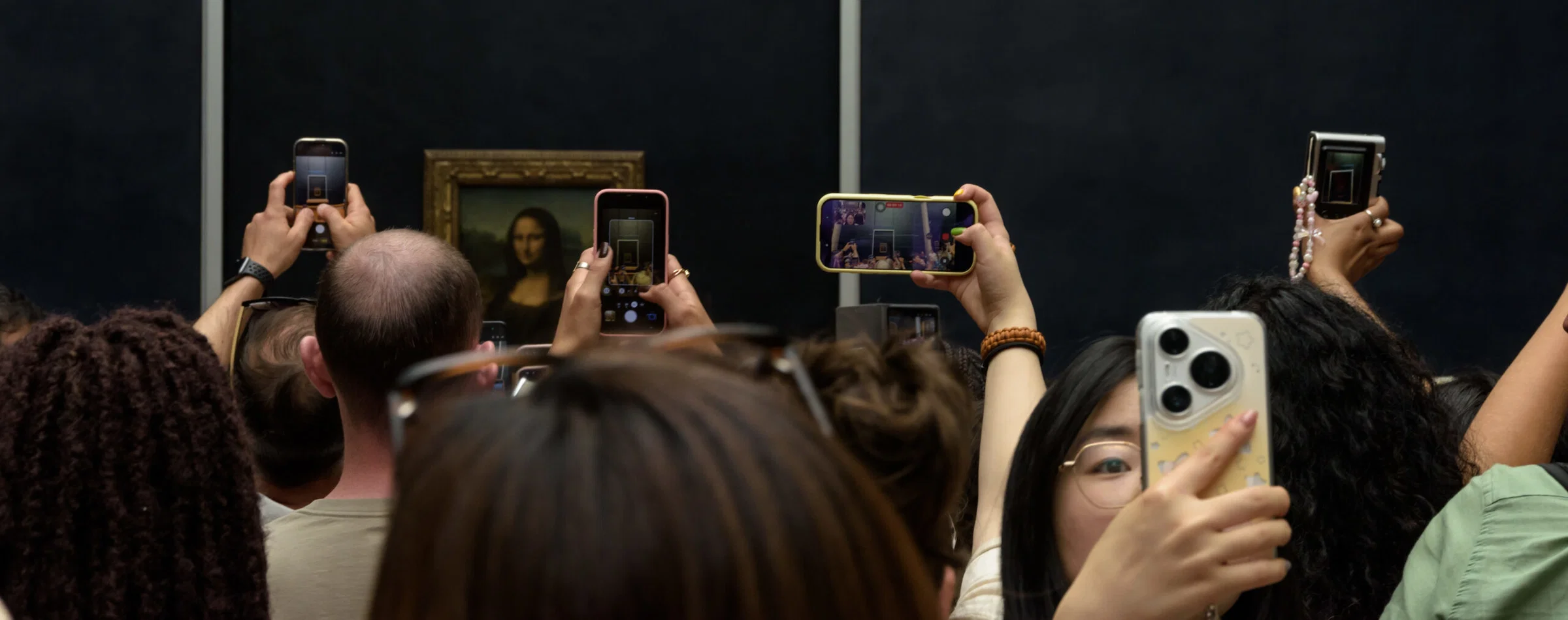

For almost two centuries, photography has entered the Louvre as a tool, a witness, a rival art form and a way of remaking the museum in the public imagination. On November 4, the institution opened Louvre Photo, an exhibition that turns the camera back on the museum itself.
The subject is deliberately bounded: photographs made at the Louvre and photographs made of it. Within that frame, however, lies an unusually expansive history. The exhibition moves from early photographic processes to contemporary digital images, tracing how the palace, galleries, collections, gardens, staff and visitors have repeatedly become material for another medium.
From reproduction to interpretation
The Louvre opened only a few decades before photography was invented. The new technology quickly became indispensable to museums because it could reproduce artworks, support scholarship and extend access beyond the gallery. Early practitioners also understood that documenting a masterpiece could demonstrate their own technical authority.
By the 1850s, proposals had already emerged for a museum of photography within the Louvre, although none came to fruition. Photographers competed for official access, and in 1883 the museum entered an agreement with Ad. Braun et Cie, a firm known for reproducing works of art.
That history complicates the idea of the museum photograph as a neutral record. A camera position chooses scale, distance, light and emphasis. It can isolate an object from its architectural setting or make the room part of the meaning. It can show an empty gallery as a temple of contemplation or reveal the same space as a workplace, a tourist destination or a stage for public life.
The museum as image
Louvre Photo spans the invention of photography to the present, including daguerreotypes, prints, projections, slides, postcards and digital images. It follows the museum through the Paris Commune, two world wars, the movement and return of collections, the transformation of the Grand Louvre and the expansion of mass tourism.
These events changed what the camera could see. Photographs of evacuated rooms can turn absence into evidence. Images of visitors show how attention is organized around celebrated works. Views of restricted corridors and museum labor reveal an institution that exists beyond the public route.
The exhibition’s curators, Dominique de Font-Réaulx of the Louvre and Quentin Bajac of the Jeu de Paume, draw on the museum’s own archives and loans from major French institutions. The result is not simply a history of cameras inside a famous building. It is a study of how institutional identity is built through images.
What this means for artists
For artists, the exhibition offers a useful reminder that documentation never remains merely secondary. Installation photographs, studio images, portraits and reproductions become part of how a practice is remembered. They circulate farther than the physical work, enter archives and publications, and may eventually shape the historical account of an exhibition or career.
The Louvre’s own history shows how quickly a reproductive image can become an artwork, an argument or a cultural artifact in its own right. A photograph made to record a painting may later reveal an obsolete hanging system, a lost architectural detail or an earlier philosophy of display. A visitor’s image may capture not only the object but the social behavior surrounding it.
That is why image-making deserves the same intentionality as other forms of artistic record. Credit, date, location, rights and context should travel with the file. Without them, an image may survive while the knowledge that gives it meaning disappears.
A museum looking at how it has been seen
Louvre Photo remains on view in the Mezzanine Napoléon through May 3, 2027. Its strongest proposition is that the Louvre is not only a container for images. It has become an image-making machine: photographed by professionals and visitors, mobilized by governments and filmmakers, and continually reframed by each new technology of looking.
By making that process visible, the museum also reveals something about cultural authority. Institutions do not control every image made of them. Their meaning is produced in the tension between official record and independent vision, between preservation and reinvention, and between the work on the wall and the person raising a camera before it.