
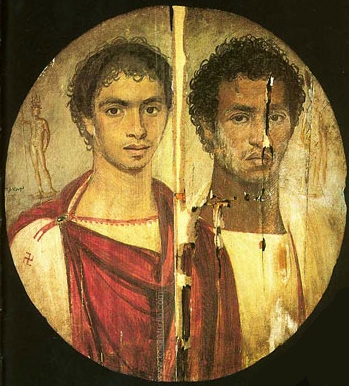

For nearly eighteen centuries, two young men have faced the viewer from a single circular panel. One survived clearly. The other reached the present through insect tunnels, separated fragments and an earlier restoration that placed parts of his mouth and chin in the wrong position.
The Tondo of the Two Brothers, made in Roman Egypt during the second century, has now emerged from a three-week Egyptian-Italian conservation project with the damaged face stabilized and its displaced features returned to their correct arrangement.
The object is extraordinary even before its recent recovery. Most portraits associated with the Fayoum tradition present one individual. This large tondo places two figures side by side, preserving an encounter with people whose names are lost but whose presence remains startlingly direct.
A painting built from wax and wood
The portrait was made on a thin wooden support using encaustic technique, in which pigments are mixed with heated wax. Its surface carries clothing, skin, hair and small symbolic figures with a clarity that bridges Egyptian funerary practice, Greek painting traditions and the visual culture of the Roman world.
Wood gave the artist a portable surface, but it also created the conditions for later damage. An ancient infestation by wood-boring insects, probably termites, left tunnels and losses throughout the panel. Along the edges of those voids, areas of paint no longer had solid support beneath them. Even slight pressure could have caused fragments to fall.
Time was not the only threat. Earlier repair work had reassembled sections of the figure on the right incorrectly. Conservation therefore required more than filling damage. The team had to distinguish original material from previous intervention, understand how the fragments belonged together and recover the face without inventing what no longer survived.
Moving fragments back into truth
Specialists from Rome’s Fabrica Conservazione e Restauro worked with conservators at the Egyptian Museum in Cairo. They secured vulnerable paint, treated voids beneath sunken areas and used lightweight material colored to harmonize with the wood. Displaced fragments were dismantled, flattened, reinforced and returned with discreet balsa-wood supports.
The result does not make the panel look untouched. Loss remains visible, and the work’s long history is not erased. What changed is legibility. The brother on the right can again be encountered as a coherent face rather than as a face altered by damage and mistaken assembly.
Ultraviolet examination also revealed traces in the hair of both figures that may be remnants of an ancient transparent varnish used to intensify dark tones. That small discovery opens another window onto the sophistication of painters working nearly two thousand years ago.
Two faces, many cultures
Fayoum portraits are often described as mummy portraits because many were attached over the faces of the deceased. They emerged within a society where Egyptian burial traditions, Greek artistic language and Roman forms of identity met without becoming a single simple style.
The Tondo makes that cultural density visible. Clothing, hairstyle, technique and symbols all carry information, but the work’s power is not exhausted by classification. The two men look outward with the psychological immediacy associated with portraiture across centuries. Their gaze collapses the distance between archaeological object and human encounter.
The Egyptian Museum identifies the panel with the reign of Hadrian and its origin in Antinoe in Middle Egypt. Although the pair are traditionally called brothers, the exact relationship and identity remain uncertain. Conservation can correct the placement of a fragment; it cannot recover every lost biography.
The ethics of bringing a face back
Egyptian officials described the project with a crucial distinction: conservation is not undertaken to beautify an artifact, but to preserve it. The restored tondo demonstrates why that principle matters. A treatment can easily become an attempt to make ancient art conform to modern expectations of completeness. Here, the intervention supports what survives and corrects an earlier mistake while allowing absence to remain part of the object.
The panel is preparing to travel to Rome, but its deeper journey has already occurred in the conservation studio. A face separated by termites, time and human error has been made readable again—not new, not whole, but truthful enough to meet another viewer.
Across almost eighteen centuries, the two figures continue to perform the essential act of portraiture. They insist that history is not only a sequence of civilizations and dates. It is also the fragile survival of an individual expression, held in wax on wood, waiting for someone to look back.