
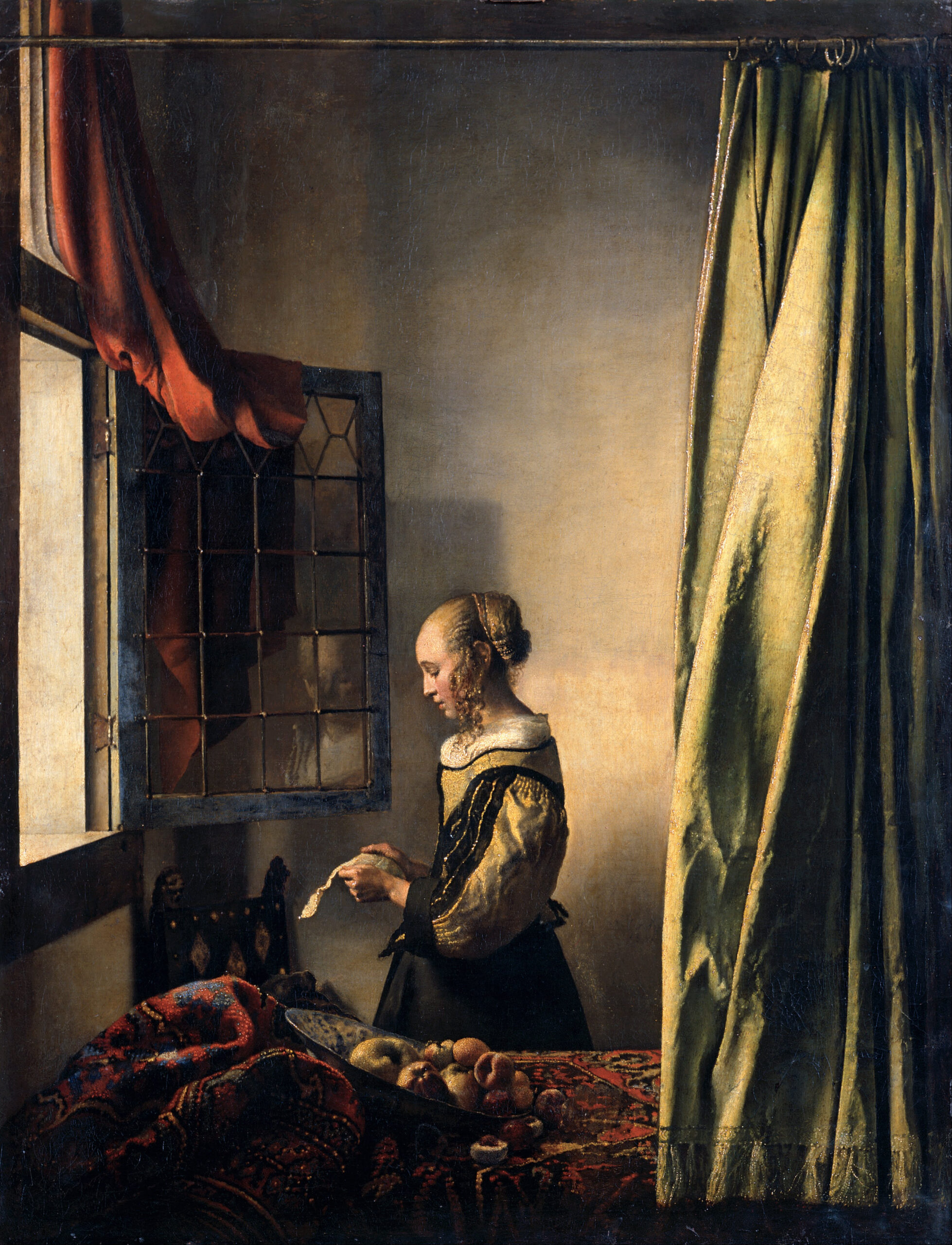

For centuries, a young woman has stood at an open window, reading a letter in silence. A green curtain hangs at the edge of the scene, and behind her, for generations of viewers, stretched a pale, empty wall. It seemed the very essence of Johannes Vermeer: stillness, privacy, a room holding its breath.
The wall was never meant to be empty.
A painting that kept changing its name
Girl Reading a Letter at an Open Window, painted around 1657 to 1659, has lived a life of mistaken identities. In 1742 Augustus III, Elector of Saxony and King of Poland, bought it believing it was by Rembrandt. It was later attributed to Pieter de Hooch before being recognized as a Vermeer in the nineteenth century.
The twentieth century tested it further. The painting survived the bombing of Dresden in the Second World War, only to be taken by Soviet forces, who held it until 1955. It then returned to the Gemäldegalerie Alte Meister, the Old Masters Picture Gallery of the Staatliche Kunstsammlungen Dresden.
In 1979, X-rays revealed something startling: a full-length Cupid on the wall behind the reader. Infrared photography later confirmed it. A painting within the painting had been hidden beneath the background.
The clue in a layer of dirt
In 2017, conservator Christoph Schölzel began work on the canvas, using X-ray, infrared reflectography and microscopic analysis. The decisive evidence was humble. Above the original varnish on the Cupid, conservators found a layer of dirt. That meant the picture had hung in its original state for decades before anyone covered it.
The overpaint itself told a similar story. It was slightly darker than Vermeer’s own background, because whoever applied it had to match varnish that had already darkened with age. Laboratory tests in 2019 showed the covering was not by Vermeer at all, but by an unknown hand, likely decades after his death.
The museum decided to remove it, taking away the later varnish and overpaint to return the work to its original state. Senior conservator Uta Neidhardt described the experience plainly: “This is the most sensational experience of my career.” Of the result, she said: “It makes it a different painting.”
Love, unmasked
When the restoration was completed in 2021, the empty wall had become a framed picture in a thick black frame. A blond Cupid gazes out, holding a bow in his right hand. Two masks lie on the floor behind him, and he tramples one with his right foot, an image read as an allegory of faithfulness and true love triumphing over deception.
The figure was not a stranger to Vermeer’s world. A 1676 inventory of his widow’s belongings lists “a Cupid,” and a closely related figure appears on the wall in his later A Young Woman Standing at a Virginal (1670–72), now in London’s National Gallery.
For Stephan Koja, director of the Dresden gallery, the restoration revealed meaning rather than decoration. “Beyond the ostensibly amorous context, it is a fundamental statement about the nature of true love,” he said in a statement. “Before, we only looked at a vestige. Now we understand it as a key image in his oeuvre.”
The restored painting became the centerpiece of Johannes Vermeer: On Reflection at the Gemäldegalerie Alte Meister, from September 10, 2021, to January 2, 2022, alongside around 50 Dutch genre paintings, nine of them by Vermeer. With fewer than 40 of his paintings known to exist, it felt almost like meeting a new one.
The young woman still reads her letter, still silent. But now, over her shoulder, the god of love is watching, and the room no longer holds its breath. It answers her.