
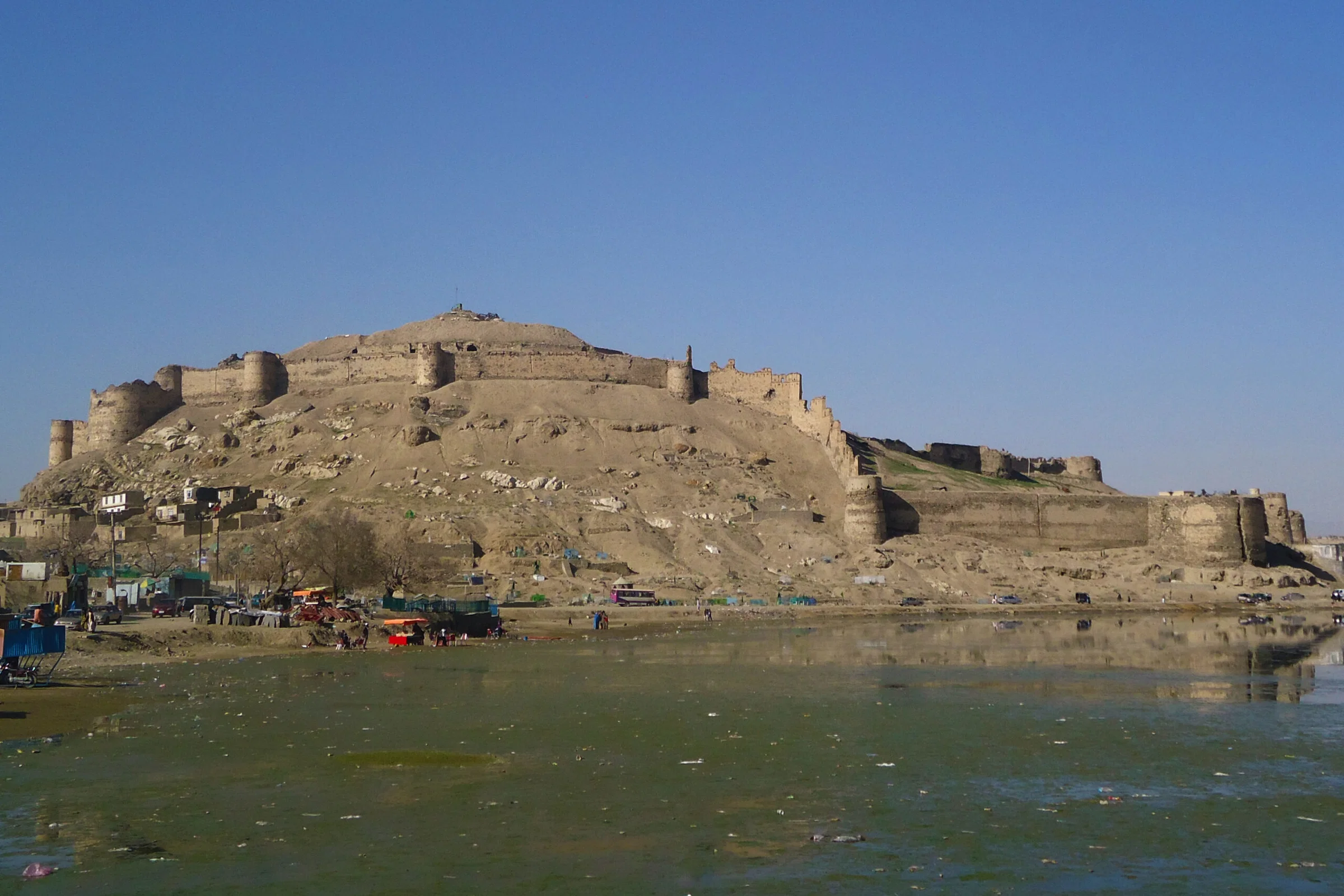

Above Kabul’s old city, a fortress marked by invasion, uprising, military occupation, and neglect is revealing a history deeper than its surviving walls. Archaeologists and conservators working at Bala Hissar have uncovered evidence spanning more than two thousand years, from ancient settlement and Buddhist life to Islamic ceramics and the remains of a Mughal palace.
The discoveries, reported this week by the Associated Press, turn a familiar monument into something far more complex: a vertical archive in which each layer records a different Kabul. The conservation project led by the Aga Khan Trust for Culture aims eventually to open the site as a public archaeological park.
A city beneath the citadel
Work in multiple trenches has produced coins, fragments of Buddhist sculpture, glazed ceramics, lamps, pottery, and the remains of dwellings, monasteries, and palaces. At the summit, archaeologists found traces of a Mughal complex with murals, a throne-like structure, bathing areas, and a star-shaped pool cut into rock.
These finds complicate the popular image of Bala Hissar as a military stronghold alone. Its position above routes through Kabul made it strategically powerful, but the site also functioned as a religious settlement, residence, administrative center, prison, arsenal, and garrison. Control of the citadel often meant control of the city; life inside it was never only martial.
The depth of the excavation is physical as well as historical. One trench has reached eleven meters, and the project’s archaeologists say substantial layers remain. The sensation is not of uncovering a single lost period but of meeting successive cities compressed into the same ground.
Conservation after repeated destruction
Bala Hissar has been damaged and rebuilt many times. British forces destroyed large parts of the complex in 1879 after the killing of envoy Louis Cavagnari. Later conflicts, military use, and modern interventions added further losses. Defensive walls cracked, towers destabilized, and archaeological layers were disturbed.
Planning for the current conservation effort began in 2017, with fieldwork starting the following year. Surveying, ground-penetrating radar, and three-dimensional scanning preceded emergency stabilization. New masonry is being set slightly apart from original fabric so that repair can support the structure without pretending to be ancient.
That visible distinction is an ethical choice. Conservation is not the manufacture of an unbroken past. It is an agreement to protect what survives, document what has changed, and let future visitors tell the difference.
A public future for a layered place
The plan for an archaeological park, museum, gardens, and public facilities is ambitious in a country where cultural heritage has repeatedly been threatened by war, poverty, political upheaval, and deliberate destruction. The project also includes training for Afghan archaeology students, making the site a place where expertise can be sustained as well as displayed.
There are no simple narratives here. The present authorities’ stated commitment to preservation exists beside the memory of the Bamiyan Buddhas destroyed in 2001 and the ongoing restrictions shaping cultural life. The fortress itself resists simplification: Buddhist and Islamic remains, royal luxury and military violence, collapse and repair occupy the same terrain.
That is what makes Bala Hissar extraordinary. It is not returning one vanished city to view. It is showing how many cities can survive inside a single wounded place—and how conservation can create the conditions for those histories to be encountered without being made tidy.