
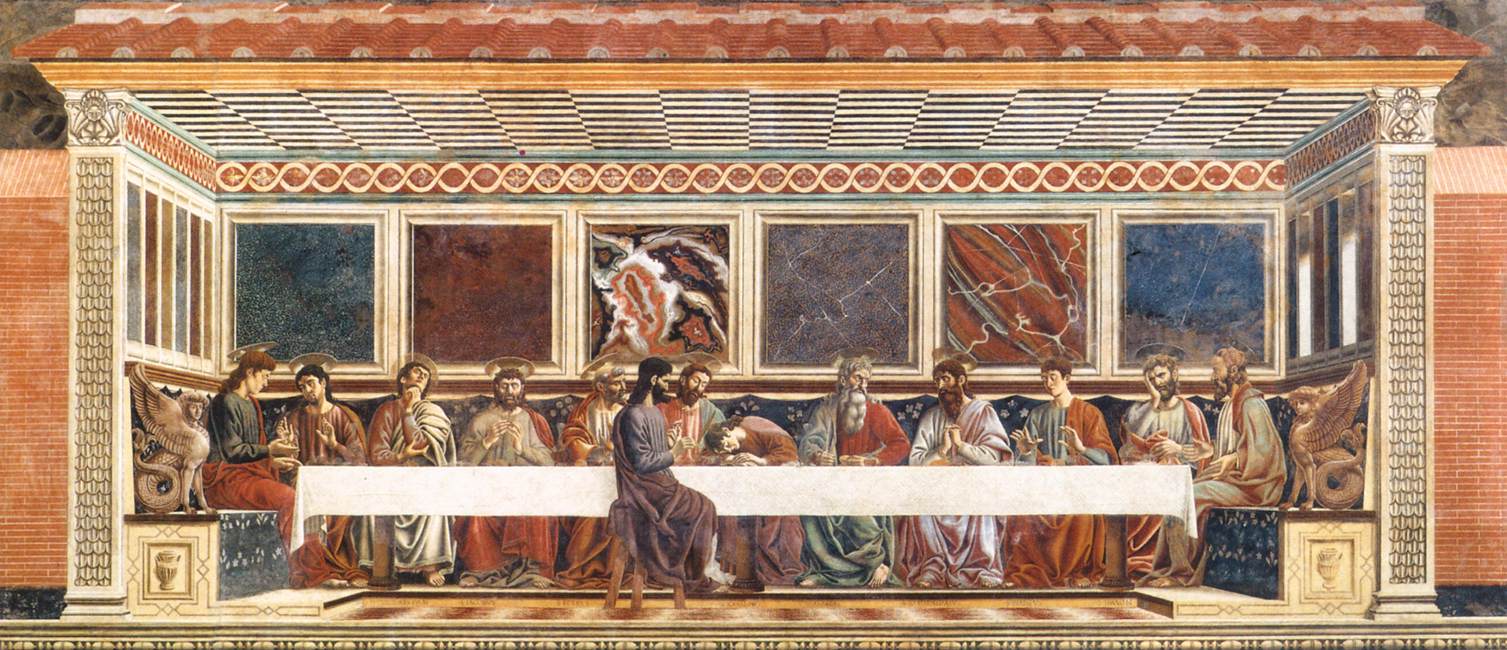

In Florence, a scaffold is about to become a public viewing platform. Beginning November 15, visitors to the Museo del Cenacolo di Sant’Apollonia will be able to climb close to Andrea del Castagno’s monumental Last Supper while specialists carry out a new conservation campaign.
Painted around 1447, the fresco stretches across the former refectory wall of the Benedictine convent of Sant’Apollonia. From the floor, its marble patterns, architectural illusion and sharply modeled figures read as one commanding scene. From the scaffold, the work can be encountered at the distance of the people studying its surface.
Restoration becomes visible labor
The project brings together the regional museum authority with the Opificio delle Pietre Dure and scientific partners including the National Research Council. Before and during treatment, specialists are using diagnostic investigation to study materials, technique and earlier interventions. The goal is not to make the fresco look newly painted, but to stabilize it, improve legibility where appropriate and understand what has happened to it over time.
Open restorations change the public role of conservation. A finished gallery usually hides the decisions, tests and delays behind a work’s appearance. A scaffold reveals that cultural heritage survives through skilled, methodical labor. Visitors can see how close observation precedes intervention and how uncertainty is recorded rather than concealed.
A masterpiece at working distance
Castagno’s composition rewards proximity. The apostles sit within an invented chamber articulated by colored stone panels and a dramatically foreshortened ceiling. Small shifts in line, pigment and plaster help build the illusion. Close viewing can also reveal abrasion, repairs and variations that disappear when the image is reproduced at textbook scale.
The experience should not be confused with privileged access to spectacle. The scaffold is part of a live workplace, and the conservation process remains governed by the needs of the fresco. Its value is educational precisely because it shows restraint: examination, documentation and testing are as consequential as any visible cleaning.
A different kind of encounter
The Cenacolo is a state museum devoted to the refectory cycle and works connected to the former convent. By keeping the site partially accessible and adding a second visitor scaffold, the museum turns a period of necessary disruption into an encounter with how knowledge is made.
For artists, the project is a reminder that surfaces carry time in ways reproductions cannot. For audiences, it offers something rarer than an unobstructed masterpiece: a view of the care, judgment and collective expertise required for that masterpiece to remain present.