
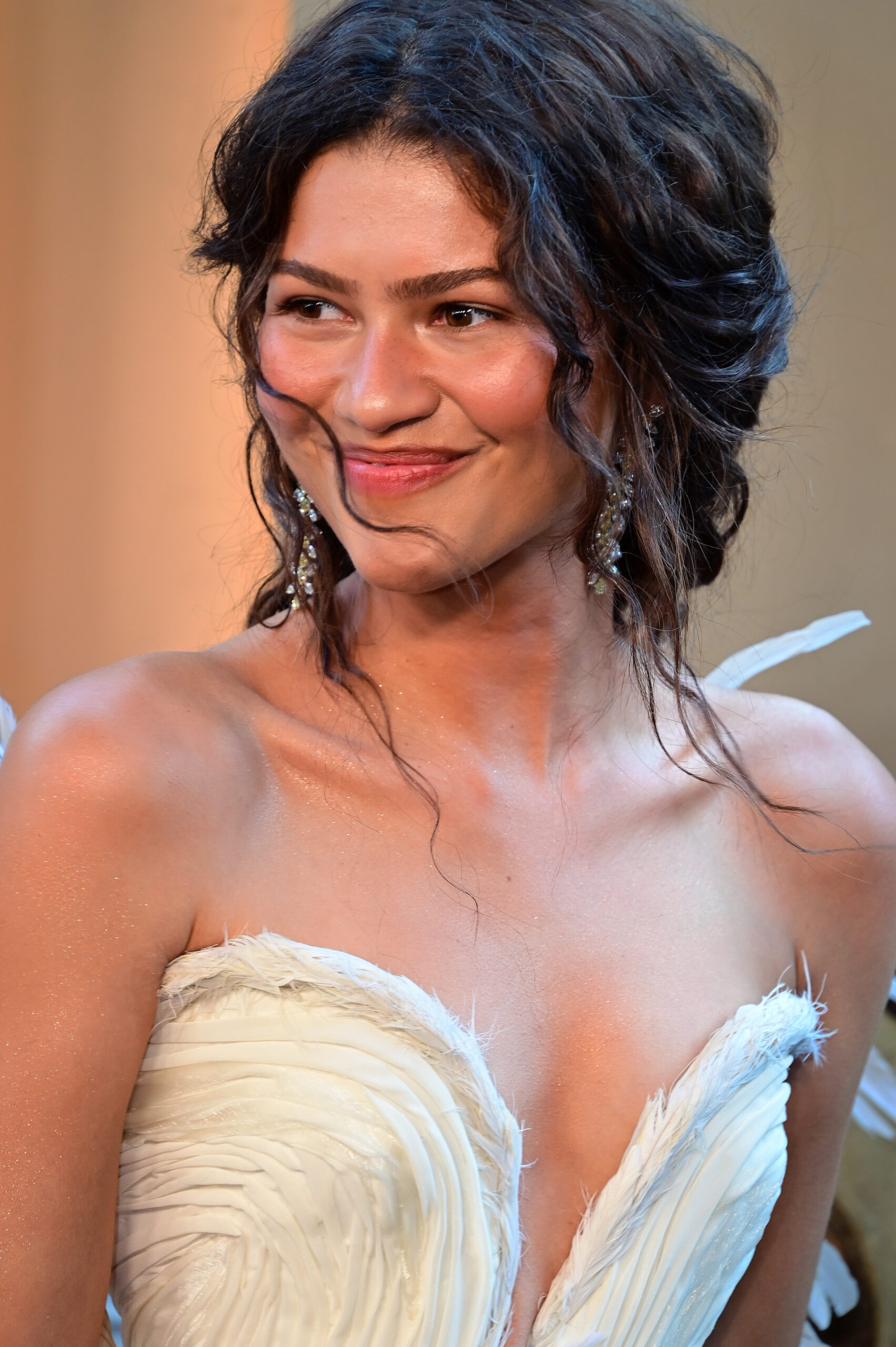

Zendaya at the New York premiere of The Odyssey, July 14, 2026. PhilipRomano / CC BY-SA 4.0.
Zendaya understands that a public entrance can carry narrative. Before the interview, before the premiere, before anyone debates a performance, she and image architect Law Roach have already built a visual threshold into the world of the film.
This is not simply “dressing on theme.” A theme can become a gimmick in seconds. Zendaya’s strongest appearances work because the clothes identify a deeper formal idea—machinery, desert, tennis, transformation—and then allow designers, archives and the body to interpret it.
When promotion becomes world-building
For Dune: Part Two, she appeared at the London premiere in Thierry Mugler’s robot suit from the house’s fall 1995 couture collection. The transparent panels, chrome armor and articulated silhouette did not imitate a specific costume from Denis Villeneuve’s film. They carried its questions about technology, survival and the future into a different arena. A thirty-year-old object suddenly looked sent from tomorrow.
The decision required nerve. Archival fashion is often treated with ceremonial distance, but Zendaya activated the suit. It became movement, flash, vulnerability and protection. She did not disappear inside a famous design; she gave it a new chapter.
That is the difference between borrowing an icon and collaborating with one.
At other stops on the same tour, the language shifted: a Torishéju gown in Mexico City, a white sculptural Stéphane Rolland look in New York, and a vintage Givenchy suit designed by Alexander McQueen in Seoul. No single uniform was repeated. The continuity came through atmosphere—bodies shaped by hostile environments, ceremonial power and silhouettes that seemed engineered rather than merely sewn.
The tennis court enters the wardrobe
With Challengers, the method became lighter and more literal without losing intelligence. Jonathan Anderson designed the film’s costumes and also created several of Zendaya’s promotional looks. At the Sydney premiere, a custom Loewe gown carried the shadow of a tennis player across green fabric. In Rome, a sparkling mini dress was paired with heels pierced by tennis balls. In London, Thom Browne used white mesh and racquet embroidery to make the conventions of tennis dress theatrical.
The archive remained active. Zendaya and Roach selected vintage Ralph Lauren, including a white dress originally modeled by Cindy Crawford in 1992, as well as Vivienne Westwood and earlier Louis Vuitton. Tennis culture arrived not as one logo but as a network of references: club whites, pleats, nets, grass, trophies and the polished codes of spectatorship.
The dress does not summarize the film. It opens a door into its atmosphere.
I admire this because it respects the audience’s visual intelligence. We can recognize a ball or a racquet, but we can also feel the psychological game beneath the surface. Challengers is about appetite, control and three people turning competition into intimacy. The wardrobe uses sport as an entry point, then lets glamour complicate it.
Authorship made visible
Roach has described clothing as a way for Zendaya to put something on, give it to the world, and then return to herself. That separation is crucial. Red-carpet image-making is performance, not proof that a person lives every hour as a character. The collaboration protects the private self by making the public construction deliberate.
Artists know the value of that boundary. A canvas can reveal emotional truth without functioning as a diary. A costume can communicate confidence without claiming the wearer never feels fear. Artifice is not dishonesty when its terms are clear.
Zendaya also gives designers room to be legible. She names the archive, honors the maker and allows unusual silhouettes to remain unusual. Her body becomes part of the composition, but not the only reason the object matters. That generosity has helped audiences see fashion history as a living resource rather than a locked room.
What she and Roach have built is a continuing practice of translation. Cinema becomes cloth. Character becomes proportion. A promotional obligation becomes a sequence of authored images.
The method has also changed expectations around a press tour. A premiere is temporary, but a sequence of connected looks can accumulate like chapters. Each city receives its own image; together, they form a visual essay that travels faster than any conventional campaign.
That is culture magnified: not more noise, but a clearer decision about what the eye should remember.
Continue reading: Björk Does Not Stage Concerts—She Builds Living Worlds · Serena Williams Returns in Purple · The Enigma of Alexander McQueen: When Fashion Met Art