
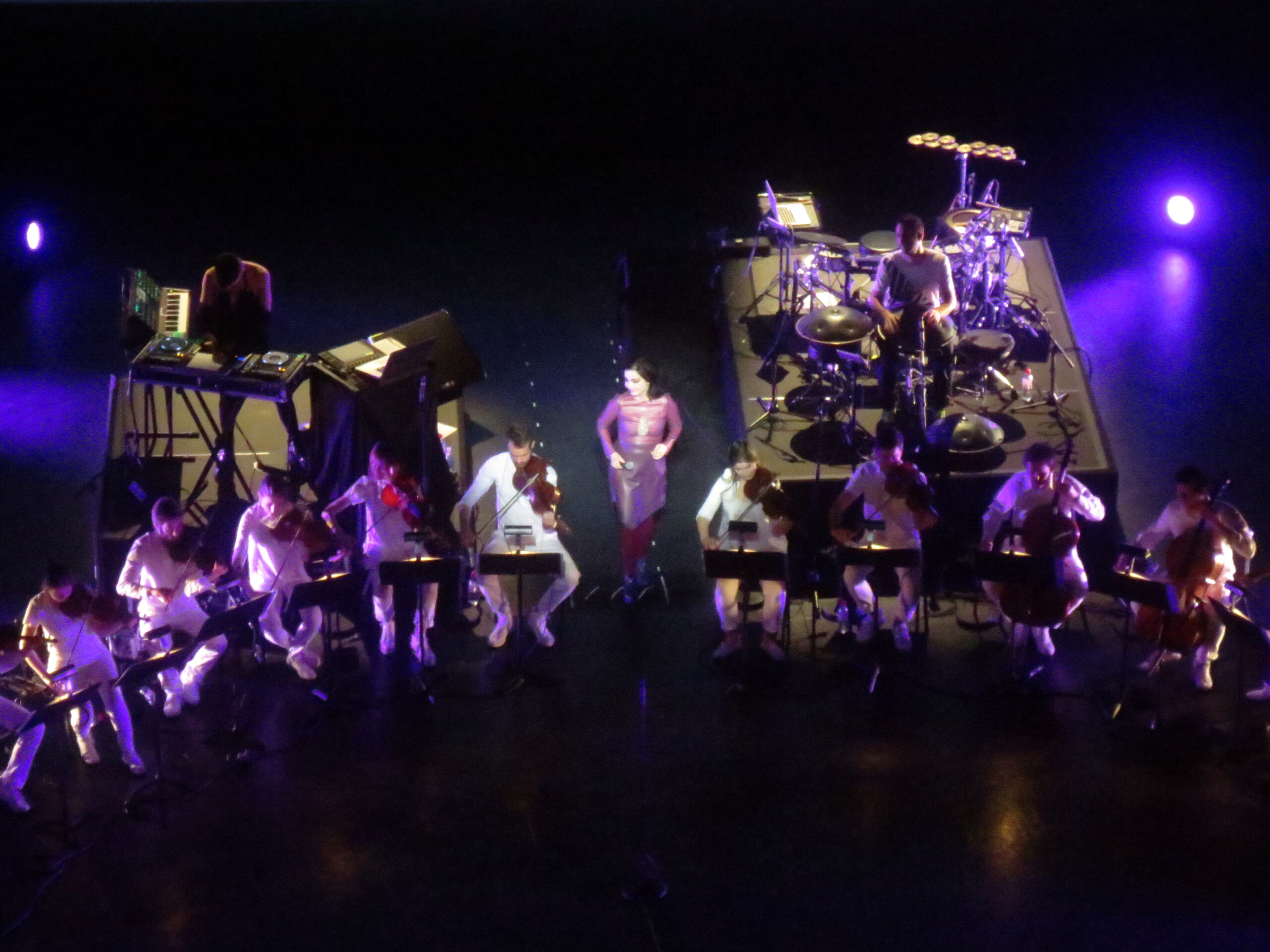

Björk performing at New York City Center on April 1, 2015. Vladimir / New York + Philly Live! / CC BY-SA 2.0.
Björk makes music that refuses to stay only in the ear. It wants a body, a climate, a mask, a moving image, an instrument that did not exist before the song required it.
That appetite is not excess. It is method. Across albums, apps, films and performances, she has treated sound as the spine of a complete environment. Every collaborator and material is asked the same question: what form does this music need in order to become fully visible?
From the headset to the theatre
Cornucopia is the clearest answer yet. Björk developed the production after years working with 360-degree sound, virtual reality and animation through projects including Biophilia and Vulnicura VR. Her stated intention was precise: bring an experience developed for twenty-first-century VR into a nineteenth-century theatre.
The solution used twenty-seven moving curtains that caught projections on different textures alongside LED screens. Images did not sit behind the performer like wallpaper. They traveled through layers, appeared and dissolved, producing what Björk called a modern lanterna magica. The old theatre machine and the digital image learned to breathe together.
The production also created its own instrumental ecosystem: a magnetic harp, circular flute, aluphone and reverb chamber. Onstage, Björk was joined by musical director Bergur Þórisson, percussionist Manu Delago, harpist Katie Buckley, the seven-member flute ensemble Viibra and the Hamrahlíð Choir. The scale was collective, but the world remained unmistakably hers.
For Björk, collaboration is not a decoration around authorship. It is the architecture that lets authorship expand.
An album you could touch
The roots of that thinking were already vivid in Biophilia. Released as both an album and an interactive application, it placed ten songs inside a navigable galaxy. Each star opened a mini-app with graphics, animation, musical structures and opportunities for the listener to participate.
MoMA acquired Biophilia as the first downloadable app in its collection. That decision recognized something radical: an album could also be software, an educational system and a designed object. A song did not have to end at playback. It could become an instrument in the listener’s hands.
The “Virus” app visualized a cell under attack, transforming biological invasion into a strange love story. Other parts of the project connected rhythm and melody to natural patterns. Science was not used as decorative vocabulary. It shaped interaction.
I love the seriousness with which Björk approaches wonder. She never assumes that imagination means abandoning structure. The fantasy works because engineers, programmers, musicians, animators, costume makers and sound designers solve specific problems together.
A body at the center of technology
Technology in Björk’s work rarely feels cold because the voice remains physical. Breath, consonants, strain and intimacy survive inside the largest apparatus. Even when projections fill a hall, the sound can return us to one mouth forming one phrase.
Her costumes and masks perform a similar task. Designers including Iris van Herpen, Alexander McQueen, Marjan Pejoski and James Merry have helped extend the body into swan, bell, fungus, armor and flower. The transformations are theatrical, but never anonymous. Björk’s face may be partially covered while her creative identity becomes even clearer.
The official Cornucopia film, recorded in Lisbon and directed by Ísold Uggadóttir, carries that layered stage world into cinema with Dolby Atmos spatial sound. It is another translation, not a substitute for the concert. Theatre becomes film while preserving the sensation of sound arriving from several directions.
This is what makes Björk essential beyond music. She does not defend borders between disciplines. She tests what each one can give the others. Code can teach melody. Fabric can alter a voice’s emotional scale. A choir can become architecture. A screen can move like weather.
The lesson reaches far beyond performance design. When a work crosses mediums, the artist must decide what is essential and what can change. Björk preserves the emotional structure of a song while allowing its visible body to evolve. That confidence turns experimentation into continuity rather than novelty.
Her worlds are strange because they are specific. They are built, rehearsed, wired, projected and sung into existence. The wonder survives because the craft is never treated as an afterthought.
Nothing is added merely to make the spectacle larger. Every element must make the song more alive.
Continue reading: Zendaya Dresses the Story Before the Film Begins · Andrea Galvani Builds a Garden for the Apples We Lost · The Enigma of Alexander McQueen: When Fashion Met Art