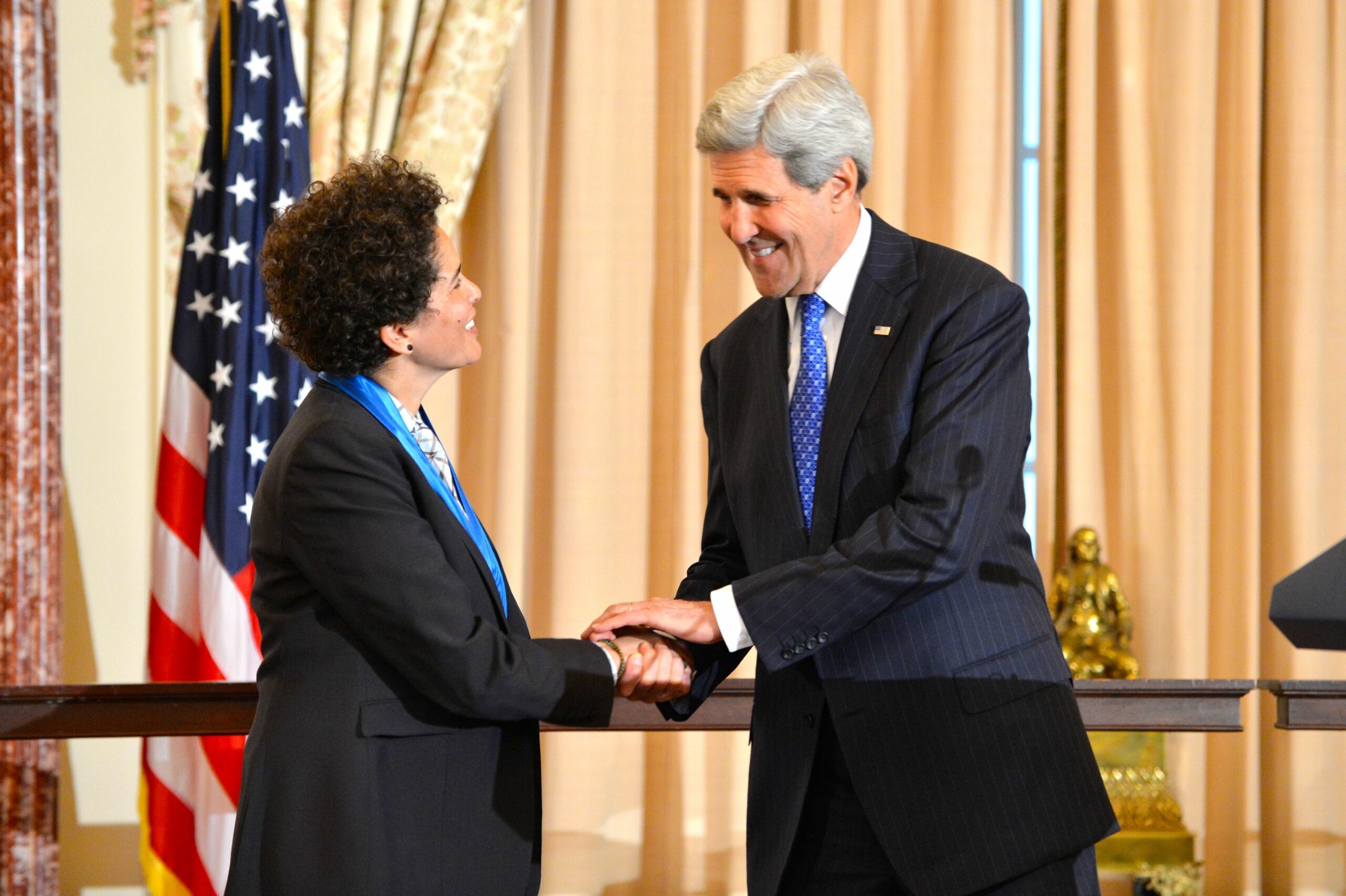

Julie Mehretu receiving the Medal of Arts from John Kerry, January 21, 2015. U.S. Department of State / Public domain.
Julie Mehretu speaks about abstraction as a place where another form can become possible. She does not offer the viewer a diagram of current events, even when news images, migration, protest, fire and architecture enter the work. She lets those pressures collide until a different visual language appears.
Her words are precise about what painting should not do. It should not dictate one history or deliver one political instruction. It should create enough opacity for the imagination to remain active.
The right not to illustrate
In conversation with Ocula, Mehretu described the “right to abstraction” and the right to opacity. Artists of color are often expected to make identity immediately legible, to explain themselves and provide a usable message. She resists that demand because abstraction can hold contradiction without resolving it for the viewer.
The source images in recent paintings may begin with a wildfire, an uprising or a bombed building. Mehretu blurs and alters them until the particular event becomes difficult to identify. What remains is not indifference to the event. It is the visceral atmosphere of collective experience: smoke, velocity, rupture, panic and unstable ground.
She has said that viewers do not need to know which California fire appears beneath a painting; it might resonate with Beirut, Brazil or Myanmar. The blur lets geographically separate violence occupy a shared emotional field without pretending that their histories are identical.
Mehretu protects uncertainty because certainty would close the painting too soon.
Architecture becomes a palimpsest
Earlier works layered maps, stadium plans, airports, fortifications and urban systems. Mehretu told Art21 that architecture and the built environment become a palimpsest—one surface carrying traces of what has been written, erased and built again.
Those lines are never neutral. Buildings organize movement; borders separate populations; plazas can become sites of assembly or control. Yet the painting does not remain an architectural drawing. Ink marks, erasures, colored clouds and gestures work against the underlying structure.
In a public lecture at Tate, Mehretu spoke of a constant battle between her head and hands. A mark is made, then undermined. Construction meets erasure; mechanical line meets bodily gesture. She called the emerging result a “third space,” neither one position nor its opposite.
That struggle explains the paintings’ energy. They do not show a finished world observed from above. They stage formation and collapse at the same time.
Painting asks for slowness
Mehretu has also expressed frustration with the desire to decipher every element. The search for a code can obstruct physical immersion. In her Tate conversation, she emphasized that painting is slow while contemporary images are consumed rapidly.
Her large canvases insist on duration. From a distance, the viewer meets an overall weather system. Closer, tiny marks, printed traces and translucent layers separate. One area may feel controlled and diagrammatic; another seems to erupt beyond the artist’s command.
This is not a puzzle with one correct solution. It is an encounter between the historical material beneath the surface and the living process of painting over it. Mehretu’s language grows through accumulation, cancellation and return.
What moves me in her public words is the confidence to let abstraction remain socially charged without becoming propaganda. She does not retreat from the world. She refuses to make the world simpler than it is.
The paintings hold migration, capitalism, climate crisis and collective struggle as forces rather than captions. Their politics live in instability: who can move, who is enclosed, what has been erased, and what new form might still emerge.
The evolution can be seen across her career. Works such as Stadia II use sweeping diagrams, flags and stadium architecture to suggest crowds and spectacle. The four-part Mogamma series draws on civic squares associated with the Arab Spring. Later paintings allow blurred photographic color to occupy more of the field while drawn marks migrate across it like signals.
For the SFMOMA diptych HOWL, eon (I, II), Mehretu worked in a deconsecrated Harlem church near her family. The monumental canvases pass historical imagery through blur, ink and gesture. She explained that abstraction was not being asked to narrate one particular history; the task was to keep developing painting’s language in the present.
Her process therefore joins research with deliberate loss of information. A photograph may be selected for its political charge, enlarged, blurred and printed beneath layers, then partly obscured. What disappears is as consequential as what remains. Erasure does not empty the work; it creates pressure beneath the visible surface.
Mehretu does not promise that the third space will be comfortable. She makes it visible as a necessity.
Continue reading: Pope Leo XIV Draws a Line Between Human Art and AI · RM Opens His Private Art Collection to the Public at SFMOMA