
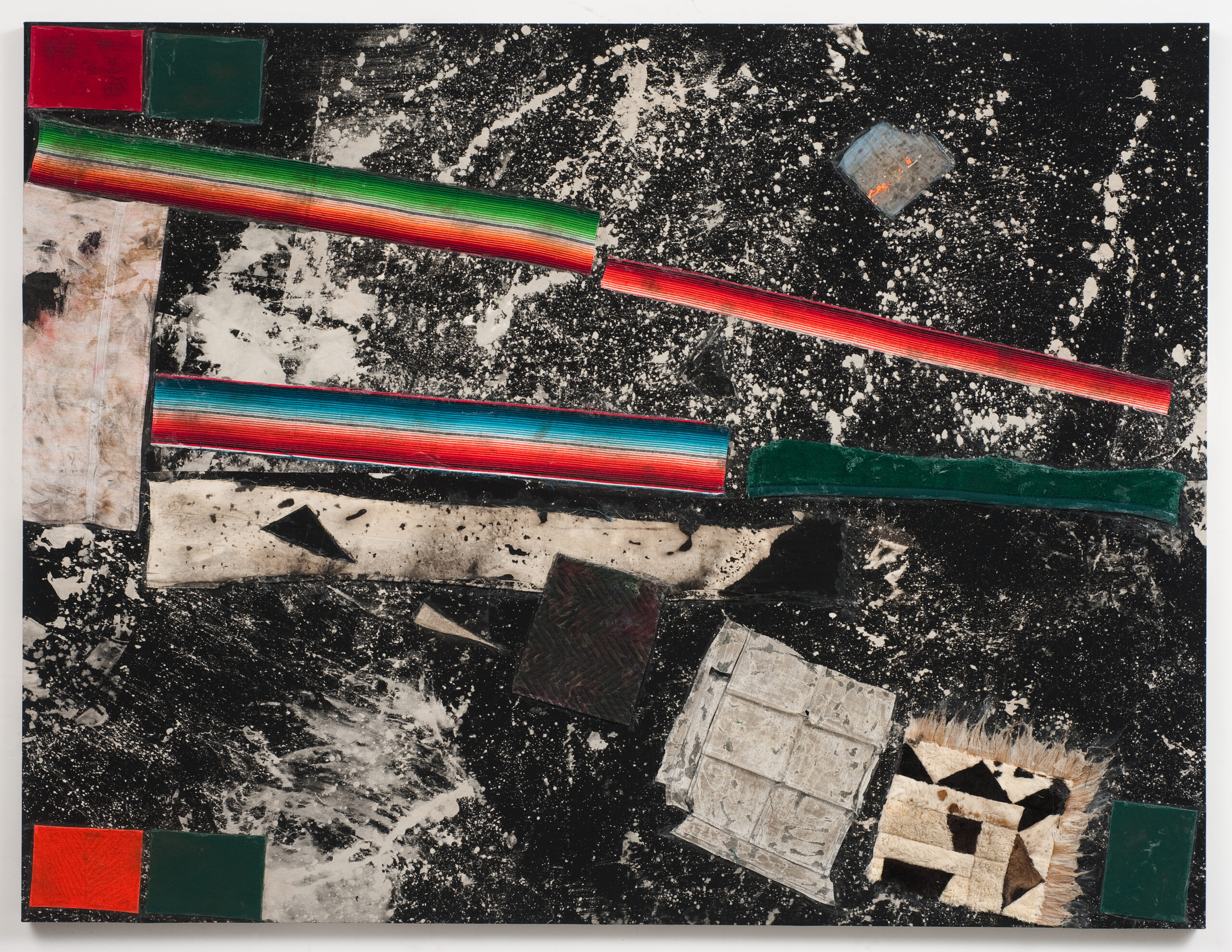
Sterling Ruby, BC3549. Archival artwork image supplied by the artist. Sterling Ruby / CC BY-SA 1.0.
At Gagosian Paris, the walls have turned blue and the flowers have become bronze. Sterling Ruby’s TILL DEATH DO US PART uses the gallery as an emotional field: cyanotype marks move across the architecture while paired blooms stand in the room like bodies posing for a wedding portrait.
The exhibition runs from June 12 through October 3, 2026, at 9 rue de Castiglione. Its collages and cast sculptures grow from flowers cultivated in Ruby’s studio garden in Vernon, California, and from time spent in the Eastern Sierra.
Blue covers the architecture
Visible through the storefront windows, enlarged prints from the GHOSTS series paper the gallery walls. Their deep blue linear marks have the density of grass moving under wind. Rather than placing works on a neutral white backdrop, Ruby turns the backdrop into one continuous atmospheric image.
Smaller source collages hang over this field. They combine cyanotype—a camera-less photographic process activated by light—with watercolor and mixed-media drawing. The layering allows intimate paper works to remain legible inside an installation scaled to the room.
The blue changes every object placed before it. Bronze reads warmer; shadows become heavier; the storefront no longer offers a transparent glimpse into a white cube. From the street, the gallery announces itself as environment before it reveals individual works.
This is what a gallery installation can do when the walls participate. The room does not merely hold the exhibition. It becomes its weather.
Flowers bound as couples
Ruby’s Bound Flowers. Couple. sculptures preserve pairs of flowers joined in an embrace. The largest listed work rises more than 272 centimeters and extends 170 centimeters into space. Smaller bronzes bring the paired gesture closer to domestic scale.
Ruby casts the flower at the moment when tenderness and restraint become difficult to separate.
Stems overlap. Blooms lean toward one another. Some pairings appear protective; others look trapped by the very bond that gives them form. The title frames them through marriage, particularly the rigid performance of togetherness in formal wedding photographs.
Bronze intensifies the contradiction. A cut flower is temporary, already moving toward collapse. Casting arrests that process and gives decay the durability of a monument. Details of petal and stem preserve vulnerability in a material associated with public heroes and historical permanence.
A still life large enough to enter
Ruby looks toward seventeenth-century Dutch and Flemish still-life painting, where flowers, fruit, insects and luxury objects carried reminders of mortality. Those paintings gathered impossible bouquets—blooms from different seasons appearing together—then allowed beauty to announce its own ending.
In Paris, the reference leaves the canvas. Visitors move among the bronzes while the blue walls surround them. The unified arrangement behaves like a still life expanded to architectural scale.
I am drawn to the amount of labor hidden inside apparent naturalness. A flower may look spontaneous in a garden, but casting requires selection, molding, transformation and finishing. The cyanotype also depends on exposure and chemistry. Ruby uses process to hold forms that ordinarily change too quickly to keep.
The gallery’s circulation makes those pairings unfold rather than arrive in one glance. A visitor sees one bronze against blue, then discovers another alignment by moving sideways. The sculptures appear to look at one another because the sightlines give their tilted blooms a direction. Space supplies the relationship.
The source garden adds another layer. Ruby did not begin with a universal symbol drawn from a handbook; he began with plants cultivated at his Vernon studio and with observation in the Eastern Sierra. The personal act of tending enters a process associated with industrial permanence.
Even the paper works complicate preservation. Cyanotype is made through exposure to light, while works on paper must later be protected from too much of it. The blue field records illumination and then asks the gallery to control illumination. Material and display remain in active conversation.
The installation never becomes a simple celebration of romance. “Till death do us part” is both vow and limit. Every couple exists in relation—to another body, another sculpture, the wall, the garden from which the source came, and the mortality the bronze denies.
The show remains open at Gagosian’s rue de Castiglione gallery through October 3. Go for the flowers. Stay with what is binding them.
Continue reading: Pope Leo XIV Draws a Line Between Human Art and AI · RM Opens His Private Art Collection to the Public at SFMOMA