
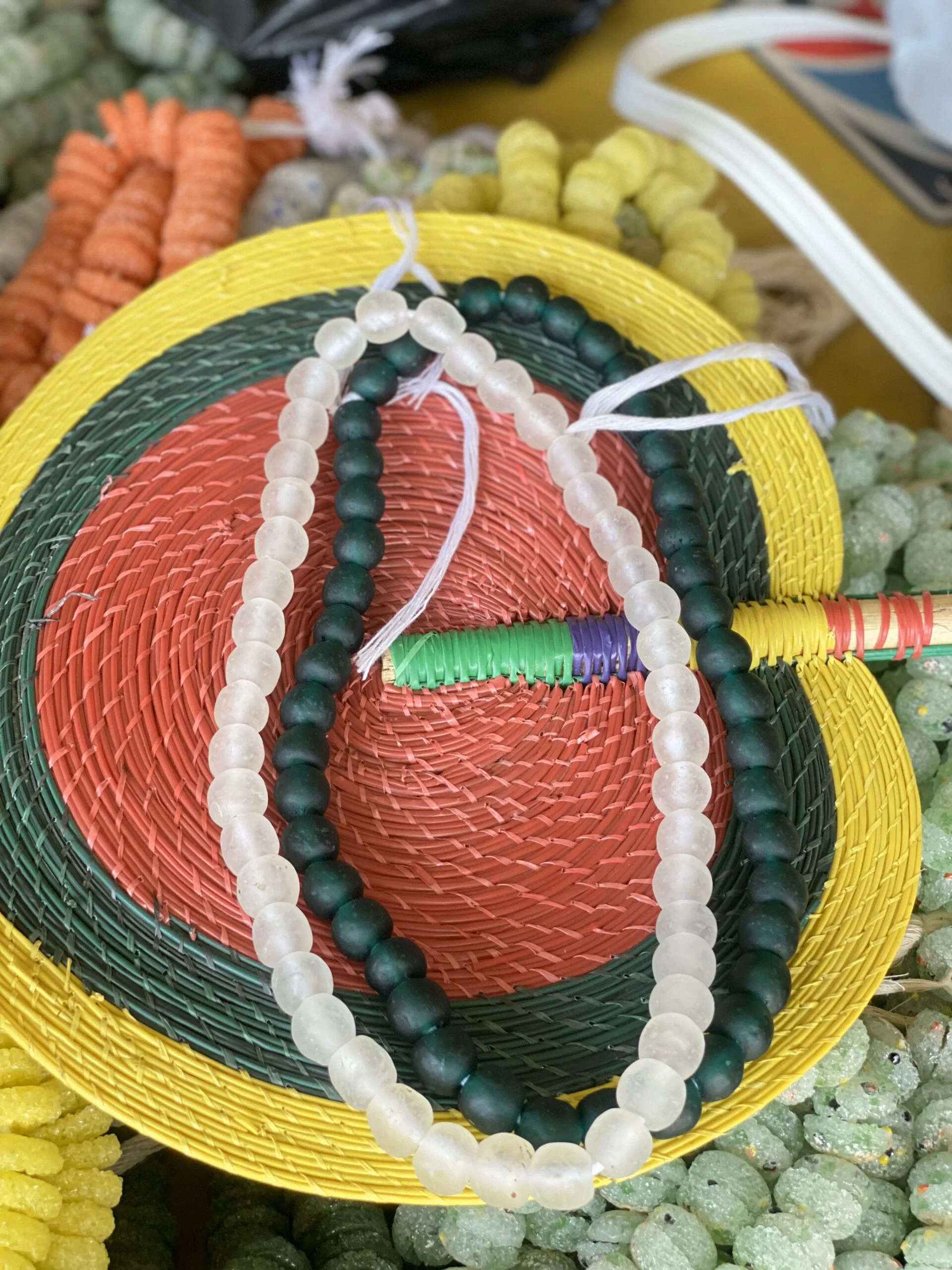
Round glass beads, shown as a craft material. Mobash12 / CC0 1.0.
Joyce J. Scott can make a bead carry the weight of history without asking it to stop shimmering. Her sculptures attract the eye through color, intricacy and astonishing labor, then bring that attention into contact with racism, violence, gender, ancestry and survival.
Joyce J. Scott: Declarations—Beaded Histories opened August 15, 2026, at Princeton’s Bainbridge House and continues through January 10, 2027. Presented during the 250th anniversary of the Declaration of Independence, the exhibition places Scott’s commitment to free expression beside a national promise that has never been equally realized.
Beadwork becomes public speech
Scott’s practice is rooted in Baltimore, in African American ancestry and in global craft traditions. She works with sculptural beadwork as well as handblown glass, quilting, found objects, printmaking, performance and song. The range resists any boundary between “fine art” and forms historically assigned to domestic, decorative or communal labor.
Beads are small, portable and ancient. Joined through patient repetition, they can become adornment, image, skin or structure. Scott exploits their visual seduction while making figures and scenes that can be difficult to witness.
Scott uses beauty as an invitation, then refuses to let beauty become an escape.
This strategy matters in a culture trained to glance. A luminous surface slows the viewer long enough for narrative to emerge. Pleasure and horror can occupy the same object, not because suffering is beautified but because contradiction is part of how history survives in the present.
A declaration is tested by experience
The exhibition’s timing creates a charged frame. The United States marks 250 years since its Declaration of Independence in 2026, celebrating language about equality and unalienable rights. Scott’s work asks what those ideas mean when measured against the lives of people excluded from their original political scope and endangered long afterward.
Her art does not function as an illustration placed beneath a historic document. It declares through material intelligence. Threading, knotting and accumulating become ways to build an alternative record—one held by bodies, families and cultural memory.
The subtitle Beaded Histories is plural for a reason. No national story can be truthful if it moves as a single triumphal line. Scott’s figures hold personal, communal and political time together. Found objects introduce the residue of ordinary systems; glass can suggest fragility, transparency or bodily vulnerability.
Intimacy sharpens the encounter
Bainbridge House is an eighteenth-century building at 158 Nassau Street rather than a vast contemporary hall. That scale can intensify the works. Bead sculpture rewards close looking, and domestic architecture keeps declarations connected to the spaces where history is lived rather than only commemorated.
Approach slowly. Notice how structure works before searching for a message. Where does a line of beads support weight? When does pattern become anatomy? How do reflective surfaces alter a figure as the viewer moves? Material questions are not distractions from political meaning; they are how that meaning reaches us.
Small scale can produce enormous pressure. When a figure fits near the hand, the encounter becomes intimate, almost private, even as the subject addresses public violence. Larger or suspended works redistribute that pressure through the room. Attend to the distance the display asks you to keep and to the details that remain just beyond easy sight.
The surrounding university setting adds responsibility. Anniversaries often invite polished institutional language; Scott’s work keeps celebration answerable to lived history. Students and families can begin with what they see materially, then allow difficult questions to emerge without demanding that one object summarize an entire community.
Scott received a MacArthur Fellowship in 2016, recognition that described her as a sculptor and jewelry maker repositioning beadwork as a forceful vehicle for social commentary. A decade later, this exhibition shows why the practice remains urgent. Freedom of expression is not an abstract institutional value when an artist uses it to confront what a society would prefer to soften.
The show is free, and the museum advises checking current hours and access details before visiting. Give the work enough time for first impressions to change. The most intricate object may hold the sharpest accusation; a painful scene may also carry humor, resilience or tenderness.
Scott’s declarations do not arrive as slogans. They are made one connection at a time. That patient construction is their authority: history is not merely stated, but threaded into a form that demands our physical attention.
Continue reading: Pope Leo XIV Draws a Line Between Human Art and AI · RM Opens His Private Art Collection to the Public at SFMOMA