
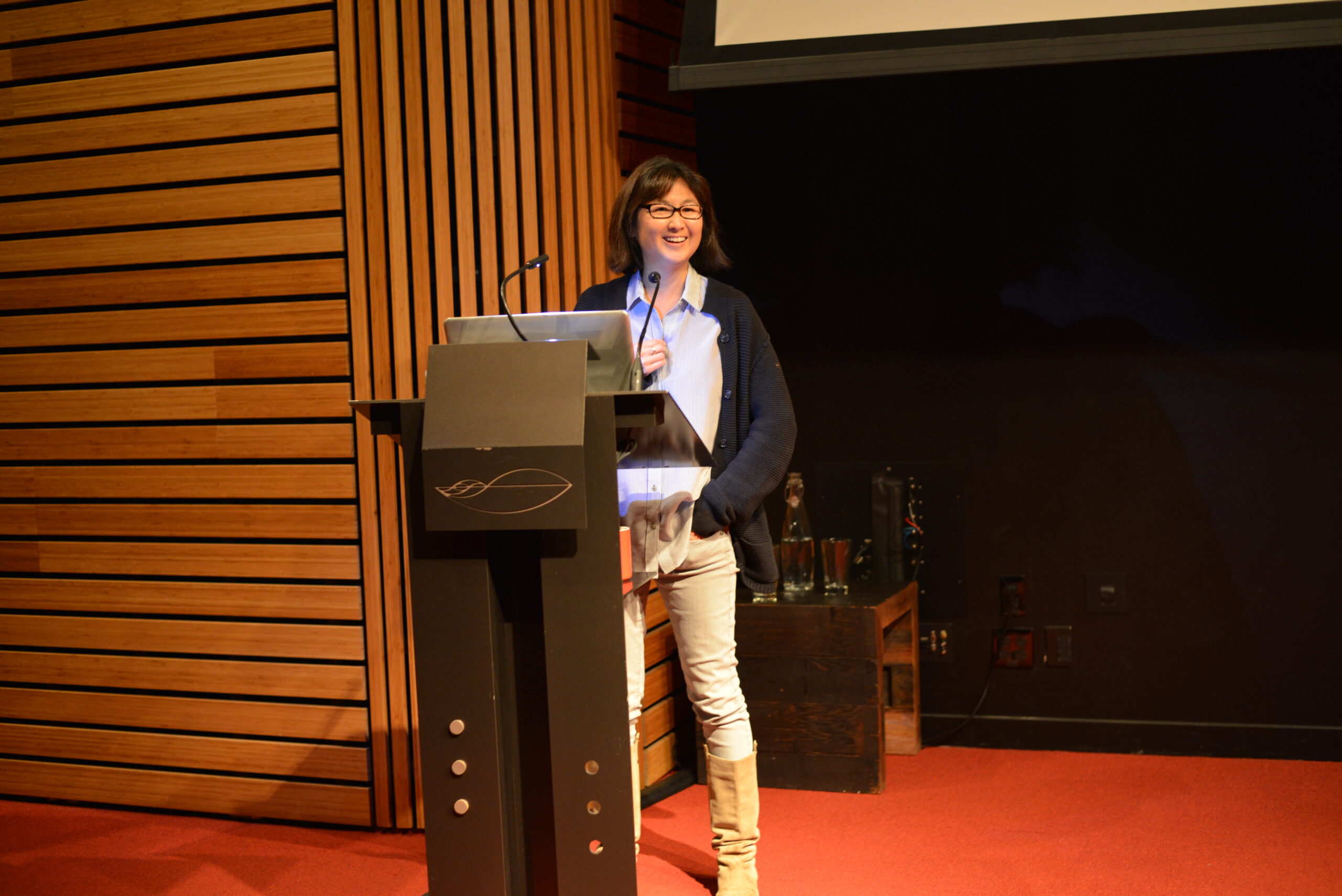

Maya Lin speaking at a Berkeley Center for New Media lecture in 2014. Berkeley Center for New Media / CC BY-SA 2.0.
A conventional memorial gathers loss into one place. Maya Lin’s What Is Missing? refuses that boundary. It exists through sculptures, temporary media works and an evolving digital map, allowing memories of species and habitats to appear across locations and continue changing.
Lin describes it as her fifth and final memorial. The project addresses the current mass extinction, connecting species loss to habitat destruction while emphasizing that restoration can protect biodiversity and reduce carbon emissions. Grief is present, but it is not the end of the design.
A memorial becomes a network
The project’s Map of Memory gathers ecological histories of animals, plants, waterways and places. Historic records, films, sounds, conservation stories and personal memories establish change across time. Former abundance becomes visible, making a “normal” depleted landscape harder to accept.
This memorial does not ask us only to mourn what vanished; it asks what can still return.
That shift matters. Environmental statistics are essential, yet numbers can become abstract when losses accumulate. A remembered birdsong, seasonal migration or childhood shoreline locates change within lived experience. Personal testimony does not replace science; it gives scientific history a human scale.
The project works with sources and guidance from organizations including the Cornell Lab of Ornithology and National Geographic. Its nonprofit foundation presents the work as science-based and solutions-oriented, linking art’s capacity for attention to conservation knowledge.
One sculpture asks visitors to listen
A permanent component at the California Academy of Sciences in San Francisco uses bronze, reclaimed wood and a multimedia screen. Its form evokes an enlarged listening device, asking visitors to approach absence through sound and image rather than a heroic figure.
The work is located on the academy’s East Terrace in Golden Gate Park and is part of the San Francisco civic art collection. Reclaimed material makes environmental history physical, while the screen permits content to change in a way a carved inscription cannot.
Lin has spent her career reconsidering what memorials do. The Vietnam Veterans Memorial makes individual names and the visitor’s reflection central; the Civil Rights Memorial uses flowing water and a timeline. What Is Missing? extends memory beyond human death to relationships among species, climate and place.
Solutions belong inside the artwork
The project’s “Greenprint” and solutions material imagine plausible sustainable futures and highlight work already underway. This prevents ecological art from treating catastrophe as a sublime image consumed at a safe distance.
Habitat restoration is especially powerful because it addresses multiple crises together. Forest, wetland, grassland and coastal recovery can store carbon while giving species places to feed, reproduce and migrate. The artistic frame helps audiences see those functions as a connected landscape rather than isolated policy categories.
Participation is carefully structured. Visitors can share memories of environmental change, contributing local knowledge to a global map. The act invites us to ask older relatives what was once common, to notice what children today may never encounter and to document recovery as well as disappearance.
Such memories must be handled with care. Individual recollection can be incomplete, and ecological baselines shift between generations. The project’s strength is the conversation between testimony and documented histories: feeling identifies what matters, while research tests scale, cause and chronology.
Sound is especially effective. An absent animal may survive in a recording after it disappears locally, and listening makes loss temporal. A call begins, occupies air and ends. Silence afterward is not an illustration added by a curator; it is part of the medium through which extinction becomes imaginable.
Memory alone is not action, and the project does not claim otherwise. Its value lies in converting attention into a sequence: learn what changed, understand causes, encounter restoration possibilities and identify choices at civic and personal scales.
Explore the digital project slowly. Choose one place you know and compare its past, present and possible future. Listen with headphones when sound is available. Then follow a cited conservation effort beyond the artwork and learn what practical support it needs.
Environmental art is often asked to solve problems far beyond any artwork’s power. Lin offers a more honest role. Art can make loss perceptible, connect knowledge across disciplines and create an image of a future worth organizing toward.
What Is Missing? remains unfinished because the environmental story remains unfinished. Its dispersed form is not an evasion of monumentality. It is a recognition that the living world cannot be remembered—or repaired—from only one place.
Continue reading: Pope Leo XIV Draws a Line Between Human Art and AI · RM Opens His Private Art Collection to the Public at SFMOMA