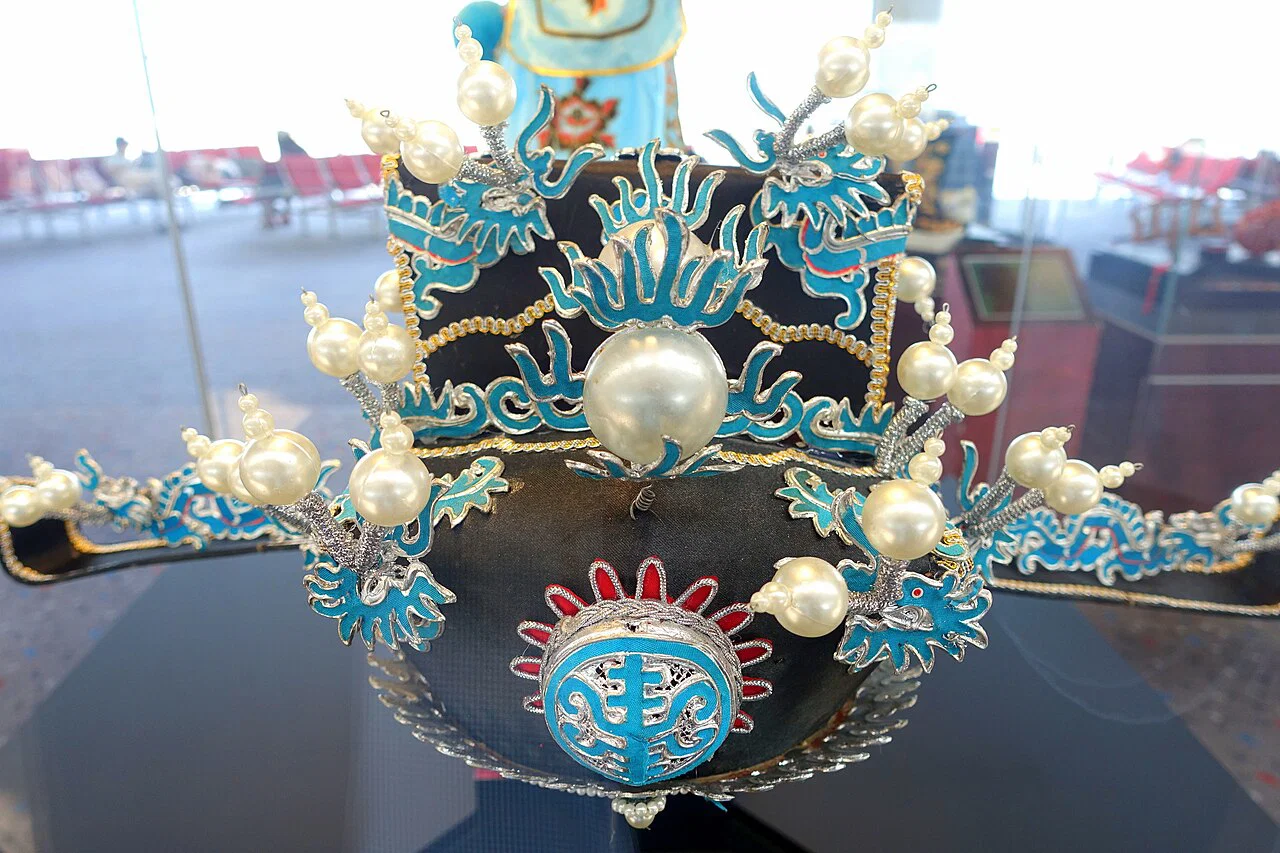

On the final day of her New Museum performance, Alison Kuo brings a four-century-old theatrical form into an installation built from the textures of contemporary Chinatown. Presenting Arrangements and Indirect Actions, performed October 22–24, is the culmination of Kuo’s 2025–26 artist residency at the museum.
The New York-based artist has described the work as a contemporary opera created through the framework of Cantonese opera. Its subject is not tradition sealed behind glass, but tradition carried through migration: learned, translated, performed and remade by communities far from its place of origin.
A stage assembled from lived materials
Kuo’s sculptural sets and costumes draw on materials found in and around Manhattan’s Chinatown. That choice gives the production a double location. Cantonese opera supplies a performance language with centuries of history, while the neighborhood supplies the physical vocabulary of daily life.
The resulting stage is neither a museum reconstruction nor a theatrical souvenir. It treats costume, voice, gesture, objects and architecture as connected forms. The opera’s traditions are present, but so are the economic and social conditions under which diasporic culture survives.
Kuo’s broader practice often moves among food, family histories, collaborative performance and sculptural assemblage. Here those threads meet a form that carries highly codified movements and visual signs. The artist’s role is not simply to quote those signs. It is to ask what they become when transmitted through family memory and the improvisations of immigrant neighborhoods.
Why the current work matters
Diaspora is sometimes discussed as distance from an authentic center. Kuo’s performance suggests a more active model. Cultural continuity is produced through use: people repeat forms, alter materials, teach one another, and build occasions where a tradition can be encountered again.
That process includes friction. A historical performance language may carry expectations that do not fit a contemporary artist’s body, politics or environment. A neighborhood may preserve cultural knowledge while facing development pressure and changing demographics. The work gains force by holding those tensions together instead of resolving them into a simple celebration.
For artists working with inherited forms, Kuo’s project offers a useful distinction between appropriation and relationship. The strongest work does not borrow the appearance of a tradition as a decorative resource. It reveals who transmitted the knowledge, how the artist is situated within it, and what responsibility accompanies the act of transformation.
Performance as a living archive
An archive usually implies objects that remain stable enough to be stored. Performance preserves differently. It lives through bodies, timing, repetition and the willingness of one generation to teach another. Costumes and sets can survive, but meaning also depends on actions that must be renewed.
By placing Cantonese opera within her residency, Kuo turns the museum into a temporary site of that renewal. The work does not claim to contain the tradition. It makes visible one route by which the tradition continues to travel.
The final performance closes a specific three-night run, but its larger proposition endures: migration does not merely displace culture. It can produce new stages, new materials and new arrangements through which memory remains active.