
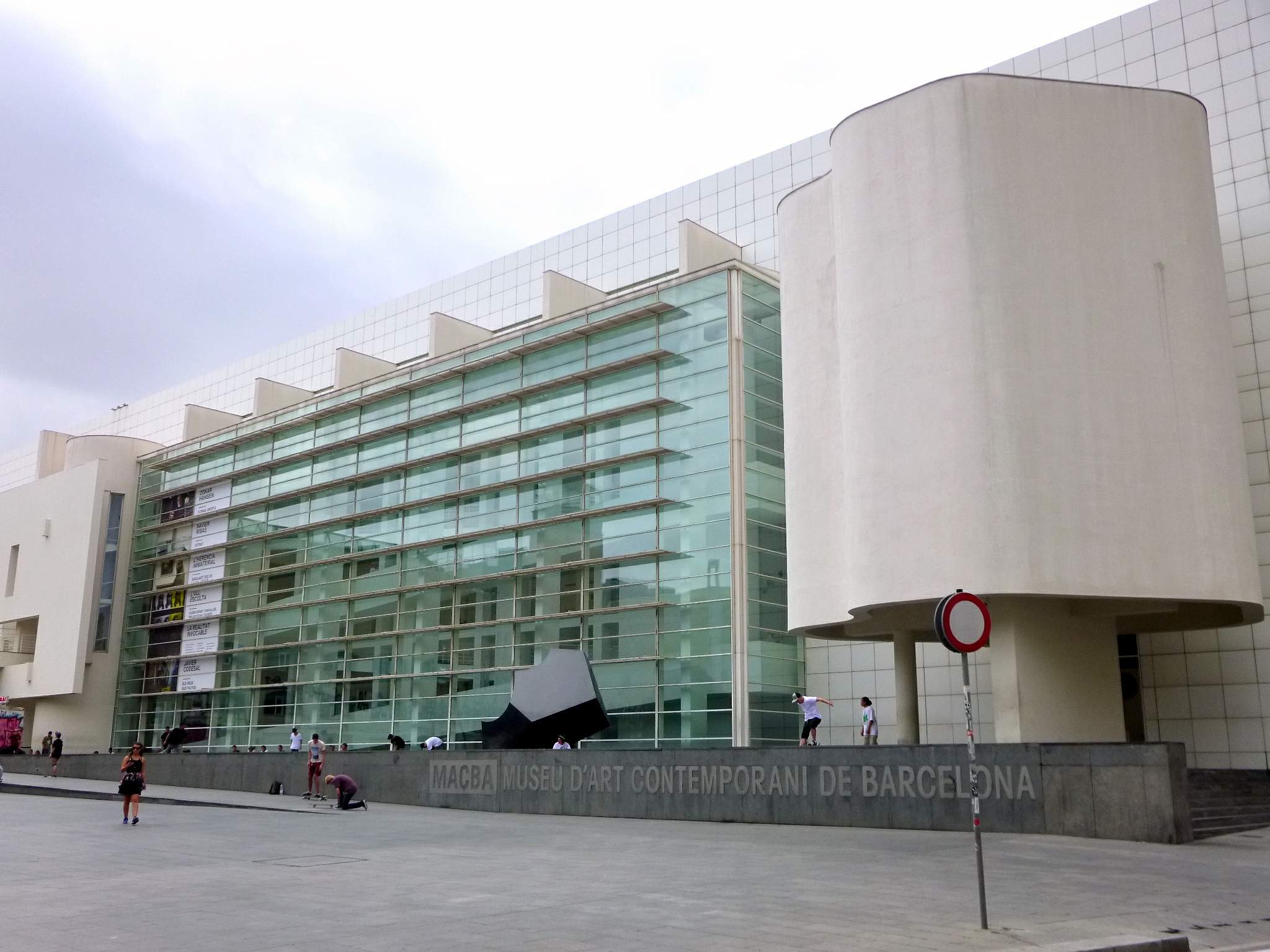

Long before ecological crisis became a familiar framework for contemporary art, Aurèlia Muñoz was building forms that seemed to breathe, fly, root, and suspend themselves between architecture and organism. A major retrospective opening November 5 at the Museu d’Art Contemporani de Barcelona places that environmental intelligence at the center of her five-decade practice.
Aurèlia Muñoz. Ens brings together early collages and assemblages, large pictorial embroideries, macramé structures, bird sculptures, handmade-paper installations, and a substantial group of drawings and models. MACBA describes several of the large structures and archival materials as previously unseen.
Fiber as a way of thinking about systems
Muñoz’s work moved beyond the flat surface associated with conventional tapestry. Knotting, tension, gravity, and air became structural elements. Fibers could define a volume without sealing it; a suspended work could respond to the space around it rather than occupy a fixed pedestal.
That openness makes the work feel ecological in more than a thematic sense. Its parts depend on one another. A knot changes the pull across a larger field. A shift in weight alters the entire form. Light, air, architecture, and the viewer’s movement become active conditions.
The exhibition’s title uses the Catalan word ens, or being. It points toward Muñoz’s recurring interest in forms that resist a simple division between object, body, creature, and habitat. Her bird sculptures and aerial structures do not illustrate nature; they propose another way to imagine material life.
An early response to post-industrial damage
MACBA’s research situates Muñoz’s practice against the emerging crises of the post-industrial world. Terrestrial, aquatic, and aerial ecosystems appear as major motifs. The museum argues that she combined ancestral techniques with contemporary resources while attending to changes in the environment and relationships with nonhuman beings.
This history matters now because ecological art is sometimes treated as a recent genre defined by data, activism, or scientific collaboration. Muñoz offers a complementary lineage. Environmental thought can also reside in technique: in repairable joins, hand knowledge, renewable fibers, structural economy, and attention to the behavior of materials.
Her practice does not make handmade work automatically innocent. Paper and fiber have supply chains; exhibitions consume energy; preservation has environmental costs. Instead, it shows how a process can make interdependence visible. The viewer encounters not an isolated image, but a system held in balance.
A retrospective across institutions
The retrospective is co-produced by MACBA and the Museo Nacional Centro de Arte Reina Sofía, in collaboration with the EINA Foundation and the Aurèlia Muñoz Archive. The Barcelona presentation follows the project’s earlier 2026 run in Madrid. Its interdisciplinary research brings textile history, philosophy, anthropology, and environmental thought into the same conversation.
For contemporary artists, Muñoz’s example is not a prescription to return to a particular craft. It is an invitation to ask what a material already knows: how it bends, stores tension, joins, degrades, and relates to the space around it. In her work, making is never separate from environment. It is the way environment becomes form.