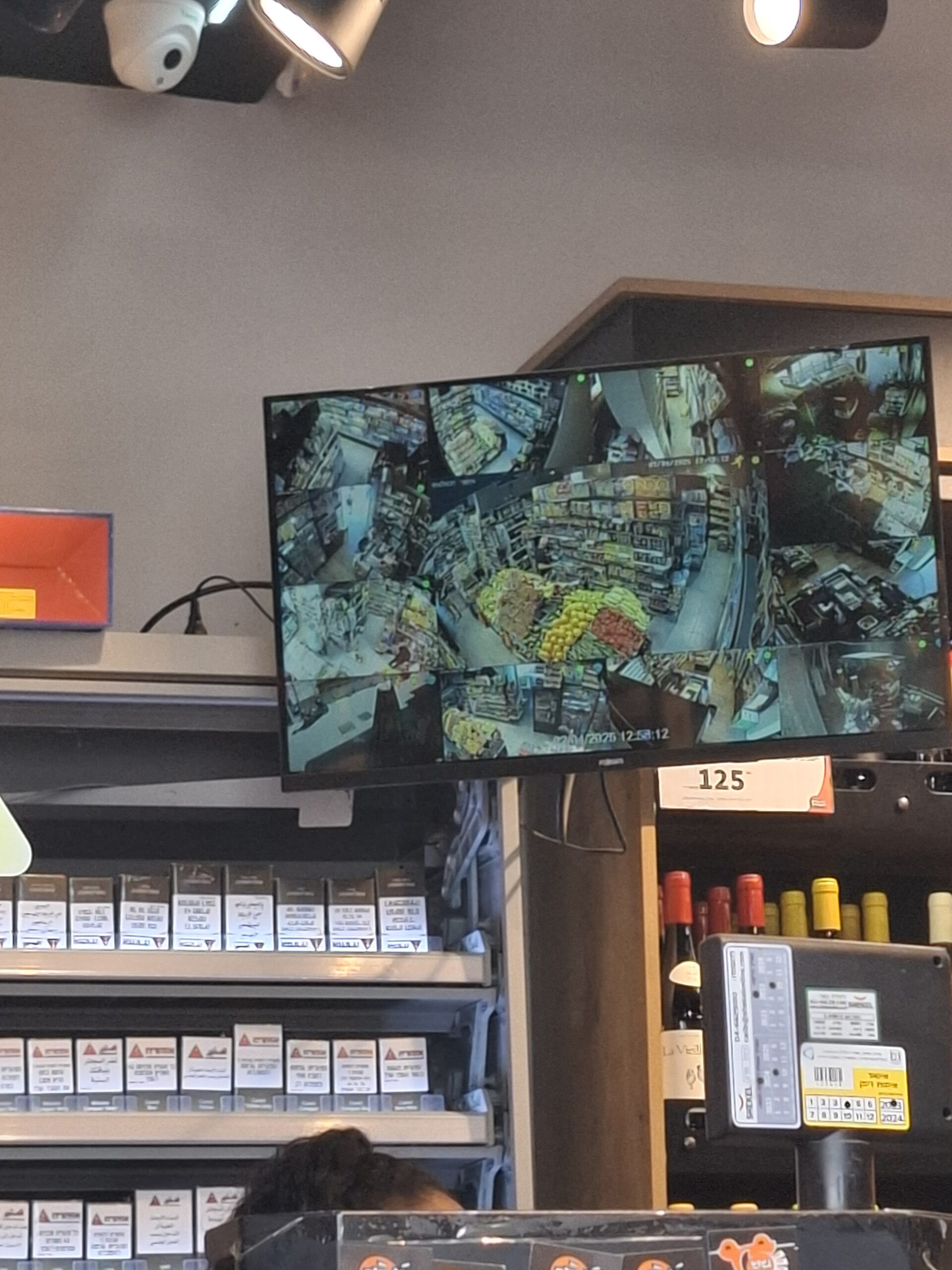

Deana Lawson has built a photographic language around intimacy, staging and the politics of looking. In Edge Control, her current exhibition at Gagosian in New York, she turns that language toward images never intended to function as art: surveillance stills displayed by beauty-supply stores to identify alleged shoplifters.
The exhibition, on view through October 24, enlarges and reframes those images alongside new photographs and holograms. Lawson intervenes to protect the identities of the people pictured, but she preserves the visual distortions of low-resolution monitoring systems. Presented at human scale and set within luminous mirror frames, the stills no longer disappear into a shop window. They make the viewer visible too.
Looking becomes participation
The title carries a double meaning. Edge-control gel is used to smooth the fine hairs along a hairline, while the exhibition examines wider systems that attempt to control people through images. Beauty, commerce, race and suspicion occupy the same frame.
Lawson’s move is neither neutral nor simple. Surveillance photographs are records of unequal power, and enlarging them risks extending the exposure of people who did not consent to becoming subjects. Her decision to conceal identities acknowledges that problem without erasing the system that produced the images. The mirrored frames then return the act of looking to the audience: anyone studying the photograph also encounters their own body at its edge.
The work does not ask viewers to determine guilt. According to the gallery, Lawson avoids condemning or valorizing the alleged acts. Instead, she focuses attention on how a commercial image can police a community while the same store sells products tied to self-presentation, aspiration and identity.
A lesson in the ethics of found images
For artists working with archives, public records, social media or machine-made imagery, Edge Control is a useful study in responsibility. Found material is not ethically empty simply because it is accessible. Its original purpose, the vulnerability of the people depicted and the power gained by removing an image from context all remain part of the work.
Lawson also shows that scale and framing are not finishing decisions. They are arguments. A tiny warning photograph can be overlooked; a life-size print can confront; a mirror can implicate; a hologram can make identity shift with the viewer’s position. Display becomes a method of analysis.
The exhibition arrives at a moment when facial recognition, automated tracking and synthetic images are expanding the reach of visual surveillance. Lawson does not illustrate those technologies directly. She does something more durable: she makes the social structure of watching visible and asks who is permitted to look back.