
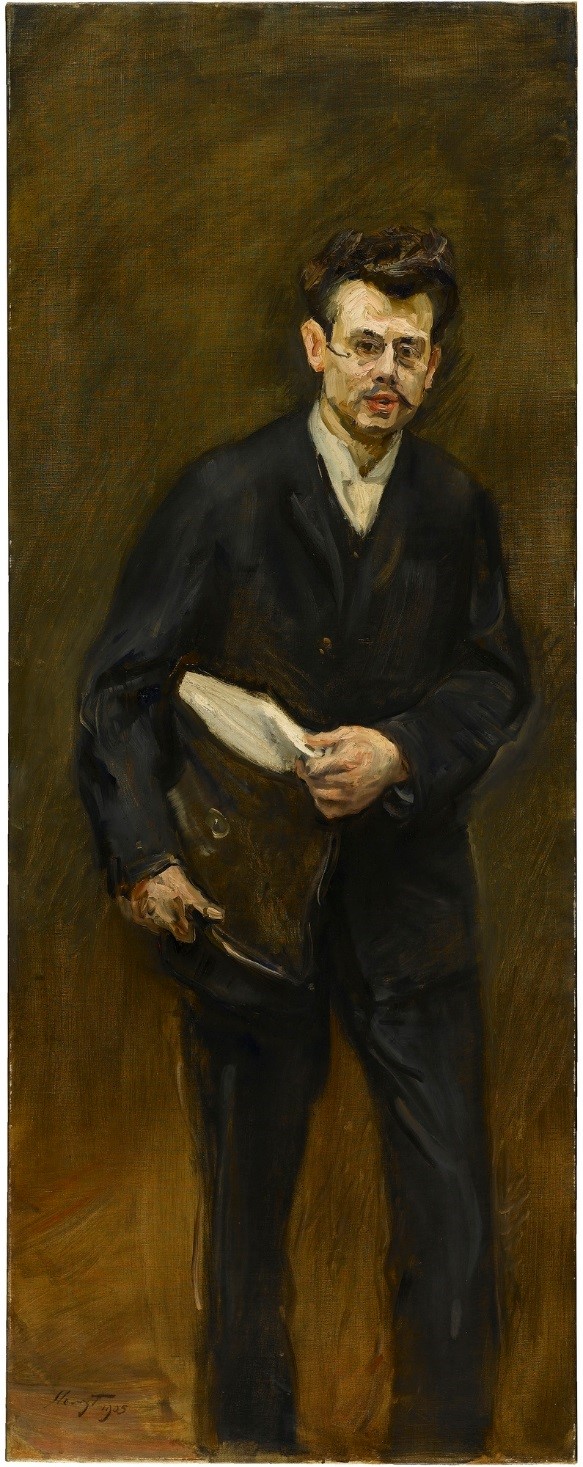

More than eight decades after Nazi persecution forced the dispersal of Eduard Fuchs’s art collection, Max Slevogt’s Paradiesvögel has been returned to Fuchs’s heirs. The Von der Heydt-Museum in Wuppertal acquired the painting in 2006 and began investigating its provenance after the family contacted the institution in 2020. The city council approved restitution in July 2026.
The return restores more than an object. It reconnects a painting with the history of a writer, cultural historian, collector and political opponent of National Socialism whose life and collection were broken apart by persecution.
A collector pushed into exile
Fuchs assembled paintings, drawings and caricatures and developed close connections with artists including Slevogt. His political commitments made him a target after the Nazi rise to power. He fled Germany in 1933 and lived in France, while his property and financial affairs remained subject to state control.
In 1937, Fuchs was compelled to sell works to meet the punitive Reich Flight Tax imposed on people leaving Germany. Paradiesvögel, painted in 1900, was auctioned in Berlin that June and acquired by the art dealer Hildebrand Gurlitt. Its route through later owners eventually brought it to the Wuppertal museum.
The history illustrates why provenance cannot be reduced to a clean list of transactions. A sale can appear formally documented while occurring under conditions that denied the owner meaningful choice. Research must ask not only who transferred an artwork, but what political, legal and financial pressure made the transfer possible.
Why a museum returns a work it bought
The museum purchased the painting through an auction house nearly seventy years after the forced sale. According to published reporting, it can no longer establish how thoroughly provenance was assessed before that acquisition. The heirs’ approach in 2020 prompted a wider investigation into the collection of Eduard and Margarete Fuchs.
Restitution acknowledges that present ownership cannot be separated from past injustice. It also shows the value of research that is willing to change a collection. A museum loses an object, but gains a more truthful account of how the object arrived and why its title was not secure.
Sale after restitution is restored agency
The heirs have consigned Paradiesvögel for auction on December 5, with a published estimate of €40,000 to €60,000. A post-restitution sale can appear to repeat the movement of the work through the market, but the ethical difference is decisive. The family now controls the choice.
Restitution does not require descendants to preserve a painting, place it in another museum or reconstruct the collector’s home. It returns the authority to decide—an authority that persecution removed. Where a family has many heirs, a sale may also be the most practical way to distribute value.
A biography carried by provenance
Fuchs died in Paris in 1940 and never returned to Germany. His wife, Margarete, later escaped to New York. Their collection was scattered, but provenance research continues to recover individual lines within that history. Another Slevogt work from the collection was returned by the Staatsgalerie Stuttgart in 2024.
Each restitution is necessarily specific: one object, one chain of ownership, one body of evidence. Together, these cases change how museums understand stewardship. A collection is not only what an institution holds. It is also the set of obligations created by how those objects moved—and the willingness to act when the record shows that possession came through persecution.