

The European Commission is inviting an artist into the machinery of climate policy. Shifting Shores: Life, Identity and Adaptation Where Land Meets Sea is a six-month residency focused on how coastal communities understand environmental change—and how artistic inquiry can contribute to restoration, resilience and adaptation.
The opportunity is hosted by the Commission’s Directorate-General for Research and Innovation and facilitated by the EU Policy Lab of the Joint Research Centre. Applications close October 24 at 23:59 Brussels time. The selected artist will receive a total budget of €15,000 covering fees, allowance, travel and accommodation, with up to twenty non-consecutive working days in Brussels and the remainder completed remotely.
Art inside the policy process
This is not a conventional residency built around uninterrupted studio time. The selected artist will work alongside teams concerned with nature-based solutions, climate adaptation, oceans and waters. The expected output is not prescribed as a single exhibition object. Instead, the program emphasizes research, exchange, work-in-progress presentations and a proposal for possible future work.
That structure signals a broader change in the relationship between art and environmental institutions. Artists are increasingly invited not only to communicate scientific findings after the fact, but to participate while problems are being framed. Their contribution may involve narrative, sensory knowledge, memory, community engagement or forms of attention that do not fit easily into technical indicators.
The call is open to artists of any nationality who are legally able to work in the European Union. Applicants must demonstrate at least two years of research-based practice connected to places, communities, scientists or institutions. Research-based, place-based, social, embodied and interdisciplinary methods are all explicitly welcomed.
What the selectors are seeking
The criteria reveal that a strong application will need more than an environmental theme. The selection committee is looking for a compelling line of inquiry, artistic quality, the ability to work with complex scientific and policy materials, sensitivity to the lived dimensions of climate change and experience collaborating across disciplines.
For applicants, specificity will matter. A proposal about “raising awareness” is unlikely to show how the artist will actually work inside the residency. A stronger statement might identify one coastal tension—managed retreat, changing fisheries, saltwater intrusion, disappearing landmarks or the emotional life of adaptation—and describe a method for listening, testing and making.
The application is deliberately compact: one combined PDF containing a statement of about 500 words, a portfolio of relevant work and a CV. Because the statement is limited to one page, every paragraph must carry evidence. Artists should connect past projects to the proposed inquiry, name the communities or forms of knowledge they hope to engage and explain what their practice can reveal that conventional policy analysis may overlook.
The image of a changing coast
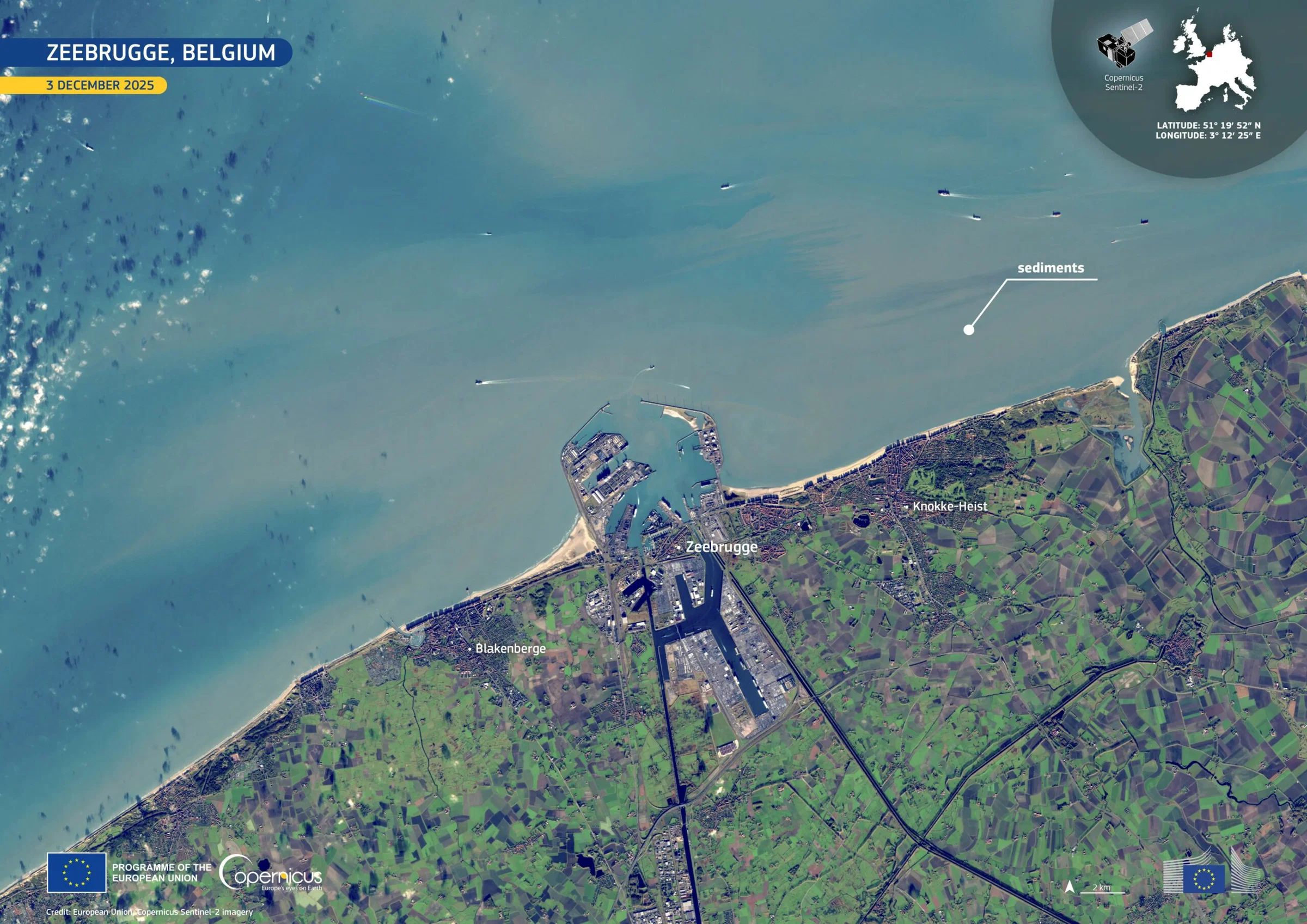
Coasts are often pictured as stable borders on a map. In reality, they are dynamic zones shaped by tides, sediment, infrastructure, livelihoods and climate. Satellite imagery of Zeebrugge, for example, makes suspended sediment visible as pale currents along the Belgian shoreline. The image is not simply beautiful. It shows that a coast is a process.
Artists working with environmental change face a similar challenge: how to make slow, dispersed or technically complex transformations perceptible without reducing them to spectacle. The residency’s attention to identity and adaptation expands the field beyond physical geography. A changing coast can alter language, ritual, labor, memory and a community’s sense of future.
A practical opportunity with a larger implication
The residency is scheduled to begin in January or February 2027. Shortlisted interviews are planned for November 11–13, with a final selection expected in mid-November. Informal sharing sessions will follow in spring, and a closing presentation is planned for June or July.
For environmental artists, the immediate value is clear: funded access to European research and policy teams. The larger implication is more significant. When institutions invite artists into the formation of climate policy, they acknowledge that adaptation is not only an engineering problem. It is also a cultural problem involving meaning, belonging and the stories people use to understand change.
That recognition does not guarantee influence. Artists should ask how their work will be documented, credited, retained and used after the residency. But it opens an important door: art can move from illustrating environmental policy to questioning how that policy sees the world.