
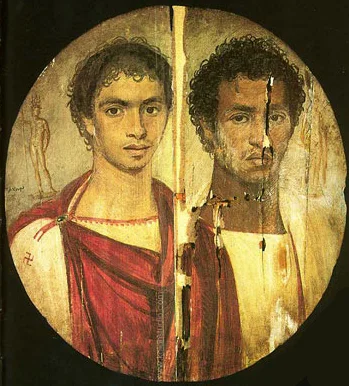

A painted face from Roman-era Egypt is preparing to travel after surviving nearly two millennia, termite damage and the fragility of a wooden support. Egypt has unveiled the restored Tondo of the Two Brothers, an exceptional second-century portrait that will join the first overseas loan of a major group of Fayoum mummy portraits.
The work is unusual before its conservation story even begins. Most Fayoum portraits depict a single person on a rectangular wooden panel and were placed over the face of the deceased within mummy wrappings. This portrait is circular and presents two young men together. Its format gives the encounter a rare intimacy: two individuals look outward from an object created for remembrance.
Three weeks of concentrated care
According to Egyptian officials, specialists from Rome worked with conservators at the Egyptian Museum in Tahrir for three weeks. The intervention had to address both termite damage in the panel and instability in the painted surface. Conservators recovered features of the brother on the right while preserving the work’s surviving material.
The project is significant because conservation here is not a cosmetic return to imagined perfection. It is a negotiation between visibility and survival. Every treatment must make the portrait safer to study and display without erasing the evidence of age, burial, damage and earlier care.
Egypt’s minister of tourism and antiquities presented the restoration as an example of international cooperation between Egyptian and Italian experts. That collaboration will continue through the portrait’s next chapter in Rome.
Faces crossing the Mediterranean
The Tondo will be part of The Power of the Portrait: Egypt and Rome, Faces of Fayum at the Ara Pacis Museum. The exhibition is scheduled from November 5, 2026, to May 2, 2027, and will bring together more than 110 objects, including painted panels, funerary shrouds, masks, sculpted portraits and jewelry.
For the Fayoum portraits, the journey carries unusual weight. These works emerged from a society in which Egyptian funerary practice met the visual languages of the wider Greco-Roman world. Their first major travel abroad therefore retraces the cultural exchange already embedded in their making.
Why an ancient portrait still feels immediate
The power of Fayoum portraiture lies partly in its refusal to remain remote. Hairstyles, jewelry and clothing locate the subjects historically, yet the faces feel observant and present. The Tondo of the Two Brothers intensifies that presence because the two figures share the frame. Their relationship is not explained; it is held in proximity.
For museums, the story demonstrates that a loan is never only a movement of objects. It requires conservation, condition documentation, transport planning, environmental controls, interpretation and trust between institutions. Those invisible systems make cultural exchange possible.
For audiences, the restoration offers something simpler and more profound: the chance to meet two people whose names are lost but whose faces endured. The portrait’s survival is extraordinary not because time left it untouched, but because generations of material, institutional and human care have allowed it to remain visible.