
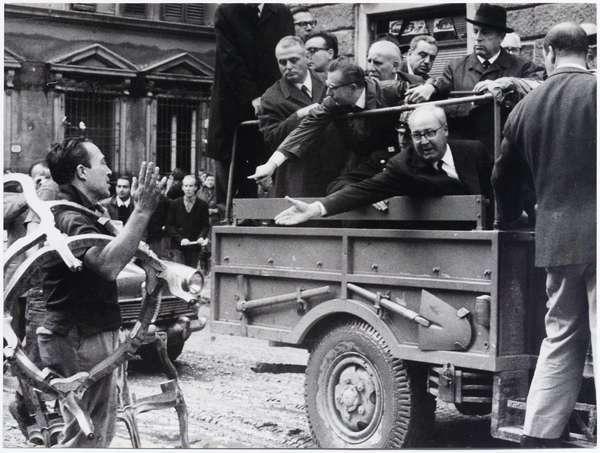

On November 4, 1966, the Arno rose through Florence with a force that carried mud, fuel and debris into streets, churches, libraries and museums. Among the works caught in the flood was a late-fourteenth-century triptych attributed to the Master of the Straus Madonna. Sixty years later, it has returned to public view.
The Galleria dell’Accademia di Firenze began displaying the painting on November 3, 2026, in its rooms devoted to late Gothic art. Normally kept in storage, the triptych appears with historical photographs documenting its damage and recovery. Its survival is both an artistic event and a record of the international conservation movement that formed around Florence after the disaster.
The water reached the oratory
Painted around 1380–1385, the triptych depicts the Madonna and Child with Saints Matthew and Michael the Archangel. It came from the church of San Michele Arcangelo at Nebbiano, near Certaldo, and entered the Florentine state collections in 1889. From 1912 it was held at the oratory of Santa Maria Vergine della Croce al Tempio.
That is where the flood found it. Water damaged the painted surface and the gilded ground, two layers whose delicacy makes their survival remarkable. The work was taken to emergency laboratories established at the Fortezza da Basso, where conservators confronted thousands of objects affected by water, oil, abrasion and unstable humidity.
The catastrophe changed conservation practice. Specialists, volunteers and institutions from many countries converged on Florence. The so-called mud angels lifted books, paintings and fragments from the sludge. Laboratories had to invent methods at the scale of an emergency, deciding what could be stabilized immediately and what would require years of treatment.
A rescue shown, then stored
After treatment, the triptych was included in the 1972 exhibition Firenze restaura, which presented works recovered from the flood and the methods developed to save them. It moved to the Galleria dell’Accademia in 2000 but remained out of regular view.
Its 2026 return accompanies Oltre l’emergenza, a study day organized by the Galleria dell’Accademia and the Bargello Museums on the flood’s sixtieth anniversary. The programme connects memory with present-day disaster planning. Palazzo Davanzati, which escaped the flood and became a refuge and restoration centre afterward, served as the meeting place.
The historical photographs are essential. Without them, the painting might appear simply as another devotional object from late medieval Florence. With them, every surviving passage of paint becomes evidence of decisions made under pressure: how to dry, clean, consolidate and document an object whose materials were changing by the hour.
Conservation is a chain of care
The story resists the fantasy of a single heroic restorer. An artwork survives catastrophe through a chain: the person who notices it, the hands that move it safely, the technicians who stabilize it, the institutions that keep records, the funders who sustain long treatment and the later conservators who continue to watch for change.
For artists, that chain begins in the studio. Clear material records, photographs of fronts and backs, installation instructions and emergency contacts can determine what is possible after damage. Experimental materials are not disqualified from conservation, but unidentified mixtures make every decision harder.
The triptych also carries a lesson for museums. Recovery does not end when an object is stable enough for storage. Public interpretation can return the history of care to the work, acknowledging the labour and knowledge that allowed it to remain.
Sixty years ago, the painting stood in the path of a river. Today it stands inside a museum not as an untouched survivor, but as something more honest: an object marked by disaster, science, patience and collective responsibility.