

In the cultivated landscape of London’s Regent’s Park, two works at Frieze Sculpture make industrial waste look uncannily alive. Douglas White’s seven-meter Black Palm rises from discarded truck tires and steel. Nearby, Catriona Robertson’s WYRM sends monumental worm-like forms through the ground, imagining organisms that have evolved to consume the debris of industry.
The 2026 edition of Frieze Sculpture brings together 11 international artists and remains free to visit through November 1. Its official theme is hybridity, but White and Robertson make that idea materially ecological: nature and waste do not sit on opposite sides of the park. They mutate into one another.
A palm made from the afterlife of rubber
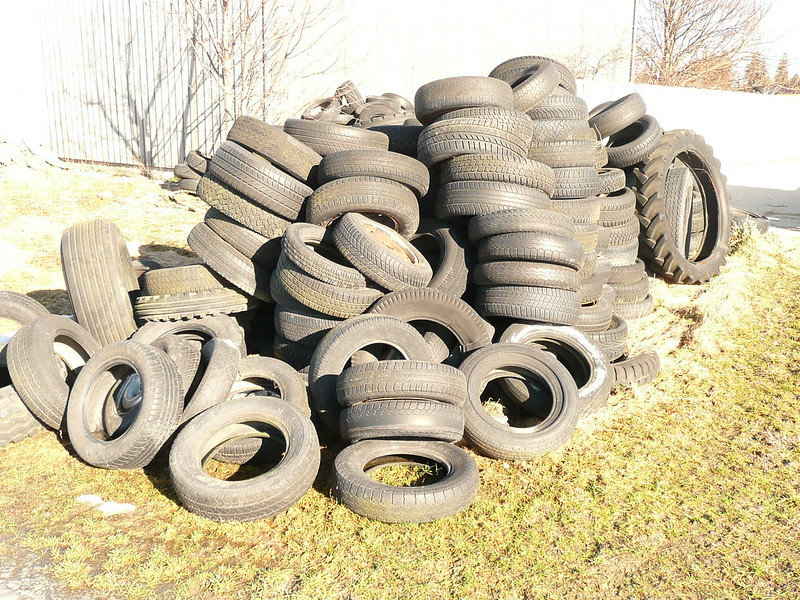
White began the line of inquiry behind Black Palm during a residency in Belize, where burst truck tires along highways initially resembled dead birds or organic remains. For the Regent’s Park sculpture, discarded tires become the dark fronds of a palm—an image that links plantation history, global transport, labor, and the transformation of rubber into a traded industrial material.
The setting sharpens the work. A carefully maintained English garden supplies the living counterpart to a tree made from mobility’s refuse. The sculpture does not hide the tire’s treads or weight. Its environmental meaning depends on the material remaining recognizable.
Waste as a future fossil
Robertson’s WYRM uses papercrete, a combination of concrete and recycled newspaper pulp. The forms resemble excavated fossils or enormous creatures passing beneath the lawn. They imagine a future ecology in which organisms adapt to consume industrial waste.
That premise is deliberately uncomfortable. Evolution cannot be treated as a convenient waste-management service, and the work does not promise that nature will repair everything people discard. Instead, it asks what today’s materials might look like when read as the geological evidence of a civilization.
What artists can take from the works
Both sculptures show that reused material is strongest when it does more than signal virtue. Tires are not merely an eco-friendly substitute for bronze; they carry histories of extraction, trade, transportation, breakdown, and disposal. Papercrete is not only recycled content; its strange surface helps Robertson construct a speculative archaeology.
For artists working with waste, the practical challenge is to preserve that conceptual specificity while addressing structure, toxicity, weathering, transport, and eventual disposal. Material provenance should be documented as carefully as exhibition provenance. Where did the material come from? What treatment makes it safe? Can components be repaired, separated, or reused after the exhibition?
Public presentation adds another layer. These works operate without an admission barrier and meet audiences in daily movement through the park. That visibility can make ecological art more accessible, but it also demands clear interpretation: viewers need enough context to understand why a familiar waste material has been given monumental form.
From object to material argument
Black Palm and WYRM are not illustrations of environmental data. They work through scale, texture, recognition, and unease. Each transforms waste without allowing it to disappear.
That may be their most useful contribution. Sustainable art practice is not only about reducing impact behind the scenes. It can also make the material systems of contemporary life visible—turning what society throws away into a form large enough to confront in public.