
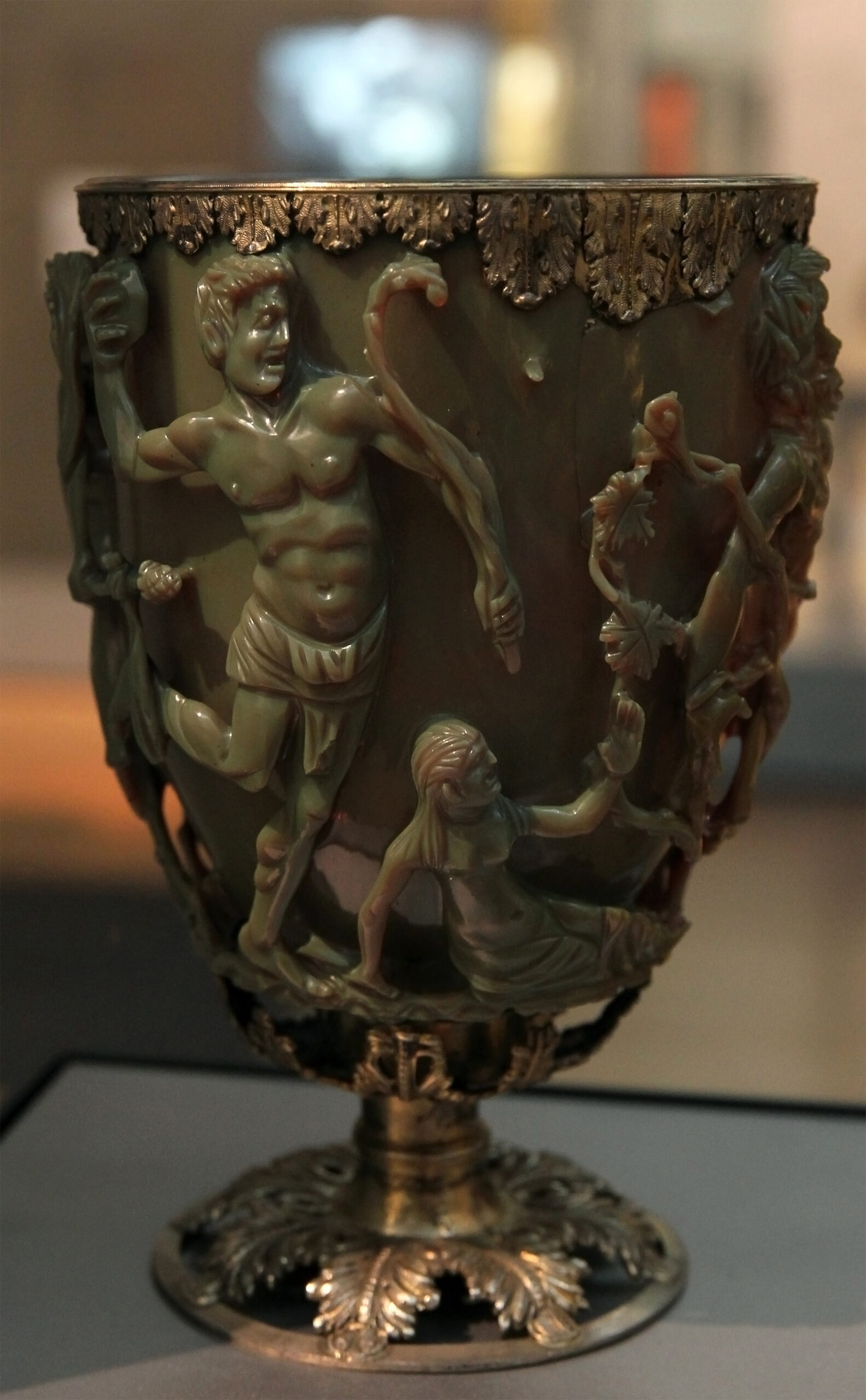

For more than 1,600 years, the Lycurgus Cup has changed color with the light. Seen from the front it appears green; illuminated from behind, it glows red. The Roman glass object has become famous as an ancient demonstration of nanoscale effects—without a reproducible workshop recipe to explain how its makers achieved them.
Now Dr. Lisa Hollands, a glass technician at the University of Sheffield, has recreated the effect in a stable glass formula that can be produced in quantity. The achievement joins experimental science to the knowledge of a maker who has spent 25 years working with glass.
A mystery measured in particles
The cup’s dichroism comes from tiny amounts of gold and silver dispersed through the glass. Those particles interact with light differently depending on whether it is reflected or transmitted. The scientific principle is understood; reproducing the material reliably has been the harder problem.
Hollands worked from an analysis of a Roman glass fragment and tested the relationship between recipe, heat and particle behavior. The result is a contemporary glass that can shift from green to red rather than a one-off laboratory sample.
That distinction matters. A material becomes creatively useful when it can survive the demands of making: melting, shaping, cooling, repetition and collaboration. The breakthrough is therefore not only identifying what ancient glass contains, but translating that knowledge into a process another artist can use.
Craft knowledge meets laboratory evidence
Stories about ancient technology often divide people into two camps: mysterious artisans in the past and analytical scientists in the present. This recreation shows a more interesting continuity. Observation, trial, controlled heat and attention to material behavior belong to both craft and science.
A glassmaker notices viscosity, color, timing and the response of a batch to the furnace. A materials researcher measures composition and particle scale. The strongest reconstruction needs both forms of knowledge. Hollands’s long technical experience is not an accessory to the scientific result; it is part of how the formula became workable.
The project also demonstrates why universities need highly skilled technicians. Research breakthroughs are often narrated through principal investigators and institutions, while the people who know how to prepare, repair and manipulate materials remain less visible. Here, the named maker is central to the discovery.
An ancient effect returns to art
The recreated glass has already moved into contemporary practice. Artist Elliot Walker used it to make a sculpture that will be presented during Sheffield’s Festival of the Mind in November before a planned display at the Turner Museum of Glass.
That step keeps the project from becoming a historical imitation. The goal is not to manufacture replicas of the Lycurgus Cup, but to recover a material possibility and place it in the hands of living artists. A color change once confined to one celebrated object can become part of a new visual language.
For artists, the story offers a model of research that respects uncertainty. The Roman makers left no surviving manual that explains their intention. It remains possible that the effect emerged through accumulated workshop practice rather than a modern understanding of nanoparticles. Reproduction does not grant access to every ancient decision.
The secret was a process
The phrase “lost secret” suggests a single missing ingredient. The Sheffield result points to something richer: material knowledge lives in proportions, temperatures, sequences, tools and trained judgment. Lose the process and the ingredients alone are not enough.
Recreating the glass restores more than an optical effect. It creates a bridge between an anonymous Roman workshop, a modern technician, scientific analysis and a contemporary sculptor. When the new work changes color in the light, it will not close the mystery of the Lycurgus Cup. It will show that the oldest technologies can still generate new art.