
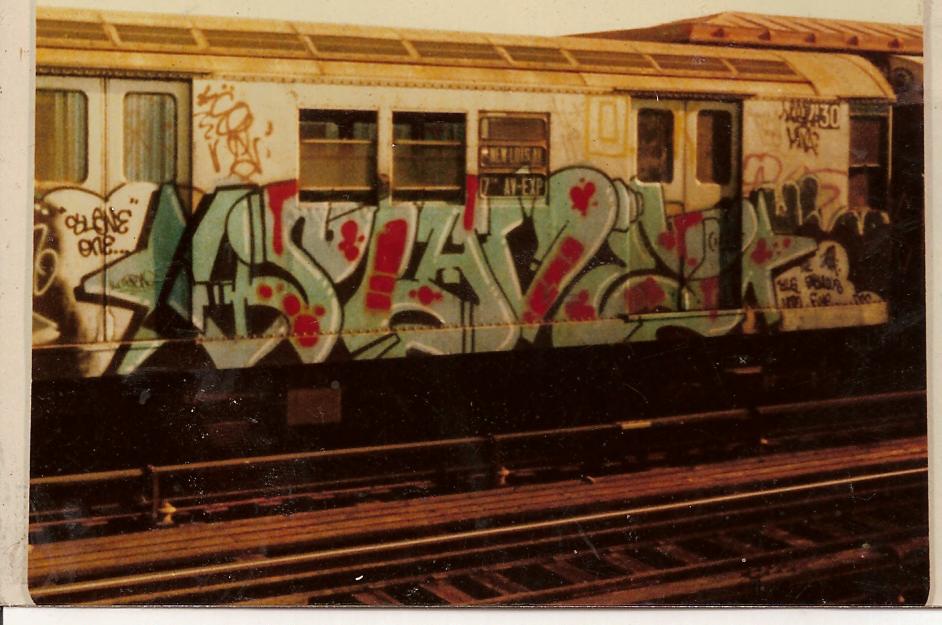

Henry Chalfant understood that a moving artwork could disappear twice: first beneath a coat of paint, then from cultural memory. Beginning in the late 1970s, he waited beside elevated subway lines in New York and photographed painted train cars in carefully sequenced frames. The archive he built preserved an art form that transit authorities were determined to erase.
That archive is now the heart of ART IS NOT A CRIME. Henry Chalfant: Capturing graffiti culture, NYC, 1977–1987 at STRAAT Museum in Amsterdam. The exhibition runs through March 13, 2027 and is the first major retrospective in the Netherlands to approach graffiti through Chalfant’s documentary core.
From passing trains to a global visual language
Chalfant began his New York career as a sculptor. Daily subway rides introduced him to painted trains moving between neighborhoods, carrying names, styles, rivalries, and invention across the city. He turned to photography and film, not as a detached critic, but as an engaged outsider who earned the trust of the writers whose work he recorded.
The resulting archive contains more than 800 photographs of painted subway trains, along with portraits and films documenting the community around early graffiti and hip-hop. His collaborative documentary Style Wars, made with Tony Silver in 1983, and the 1984 book Subway Art, made with Martha Cooper, gave audiences far beyond New York a visual vocabulary for a culture still treated as criminal damage by many institutions.
Amsterdam closes a historical circle
The location is not incidental. In 1984, Chalfant showed photographs at Yaki Kornblit’s gallery in Amsterdam. Images of that exhibition were copied and circulated among young people, helping transmit New York graffiti styles through Dutch and European networks.
More than four decades later, the complete archive returns on a museum scale. Some subway photographs are reproduced at the dimensions of the trains themselves—more than three meters high and, in some cases, 25 meters long. The enlargement restores the bodily encounter that a small print cannot: viewers face the painted car as an environment rather than an illustration.
The ethics of saving an ephemeral culture
Chalfant’s story is extraordinary because preservation did not begin after institutional recognition. It began while the work was vulnerable, mobile, stigmatized, and temporary. He recognized historical value before the museum system did.
That example carries a practical lesson for artists working in performance, public space, digital media, protest, community practice, or other forms that may vanish. Documentation is not a secondary administrative task. It can be the only future access point to the work. Dates, locations, names, permissions, context, sequence, and the voices of participants matter as much as the image.
The lesson also comes with responsibility. An archive of a community is not simply a stockpile of pictures. Trust, accurate credit, and the difference between witnessing and extraction shape its legitimacy. STRAAT describes Chalfant’s photographs as anthropological testimony from within—a recognition that the relationships behind the images are part of their meaning.
What survives when the surface is gone
The painted trains that Chalfant photographed were cleaned, repainted, retired, or destroyed. Their physical disappearance did not end their influence. Through a patient archive, they became part of a global history of art made outside permission.
The Amsterdam exhibition makes that survival visible. It is a story about one photographer, but also about thousands of fleeting acts of authorship and the communities that carried them forward. Chalfant did not prevent the trains from vanishing. He ensured that disappearance would not be the final word.