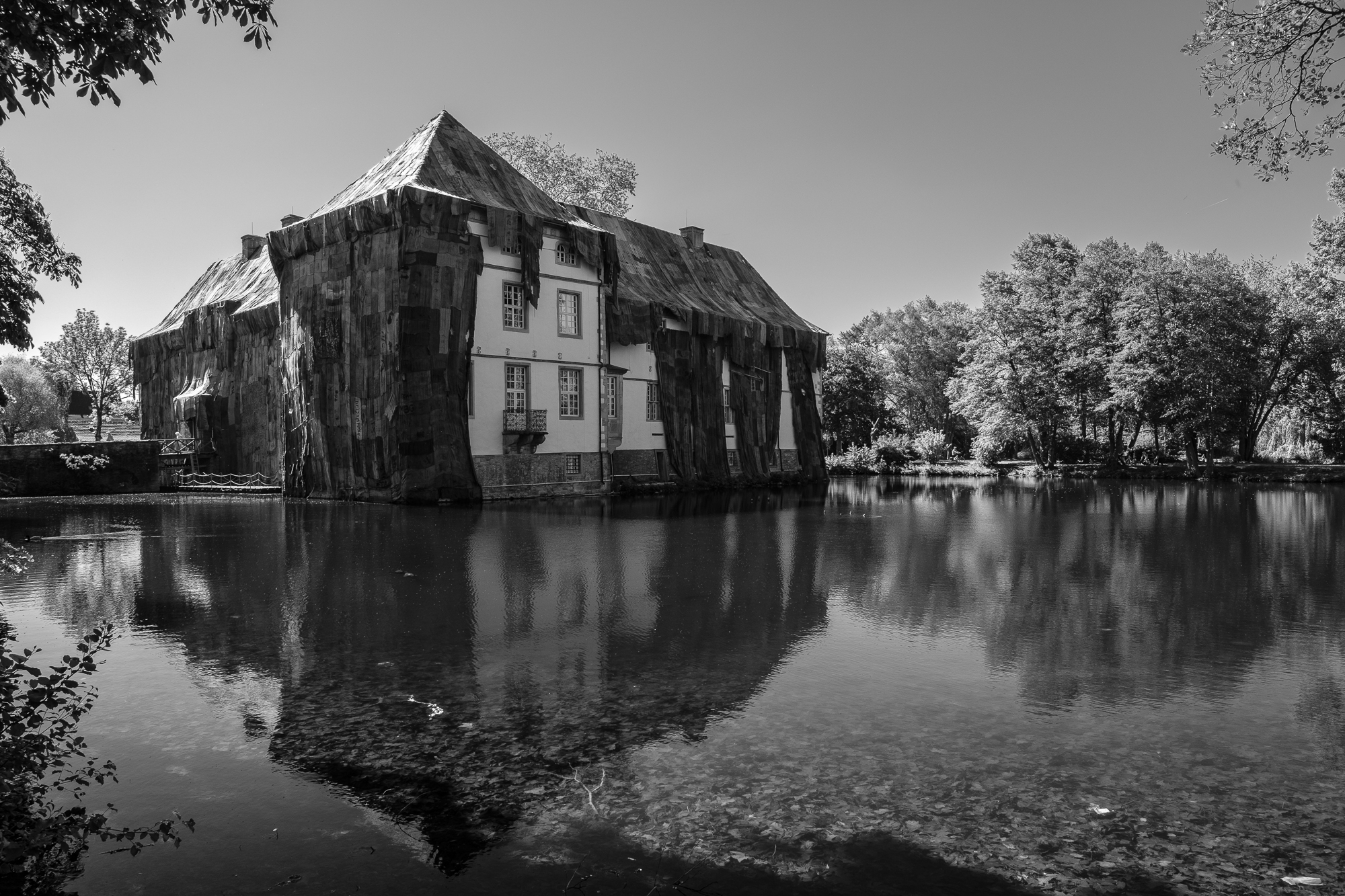

Ibrahim Mahama has filled the Fondation Cartier’s new Paris home with a proposition larger than a solo exhibition. The Harvest Season, open from October 22, 2026, through February 28, 2027, brings his monumental installations into dialogue with nine artists and collectives whose work is connected to his own through teaching, research, friendship and shared political questions.
The choice of title is telling. Mahama’s practice returns to discarded materials and interrupted histories, not to polish them into nostalgia but to ask what unused futures might still be gathered from them. Rough jute sacks, industrial fragments, railway histories, archives and architectural remains become records of labor and exchange.
The material carries the journey
Mahama is widely known for textiles assembled from used burlap sacks. Produced in South Asia and circulated through Ghana’s cocoa trade before reaching Europe, the bags bear stains, repairs and markings from their working lives. In the Fondation Cartier’s galleries, that material is not a neutral surface. It makes commerce, touch and unequal movement visible.
The exhibition occupies the institution’s Jean Nouvel-designed space near the Palais-Royal. It includes a new version of Parliament of Ghosts, with empty seats that evoke political structures and abandoned civic promises, as well as Things Fall Apart, built from elements connected to Ghana’s Aboso Glass Factory.
Mahama learned that the factory, opened in 1966 shortly before Kwame Nkrumah was overthrown, was headed for scrapping. The artist acquired it, treating the industrial site as both archive and potential public space. Part of its structure has been reconstructed in Paris, surrounded by wooden crates and thousands of green bottles. The work connects a failed industrial promise to the possibility of a different cultural afterlife.
A solo show that refuses to stand alone
The invited participants are not presented as decorative context. They make the exhibition’s argument about collective authorship concrete. Among them are artist and educator Dorothy Akpene Amenuke, photographer James Barnor, artist Gideon Appah, and the Cercle d’Art des Travailleurs de Plantation Congolaise. Their presence turns the museum into a meeting place between distinct practices rather than a monument to one name.
That structure echoes the three art centers Mahama has established in Tamale, northern Ghana, since 2019. Conceived for creation, learning and transmission, those centers redirect some of the value generated by an international art career into local cultural infrastructure. The Fondation Cartier describes the Paris exhibition as a living entity in conversation with that network.
What artists can take from the harvest
Mahama’s model does not offer an easy template. Few artists have the resources to acquire a factory or build institutions. The transferable lesson lies elsewhere: materials can preserve social memory, and professional visibility can be used to widen the field around a practice.
In The Harvest Season, scale is not only physical. It is measured in the number of histories allowed into the room, the relationships acknowledged, and the future uses imagined for things that an economy had declared exhausted. The work asks viewers to see reuse not as salvage alone, but as a form of cultural planning.