
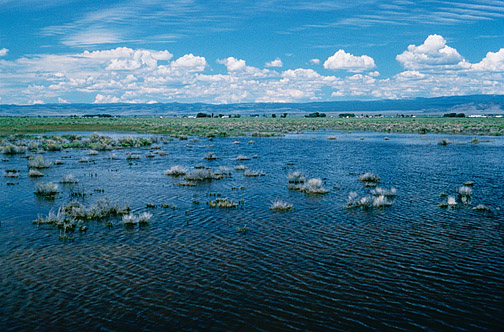

In the lobby of the Museum of Modern Art, a wetland that no longer exists in its original form continues to sing. Jakob Kudsk Steensen’s Berl-Berl, presented in Wetland, rebuilds Berlin’s lost swamp ecology through field recordings, 3D scans, macro photography, game-engine technology, folklore and music.
The work does not offer a clean digital substitute for a damaged landscape. It asks what a virtual environment can preserve, what it inevitably transforms, and whether immersion can deepen attention to a place beyond the screen.
A city remembers the swamp beneath it
The title Berl-Berl comes from a Slavic word for swamp that is connected to the name Berlin. Kudsk Steensen developed the work through months of fieldwork in the city’s remaining wetlands, collaboration with the Museum für Naturkunde Berlin and music created with Arca.
Local rocks, plants and animals were scanned and translated into the work’s visual world. Field recordings became rhythm and song. Sorbian and Slavic mythologies entered alongside scientific specimens and linguistic history. The result is not a neutral model of an ecosystem; it is a layered archive of ecology and culture.
That combination matters because wetlands are often treated as empty land waiting to be drained or built over. In reality, they regulate water, store carbon and sustain dense networks of life. They also hold names, stories and forms of knowledge. Ecological loss can therefore erase language and memory as well as habitat.
Technology as a connector, not a replacement
Kudsk Steensen has described technology as a connector. In Berl-Berl, it joins field observation to an environment that changes as visitors encounter it. Game-engine technology allows the landscape to unfold rather than repeat like a fixed film.
But digital reconstruction carries a tension. A museum can surround visitors with luminous water, roots and sound while the actual wetland remains outside, vulnerable to development and climate change. The work is strongest when that gap remains visible. Immersion should send attention back toward living systems, not suggest that data can replace them.
For artists working with ecological material, Wetland offers a demanding model of research. The project begins with repeated presence in a place, then builds collaboration across science, music, oral history and digital production. Technology arrives after attention.
An archive that behaves like an ecosystem
Traditional archives divide objects into stable categories. A wetland resists that logic: water level, season, species and human use continually change one another. By using a real-time simulation, Kudsk Steensen creates an archive that behaves less like a cabinet and more like a system.
That approach can expand what documentation means for environmental artists. A record may include scans, sounds, weather, interviews, local names and the conditions under which material was gathered. It should also record permissions and acknowledge who contributed knowledge.
Jakob Kudsk Steensen: Wetland is on view at the Museum of Modern Art through March 7, 2027. Its ecological argument is quiet but persistent: a lost landscape cannot be restored by representation alone, yet representation can help a public recognize what was there—and what remains at stake.