
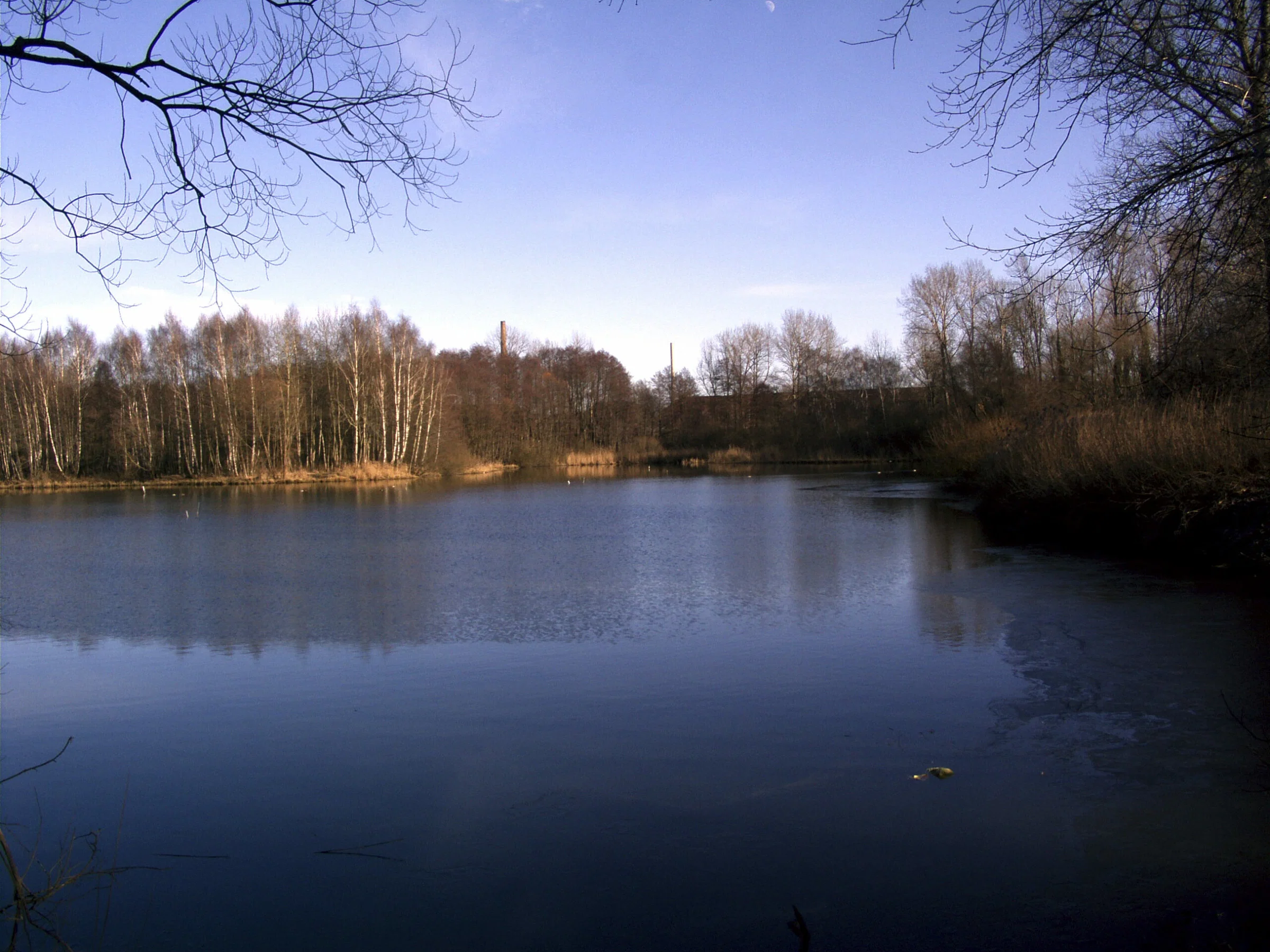

Before Berlin was streets, rail lines and stone, much of its ground was wet. In Jakob Kudsk Steensen: Wetland at the Museum of Modern Art, that submerged history returns as a singing digital swamp.
The presentation centers on Berl-Berl, an evolving virtual world whose title comes from a Slavic word for swamp associated with the name Berlin. Steensen built the work through months of field research in the region’s remaining wetlands, collaboration with the Museum für Naturkunde Berlin, archival study of Sorbian and Slavic mythology, and recordings of rocks, plants, water and animal life. The musician Arca contributes vocalization; field sounds are transformed into rhythm and song.
MoMA places the installation in the Agnes Gund Garden Lobby, where a simulated ecosystem meets one of modernism’s defining institutions. The encounter asks a deceptively simple question: can digital technology help people attend more closely to an environment that urban development has pushed out of sight?
A landscape assembled from evidence
Steensen works with tools often associated with visualization and games—macro photogrammetry, three-dimensional scanning, spatial sound and real-time world building. Their purpose here is not to produce a frictionless copy of nature. A wetland cannot be transferred intact into a museum. Its water cycles, organisms, seasons and local relationships exceed the screen.
Instead, the artist treats digital construction as a form of ecological interpretation. A scanned plant, a field recording and a fragment of folklore occupy the same environment without becoming the same kind of evidence. Scientific observation and cultural memory remain distinct, but they can inform one another.
That method is especially suited to wetlands. Long dismissed as wasteland or obstacle, wetlands are among the most dynamic interfaces between land and water. Their boundaries change; they store and release water; they sustain dense networks of life. A real-time digital system can echo that instability more persuasively than a fixed image, even while remaining an artwork rather than an ecological model.
The sound of navigating a swamp
MoMA notes that the project draws on songs once used to navigate terrain and carry stories. In Berl-Berl, song is not merely atmosphere. It recalls a way of knowing place through voice, repetition and shared memory.
The installation therefore resists the familiar division between environmental data and human culture. A wetland is physical habitat, but it is also language, use, fear, myth and memory. When a city drains or buries such a landscape, it can lose both an ecosystem and the forms of attention that grew around it.
Steensen’s reconstruction does not claim to restore Berlin’s wetlands. It offers a different kind of return: an encounter with what remains, what has been recorded and what imagination can make perceptible.
What digital ecology can—and cannot—do
Immersive environmental art sometimes risks turning threatened places into beautiful experiences detached from material action. Wetland is strongest when its technical wonder leads back to the fieldwork beneath it. The scans depend on living specimens. The sounds come from particular sites. The mythological research belongs to particular languages and histories.
For artists working with ecological subjects, the project offers a useful model: technology can be a connector when it remains accountable to place, collaborators and sources. The digital image does not replace the wetland; it can reveal how much has been lost and how much knowledge survives.
The work also complicates the idea of an archive. Archives are often imagined as rooms of stable records, but ecosystems produce change rather than permanence. A real-time virtual environment can preserve traces while allowing them to recombine. It becomes an archive that behaves more like weather than a filing cabinet.
Berlin’s buried marshes will not reappear because a museum visitor enters a digital swamp in New York. Yet attention is not nothing. By making the city’s ecological past audible and strange, Steensen opens a space in which urban ground can be understood as habitat rather than blank foundation.
Jakob Kudsk Steensen: Wetland is presented by the Museum of Modern Art in New York through March 7, 2027.