
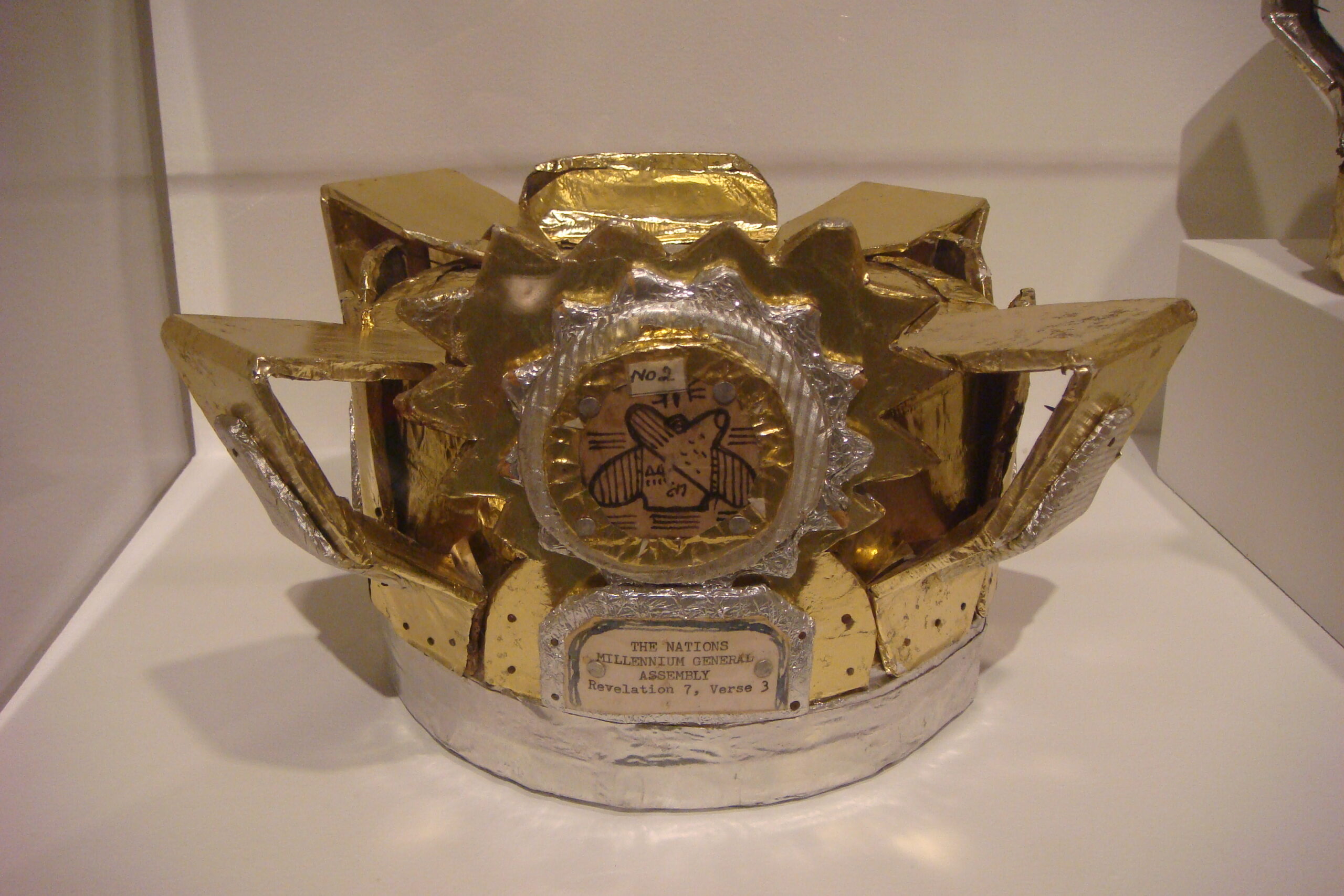

Each night, after completing his work as a federal janitor, James Hampton entered a rented garage in northwest Washington and continued building heaven. He wrapped discarded furniture, light bulbs, cardboard, jars and cans in gold and silver foil until ordinary refuse became an environment of radiance.
He called it The Throne of the Third Heaven of the Nations’ Millennium General Assembly. The installation was largely unknown during his lifetime and discovered after his death in 1964. Today it stands in the Smithsonian American Art Museum, one of the most extraordinary monuments of self-directed American art.
A private work grew to architectural scale
Hampton was born in Elloree, South Carolina, in 1909 and moved to Washington at nineteen. During World War II he served with a segregated aviation unit maintaining airstrips in the Pacific. He returned to the capital in 1945 and began work for the General Services Administration the next year.
Around 1950, he rented the garage where the Throne took shape. He worked late, often beginning at midnight after his shift. Over roughly fourteen years, the project grew to approximately 180 components: altars, crowns, pulpits, offering tables, winged forms and symmetrical ranks of shining structures.
Hampton did not need precious material to make an object of radiance; he needed devotion, repetition and time.
Metallic foil gives the ensemble visual unity, but look beneath the shimmer and the city’s material life remains present. Used furniture, blotters, desk supplies, plastic, paper and containers carry histories of work and disposal. Transformation does not erase humble origin; it makes that origin part of the miracle.
Faith supplied a complete visual system
Hampton was raised Baptist but attended different churches and resisted the idea of a denominational God. According to Smithsonian research, he understood religious visions as the source of his calling and linked the Throne to the Second Coming described in Revelation.
The installation divides imagery associated with the Old and New Testaments across its balanced arrangement. Above the central throne, the words “Fear Not” offer reassurance. Crowns, wings and reflective surfaces turn biblical expectation into a space the body can enter with the eyes.
He also produced a notebook titled The Book of the 7 Dispensation, filled with a script that remains largely undeciphered. Its existence warns against pretending we can completely explain the artist. Hampton left evidence of an elaborate personal theology, but not a tidy interpretation for museums to finish.
Discovery changed the history of the work
Hampton died before completing the Throne. His landlord entered the garage seeking overdue rent and found the installation. What had been a private sacred project suddenly required decisions about preservation, ownership and public meaning.
The work eventually entered the collection now known as the Smithsonian American Art Museum. In a museum, visitors may approach it as sculpture, religious environment, vernacular architecture or visionary art. None of those categories fully contains it.
The familiar outline of Hampton’s story—the janitor secretly making a masterpiece—can become romantic if it causes us to ignore labor. He was not magically discovered in one instant. He made choices across thousands of nights: finding material, cutting, fastening, balancing, repeating and revising. His federal job and artistic work occupied the same life.
Conservation now extends that labor. Foil, paper, wood and repurposed objects age differently, and the reflective surface that defines the experience is physically fragile. Museum care must preserve Hampton’s transformations without making improvised material appear industrially perfect. Every repair is therefore also an interpretation.
Nor should limited biographical documentation be mistaken for an empty biography. Hampton lived within segregated institutions, wartime service, Black religious culture and a changing Washington. The Throne is personal, but it was never made outside history.
Stand before it and notice how inexpensive foil converts museum light into atmosphere. Symmetry creates ceremony; repeated wings create movement; familiar chairs become seats of revelation. The materials remain breakable and the vision remains immense.
Read the labels, but allow silence before interpretation. Reflective surfaces gather other visitors into the work, briefly placing an ordinary museum crowd inside Hampton’s imagined assembly.
James Hampton’s extraordinary story is not simply that a hidden work was found. It is that one person sustained a world without public applause, using what was available until a garage could hold a heaven beyond heaven.