
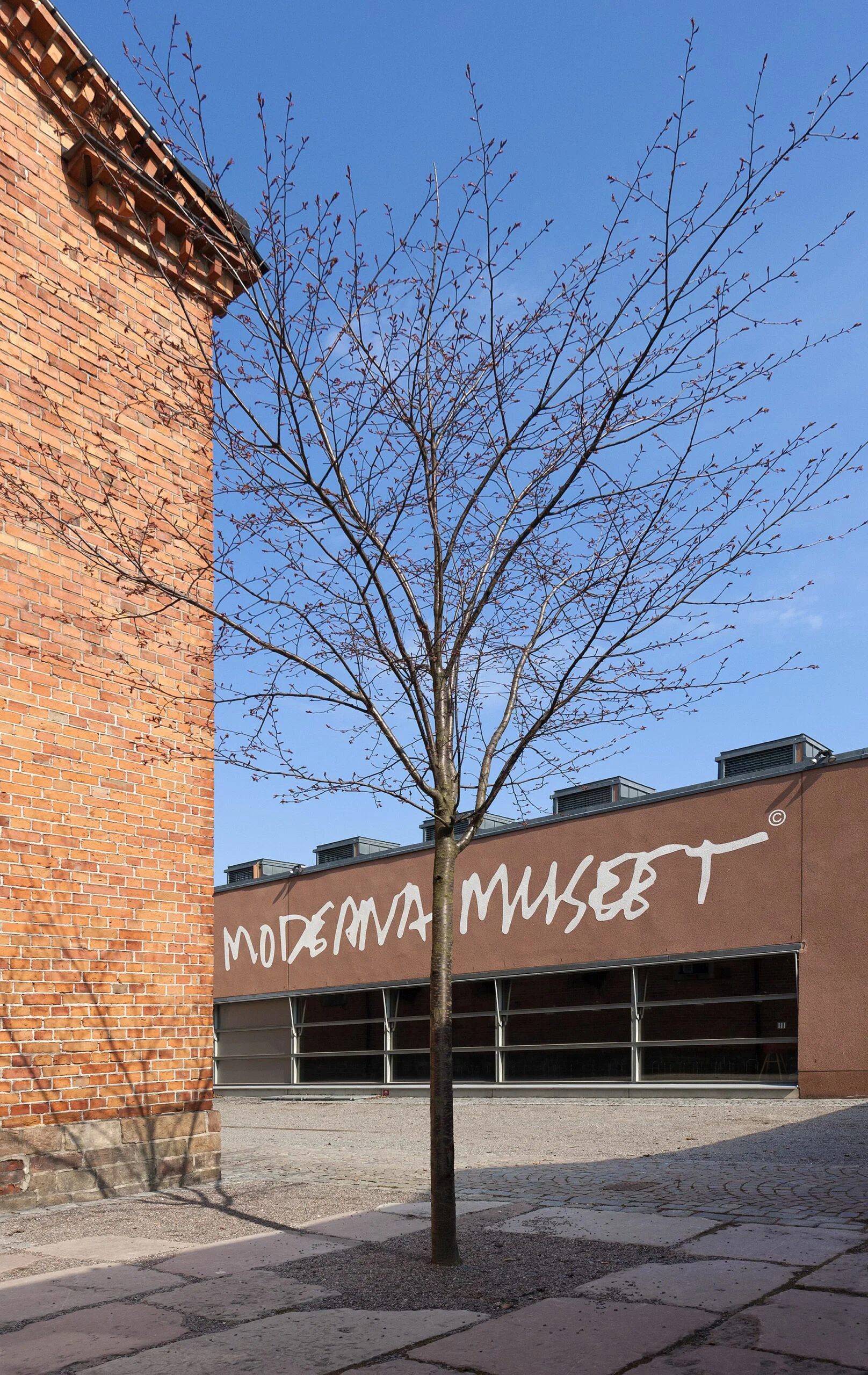

At Stockholm’s Moderna Museet, a major new exhibition begins not with a retrospective timeline but with the living disorder of an artist’s studio. Jan Håfström: The Lost World, which opened October 17, brings recent paintings, sculptures and painted objects together in clusters that preserve the sense of works being tested, revised and allowed to speak across time.
Håfström, born in 1937, has worked for six decades across painting, sculpture, printmaking, film and criticism. He is one of the central figures of Swedish contemporary art, yet the exhibition resists the ceremonial finality that can accompany a late-career survey. Its focus is present-tense work: objects arriving directly from the studio and memories continuing to change form.
The studio as subject
Curated by Matilda Olof-Ors, the exhibition takes Håfström’s daily studio practice as both method and structure. On the walls and floor of his workspace, works from different periods meet in provisional arrangements. Those encounters are not merely storage. They allow images, characters and materials to return with altered meanings.
Moderna Museet describes the studio as a sanctuary that Håfström has sought since childhood. That idea gives the exhibition its emotional architecture. The studio is a protected space, but it is not sealed from history. Personal recollection, popular culture and collective unease move through it continuously.
The title refers to Arthur Conan Doyle’s 1912 novel The Lost World, in which an expedition reaches a place where different eras appear to coexist. Håfström uses the reference less as fantasy than as a model for memory. The past does not disappear; it survives in fragments, returning beside the present.
Recurring figures, changing meanings
Throughout his career, Håfström has drawn from comics and adventure literature, including the Phantom and the character’s civilian identity, Mr. Walker. In his hands, these figures do not remain uncomplicated heroes. They become vehicles for examining masculinity, isolation, colonial imagination and the distance between observer and participant.
That strategy is characteristic of an artist who has moved between abstraction and figuration without treating either as a fixed allegiance. A borrowed image may carry childhood fascination, adult skepticism and political history at the same time. Repetition therefore becomes investigation rather than branding.
The exhibition’s clusters make that process visible. Paintings and objects are not arranged to prove a linear progression from early to late. They create constellations in which a motif can vanish, reappear and contradict its earlier use.
Why this exhibition matters now
Many museums organize artists’ careers as finished narratives, especially when presenting work made across several decades. The Lost World offers another model: longevity as an active studio condition. The artist is not asked to summarize himself. He is shown continuing to work through unresolved material.
For artists, the exhibition provides a valuable counterpoint to the pressure for constant novelty. A practice can remain alive by returning to a limited set of images and questions, provided each return changes the relationship among them. Continuity is not the absence of risk; it can be a deeper form of risk, because the artist must confront earlier decisions rather than abandon them.
The installation also restores value to provisionality. Digital presentation often rewards the isolated, finished image. A studio reveals something else: scale tests, physical adjacency, unfinished edges and objects that gather meaning simply by remaining near one another. Museums rarely allow audiences to see this part of artistic thinking without turning it into a theatrical reconstruction. Here, the exhibition’s structure grows from the artist’s actual working logic.
A career that remains open
The Lost World runs through March 14, 2027. Its most consequential gesture is to refuse the idea that a sixty-year career must arrive as a monument to the past.
Håfström’s world is “lost” only in the sense that it cannot be recovered unchanged. In the studio, memory is material: it can be moved, repainted, placed beside something new and made to speak again.