
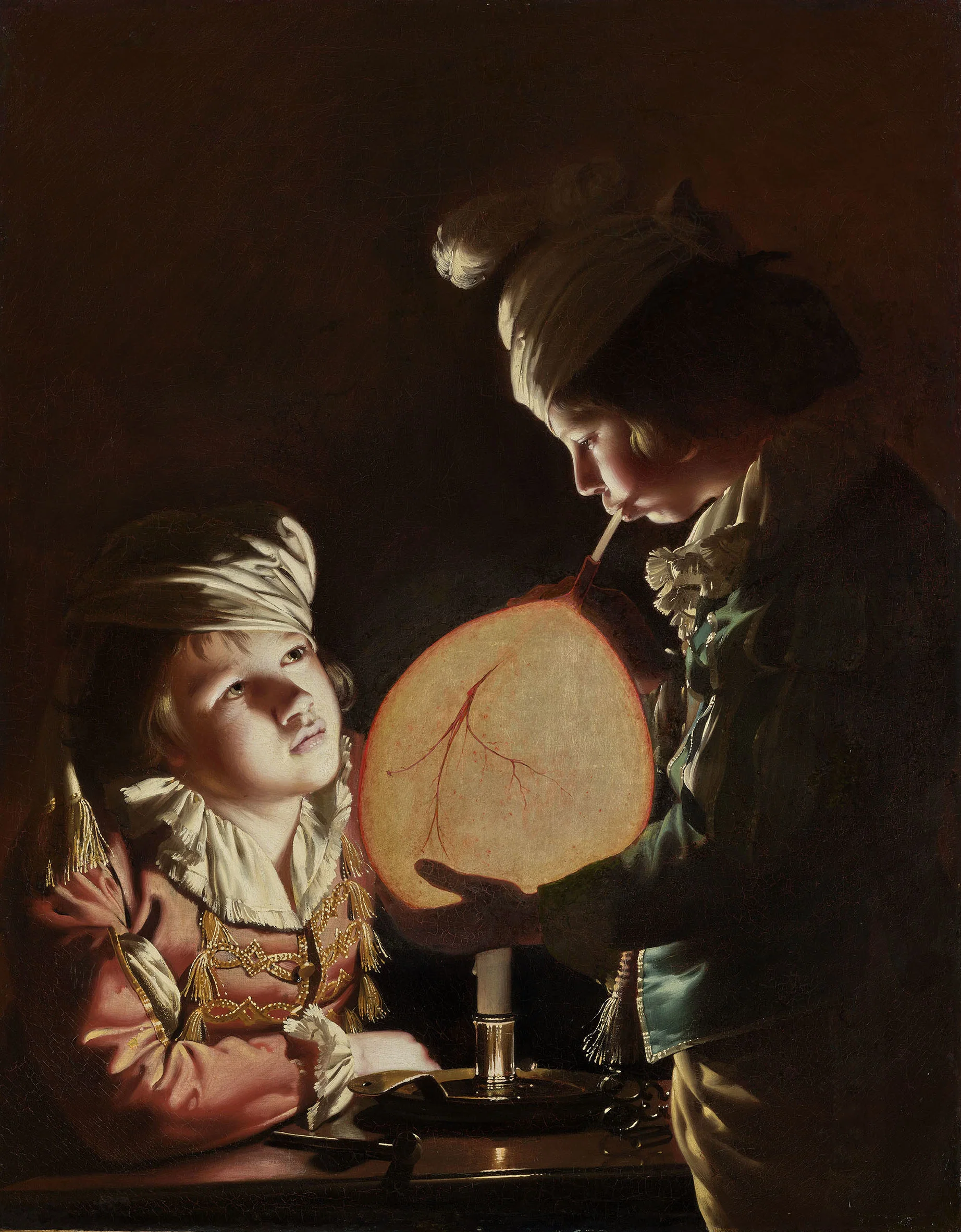

Joseph Wright of Derby painted darkness as if it were a stage and light as if it were an event. More than 250 years later, conservators have found that some of that radiance was not created with paint alone. Beneath translucent color, Wright placed sheets of high-purity silver leaf.
The discovery is central to A Light in the Dark: Joseph Wright of Derby, opening November 24 at the J. Paul Getty Museum. The exhibition reunites early candlelight paintings and presents the results of a multi-year international technical study sparked by the reappearance of Two Boys with a Bladder, a work long considered lost before the Getty acquired it in 2020.
A picture returns and changes the chronology
Two Boys with a Bladder had spent centuries outside public view. Its return allowed curators to reconsider the sequence in which Wright developed his celebrated nocturnal scenes. Research now identifies the painting as a work exhibited in London in 1767, alongside its companion, Two Girls Dressing a Kitten by Candlelight.
At the Getty, the two will be shown together for the first time since 1772. That reunion is more than visual. Technical analysis indicates that both are the earliest documented examples of Wright’s silver-leaf method.
The story has the shape of an art-historical mystery: a missing painting resurfaces, alters a timeline and leads investigators to a material hiding in plain sight. Yet the solution did not come from connoisseurship alone. It required conservation science capable of mapping elements beneath the painted surface.
Silver under the glow
The Getty-led team studied thirteen candlelight paintings using infrared reflectography, X-radiography, X-ray fluorescence mapping and sample analysis. The X-ray fluorescence work was especially useful because it could show where silver was distributed across a composition.
Researchers found that Wright applied high-purity silver leaf over a layer of likely still-wet lead white, using the paint as an adhesive. He then covered the metal with thin, translucent layers that added color and detail while protecting the silver from tarnish.
The technique appears in passages where light seems to pass through fragile material: an inflated bladder, paper, cloth or hot wax. Wright was not simply adding metallic sparkle to a surface. He was building reflected light from within the painting’s layered structure.
Getty researchers say the method appears unique in eighteenth-century British painting on canvas and seems confined to a short period, roughly 1767 to 1772. Contemporary artists’ manuals and seventeenth-century Dutch practice may have informed the experiment, but Wright adapted those possibilities to his own theatrical realism.
The Enlightenment as lived drama
Wright’s candlelight pictures often show people gathered around a demonstration, object or moment of curiosity. The darkness concentrates attention. Faces become instruments registering wonder, uncertainty and thought.
That is why the material discovery matters beyond technique. Silver leaf helped Wright turn scientific looking into emotional experience. In works such as A Philosopher Giving that Lecture on the Orrery, a lamp stands in for the sun while an audience encounters the mechanics of the cosmos. In Two Boys with a Bladder, a strange translucent object becomes both experiment and spectacle.
The exhibition brings these pictures into one room with drawings, mezzotints and the artist’s self-portrait. It also shows how prints helped Wright’s luminous compositions travel far beyond the original canvases.
What conservation can return to art
Technical imaging is sometimes described as seeing through a painting, but this project is better understood as seeing with it. The evidence does not replace the visible work. It explains how surface, metal, pigment and perception cooperate.
For living artists, the case is a reminder that process can outlast intention in unexpected ways. Material experiments may become legible to future viewers through tools their makers never imagined. For conservators, it shows the value of comparing related works across collections rather than studying each object in isolation.
A lost painting began this investigation. Its recovery has now restored something less tangible: a clearer picture of Wright as an experimental maker who engineered light, not merely depicted it. The silver was always there. The extraordinary story is how long it waited to be seen.