
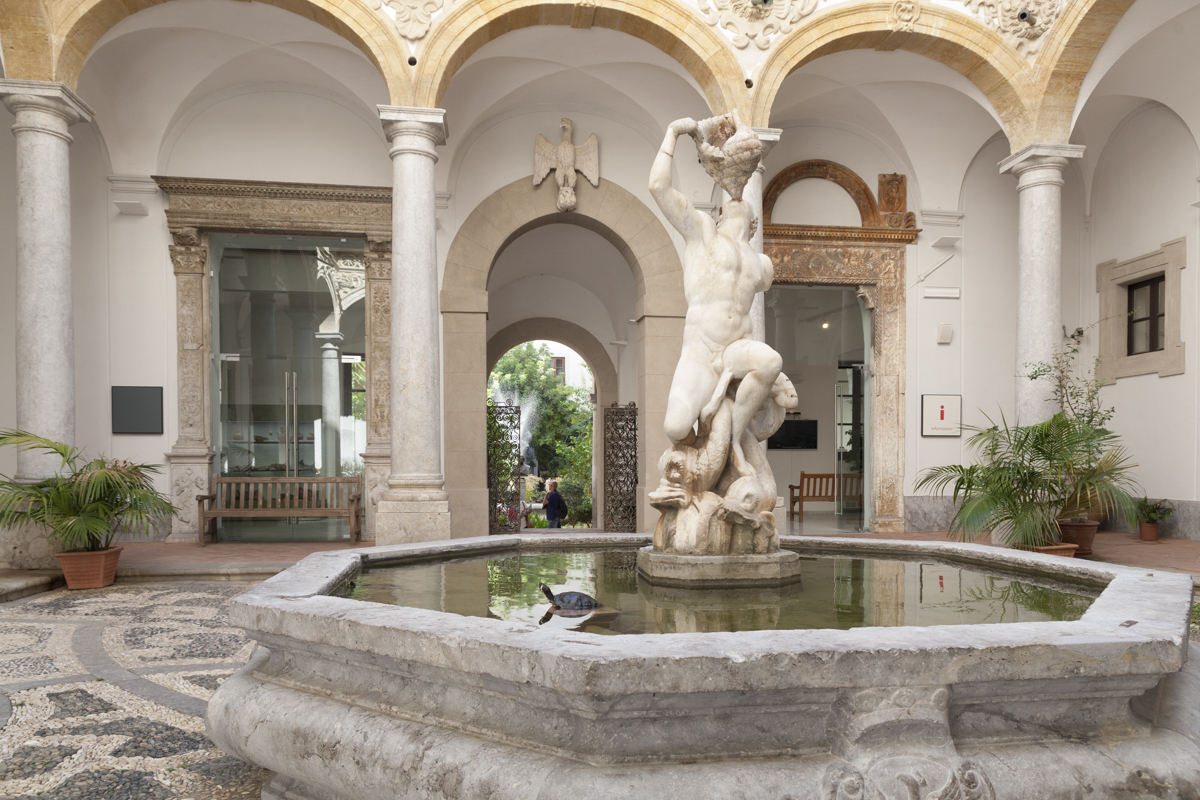

For seventeen years, Palermo’s oldest public museum was a place partly seen and partly imagined. Its ground floor reopened in 2016, but upper stories of the Museo Archeologico Regionale Antonino Salinas remained behind the long work of restoration, research and installation. On November 6, the entire museum returned to public use.
The reopening is more than the completion of a building project. It changes what can be known. Collections kept in storage now re-enter the history of Sicily and the Mediterranean, and one group of forgotten metal fragments has emerged as a ceremonial chariot from Pompeii.
A museum older than modern Italy
Founded in 1814, the Salinas has occupied the former convent of the Oratorian Fathers since 1866. Its collections were shaped by excavations, Bourbon donations, aristocratic holdings and the creation of a national archaeological culture. Restoration of the three-story complex began in 2009, supported by European and regional funds.
The first floor now gathers historical collections that once defined the museum: Etruscan works from the Casuccini collection, Egyptian material, jewelry, coins and objects from Pompeii and Torre del Greco. The second floor follows archaeology in Palermo and western Sicily through the results of twentieth-century excavations, many never previously displayed.
The discovery was waiting in storage
Among the reopening’s most remarkable revelations is a group of bronze and iron objects from the House of Sallust in Pompeii. They had entered Palermo through early nineteenth-century Bourbon donations and remained unassembled in the museum’s stores.
Six Salinas archaeologists cross-read excavation diaries, archives, museum registers and the objects themselves. The comparison allowed them to identify the fragments as parts of a ceremonial chariot dating to the first century CE, related in type to the vehicle unearthed at Civita Giuliana near Pompeii in 2021.
No new object had to be dug from the ground. The discovery came from giving stored evidence another sustained look. It is a reminder that museum deposits are not the end of archaeology; they are active research sites where documentation can reunite things separated for generations.
Restoration changed the act of visiting
The completed museum covers nearly five thousand square meters across three floors. The project addressed fire safety, security, circulation and interpretation while preserving a seventeenth-century architectural setting. Multisensory stations, simplified pictograms, app-based interpretation, an immersive room and step-free access extend the meaning of reopening beyond unlocked doors.
The final Sala dei Mosaici sits beneath a glass roof that draws Palermo’s sky into the archaeological display. The image is almost too perfect: buried fragments brought into light inside a historic building that itself required years of repair.
What seventeen years made possible
Long museum closures are often described through delay and inconvenience. The Salinas story also shows the other side of duration. Collections had to be researched, ordered, conserved and made intelligible across disciplines. Architects, archaeologists, conservators, university researchers and museum staff built a narrative that no single department could complete.
Palermo has regained the whole of an institution that began before Italian unification. More importantly, the museum has demonstrated that reopening is not a return to an earlier state. The building, the research and the public relationship have changed. The chariot from Pompeii makes that transformation visible: what seemed like disconnected fragments is moving again—not on a Roman road, but through a new account of what careful institutions can recover.