
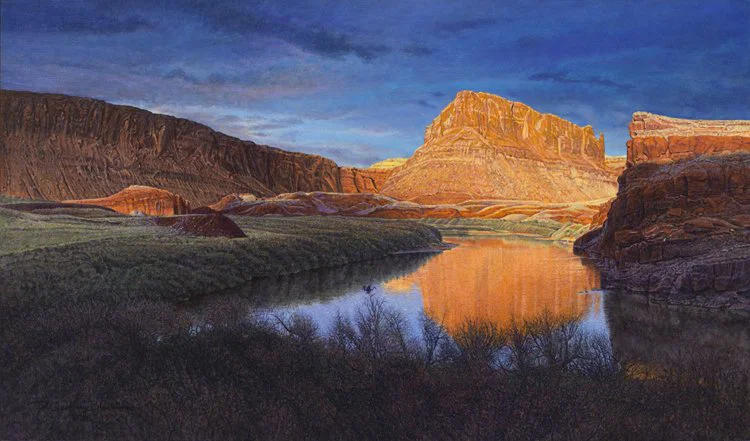
In Twilight on the Colorado, the last light reaches a sandstone formation while the river carries its reflection below. Shadow gathers along the canyon walls. R. Geoffrey Blackburn’s painting holds our attention at the meeting of these different conditions, allowing us to linger with a landscape that is already changing.
Knowing the Country
Blackburn’s familiarity with the Colorado Plateau grew through years spent working in the region. During the uranium boom of the 1970s, he operated a mineral exploration company out of Moab, Utah. The work brought him into close contact with the red rock country that became central to his painting.
Photographic studies and sketches provided references for paintings developed in the studio. His Red Rock Period began in 1974, establishing a sustained exploration of the forms and light of the American West. That background gives his landscapes the specificity of places observed over time.
His paintings reward a movement between the whole view and its individual passages. The scale of a canyon first establishes the scene, but smaller shifts of color tell us how the light travels through it. A shadow can separate one formation from another. A reflection can bring a distant cliff into the foreground, changing the route our eye takes through the composition.
In Twilight on the Colorado, the river performs precisely that role. Its reflection extends the illuminated rock downward and connects two areas of the painting. The darkened surroundings allow the remaining light to carry greater force. The effect depends on the relationships Blackburn established across the scene, rather than on brightness alone.
Building the Experience of Light
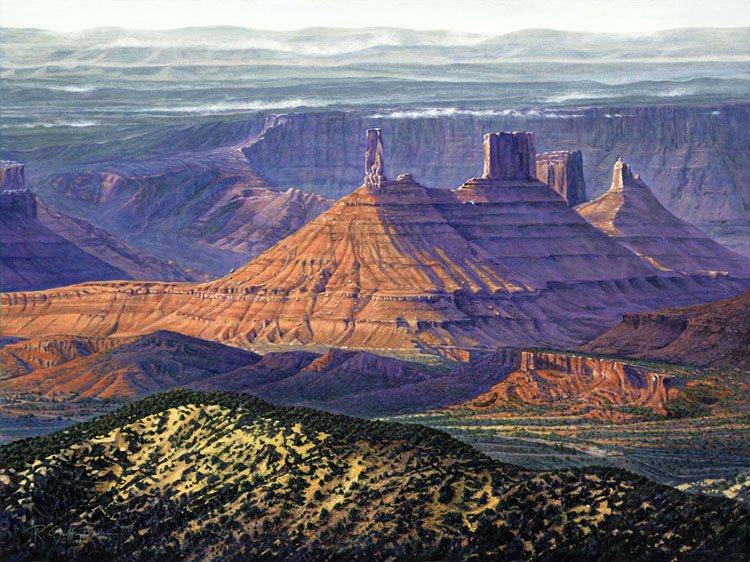
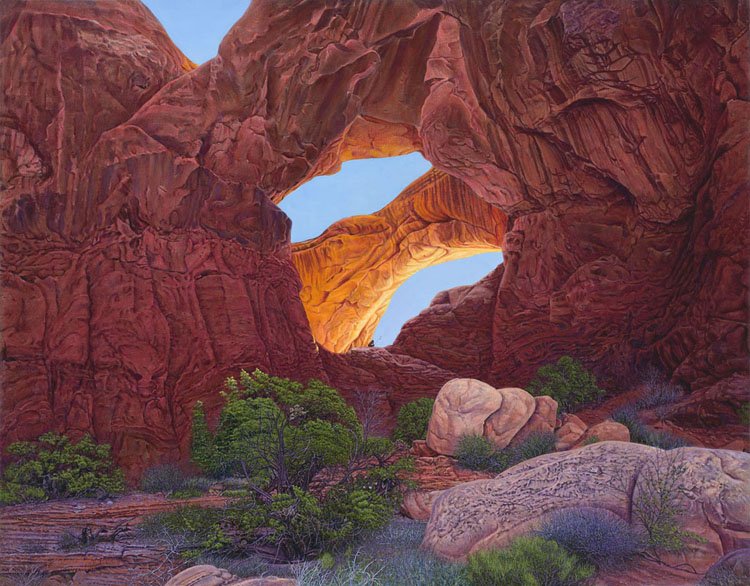
Blackburn used thin layers of transparent oil color to develop depth and luminosity. The process allowed a distant formation and the variations of a nearby surface to occupy the same carefully considered space. In Indian Summer, an arch frames the light falling on the land; Early Risers places a bare tree against the red cliffs of Zion.
Largely self-taught, Blackburn also studied Renaissance paintings in Europe. His recognition included landscape honors from the International Guild of Realism and the Salmagundi Club in New York. These achievements form part of a practice grounded in prolonged observation.
Indian Summer and Early Risers offer further ways of entering this country. The arch in one painting and the bare tree in the other give the viewer a position from which to look. These foreground structures help us register the distance beyond them. We encounter the landscape through an arrangement that feels accessible even when the formations themselves are immense.
Blackburn’s study of Renaissance painting provides a useful context for his patient use of transparent color. Layering allowed him to develop a surface through which light appears to emerge. His paintings are also held in collections including the Ronald Reagan Presidential Library. For readers discovering his work now, however, the first point of connection can remain wonderfully direct: a particular hour, a stretch of water or the familiar experience of watching daylight leave a place.
The paintings remain an invitation to spend time with the country he knew. I am drawn to their sense of distance, and to the way a passage of light can bring an immense formation close to us. Through his work, the landscape becomes an experience we can return to, with something different to notice each time.
Explore the artist’s work at rgeoffreyblackburn.com
For artists
Would you like to see your work featured by ArtTour International?