
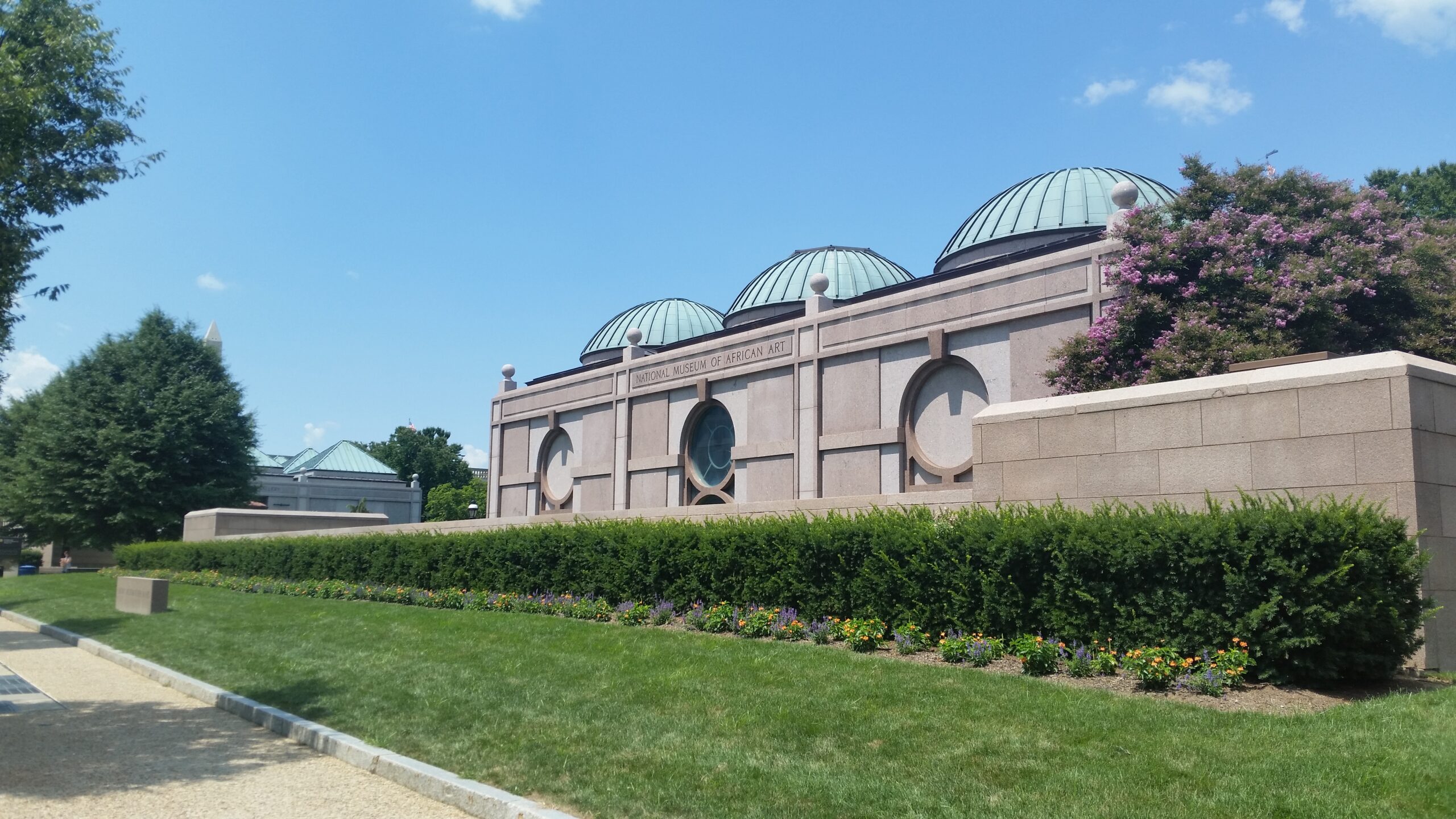

The Smithsonian’s National Museum of African Art is turning an institutional process that usually happens behind the scenes into the subject of an exhibition. Opening November 6, New & Now: A Decade Building the National Collection of African Art examines how the museum has expanded and reconsidered the national collection over the past ten years.
The exhibition is not simply a display of recent acquisitions. It asks why a museum collects, how objects enter a public collection, what histories accompany them, and what ethical stewardship requires after they arrive. For an institution responsible for nearly 13,000 objects, those questions shape both what the public sees now and the record available to future generations.
New voices and older histories
The presentation brings contemporary practices into conversation with historical material. Artists represented include Adebunmi Gbadebo, Wangechi Mutu, Thania Petersen, Beya Gille Gacha, Damien Ajavon, Pamina Sebastião, and Phoebe Boswell. At the other end of the timeline is a bowl associated with King Lewanika, identified by the museum as the oldest object in the exhibition.
That range makes the act of collecting visible as a sequence of choices rather than a neutral accumulation. A national collection can broaden whose work is studied, whose experience is preserved, and which relationships between past and present become possible. It can also reveal absences that earlier collecting priorities left behind.
The acquisition story belongs in the gallery
For artists and audiences, one of the exhibition’s most useful ideas is that an object’s route into a museum is part of its meaning. Provenance, donor history, research, conservation, and consultation are not administrative footnotes. They help determine whether an institution can responsibly care for and interpret a work.
This is particularly important for collections shaped by colonial histories and unequal markets. Ethical stewardship can require deeper provenance research, sustained relationships with artists and communities, and a willingness to revise labels or institutional assumptions when new evidence emerges. Transparency does not resolve every contested history, but it gives the public a clearer view of how museums make decisions.
The Smithsonian presentation also creates a useful distinction between visibility and permanence. An exhibition is temporary; an accession to a national collection carries obligations that may last indefinitely. Storage, conservation, documentation, scholarship, and access all continue after a gallery display closes.
What artists can take from the process
Artists entering institutional collections can support the future life of their work by keeping accurate records: title, date, materials, dimensions, editions, installation instructions, condition information, exhibition history, and the identities of collaborators. For time-based or technically complex work, the record should also explain which elements may change and which are essential.
Artists can ask museums how their work will be documented, conserved, photographed, loaned, and interpreted. They can clarify credit lines and reproduction rights, and provide context in their own words without assuming that a single statement will remain sufficient forever. A well-documented acquisition gives future curators less room to separate the work from the circumstances that formed it.
New & Now makes an important curatorial move: it treats collection-building itself as public knowledge. By showing the decisions, histories, and responsibilities behind acquisition, the museum invites visitors to look not only at what a national collection contains, but at the values that made it take its present form.