
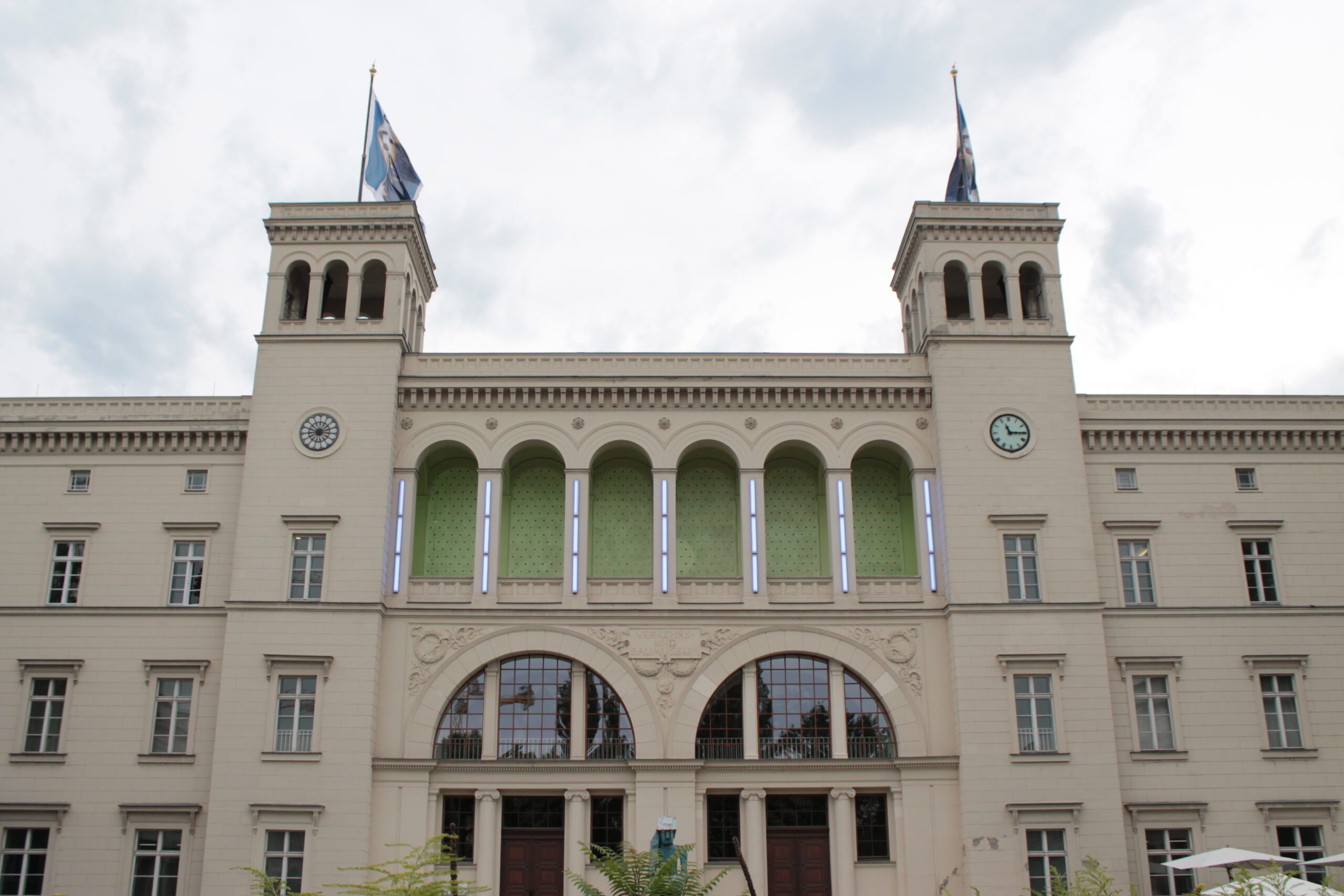
Sophie Calle has returned to Berlin with an exhibition built around disappearance, memory and the unstable evidence left behind when a person, place or symbol is gone. Opening November 13 at Hamburger Bahnhof–Nationalgalerie der Gegenwart, Is It Better? is the French artist’s first solo presentation in Berlin in two decades.
The museum brings together six bodies of work spanning roughly thirty years across photography, text, video and installation. The timing is unusually resonant: the show coincides with Hamburger Bahnhof’s thirtieth anniversary as a museum, and Calle’s practice has long treated buildings and cities as containers for memories that refuse to stay fixed.
Berlin as a city of missing signs
A central work is The Detachment from 1996. Calle photographed twelve Berlin sites where symbols of the former German Democratic Republic had been removed after reunification. She then paired the emptied locations with the recollections of passersby. The absent monuments become visible through disagreement: memory does not reconstruct one authoritative image, but a field of partial, sometimes contradictory descriptions.
That method is characteristic of Calle. She creates rules, follows clues and collects testimony, but the result does not close the case. A photograph proves that a place existed in front of a camera; a witness remembers what the camera cannot show; a text introduces another distance between event and account. The work lives in the friction among those forms.
What an institution forgets
The exhibition also includes Les fantômes d’Orsay, made from photographs, objects and texts connected to the abandoned hotel inside Paris’s former Gare d’Orsay, where Calle spent time before the building became the Musée d’Orsay. At Hamburger Bahnhof—a former railway terminus transformed into a museum—the work gains a second architectural echo. Both sites ask what cultural institutions retain from the lives that occupied them before.
A new work connected to Berlin’s demolished Palace of the Republic and the reconstructed Berlin Palace extends the question into the present. Rather than treating reconstruction as a return to certainty, Calle’s approach keeps attention on what a rebuilt façade cannot recover: competing attachments, political meanings and lived experience.
The artist as investigator
For contemporary artists, Calle offers a model of research that remains personal without becoming purely confessional. Her procedures are rigorous enough to generate evidence, yet open enough to admit ambiguity. She does not illustrate memory; she creates situations in which memory reveals its own methods and failures.
Is It Better? places that practice inside a museum whose own history is bound to transport, division and reinvention. The result is not nostalgia for what Berlin has lost. It is a sharper question: when an image disappears, what kind of truth can the stories around its absence still hold?