
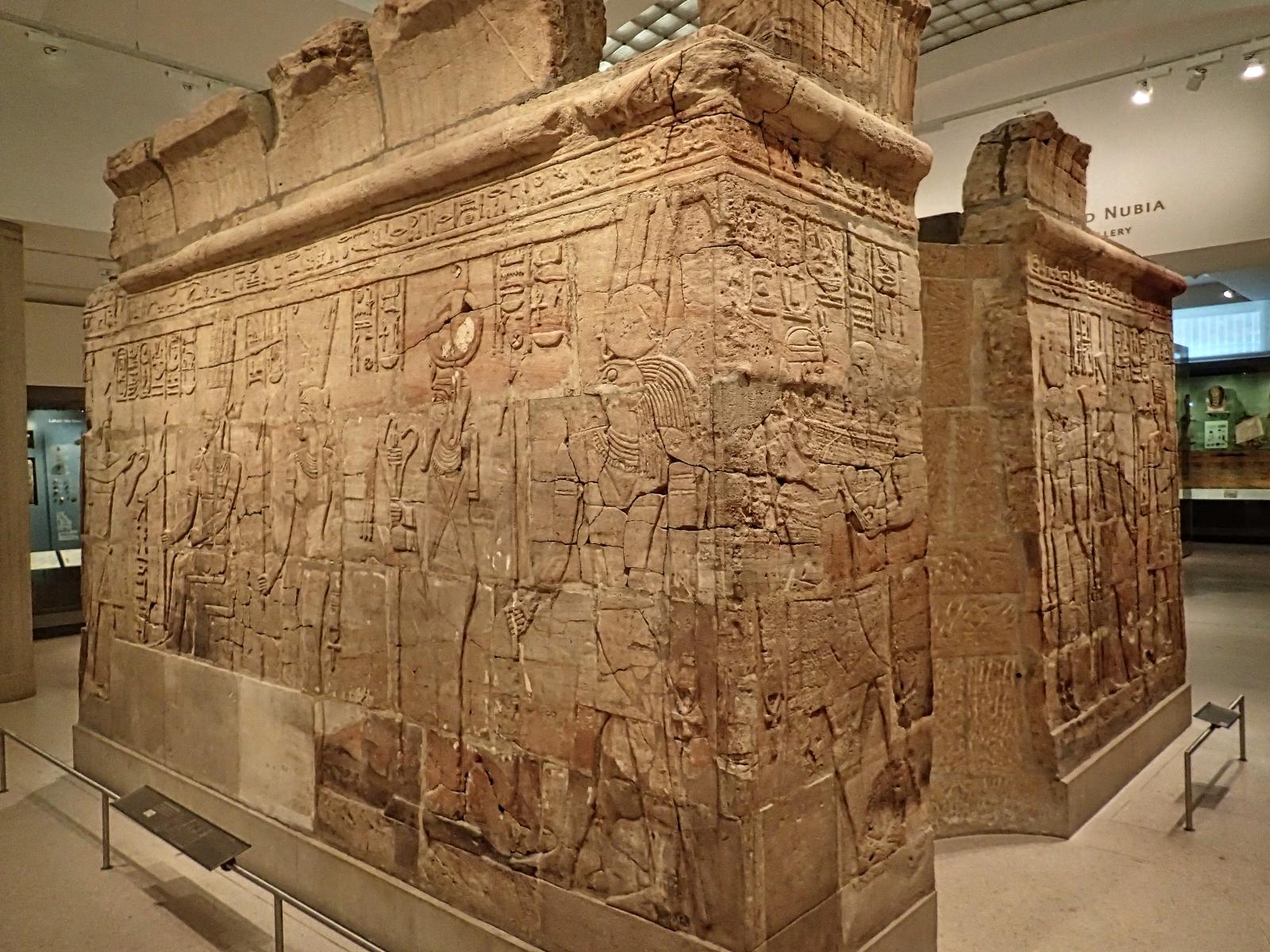

For most visitors, the Shrine of King Taharqa appears as a monumental structure of pale sandstone. Beginning November 13, the Ashmolean Museum will use light to reveal another history: the blues, reds and yellows that once covered its walls 2,700 years ago.
The projection is based on scientific investigation rather than fantasy. Microscopic pigment analysis, specialist photography and infrared imaging uncovered traces too faint for ordinary viewing, including Egyptian blue associated with particular divine figures.
A temple crossed a continent
King Taharqa ruled Kush and Egypt between 690 and 654 BCE. His shrine originally stood within the temple of Amun-Re at Kawa in northern Sudan. Its carved walls show the king making offerings to gods, joining political authority to sacred obligation.
After centuries of burial, the building was excavated in the 1930s by an Oxford expedition. It was dismantled into numbered blocks, transported to Britain and reconstructed at the Ashmolean, where it arrived in 1936. The museum describes it as the only free-standing pharaonic building in Britain.
That journey is part of the shrine’s present meaning. The new installation will include films addressing its construction, burial, excavation and scientific study. Any retelling must also keep Sudan visible—not as a remote point of origin, but as the landscape and cultural context in which the monument was made.
Color changes what stone appears to say
Modern viewers are accustomed to imagining the ancient world in bare stone. Weathering, excavation and museum display have reinforced that image. Yet many ancient buildings and sculptures were intensely painted. Recovering color changes the emotional and symbolic register of the work.
At Taharqa’s shrine, researchers found that Egyptian blue was not applied indiscriminately. Its placement appears connected to specific gods and images. Color therefore carried meaning: it directed attention, distinguished beings and helped construct the sacred order of the room.
The projection offers a rare conservation solution. No new pigment will be placed on the ancient surface. Light can make an evidence-based reconstruction visible, then disappear without pretending to be the original paint.
A reconstruction that admits it is temporary
Digital reconstruction can create false certainty when missing information is presented as fact. The Ashmolean’s approach is most persuasive when the projection remains legible as interpretation—one built from surviving evidence, scholarly choices and areas of uncertainty.
That distinction is important for artists and audiences. A reconstruction does not reverse time. It stages an encounter between the object that survives and a researched proposal about what has been lost.
The shrine’s story is extraordinary because it is not one recovery but several: a building emerged from sand, crossed more than 4,000 kilometers in numbered blocks, and now yields colors that had remained almost invisible. The new light does not complete that story. It gives the monument another way to speak—and reminds viewers how much ancient art has been filtered through the accidents of survival.