
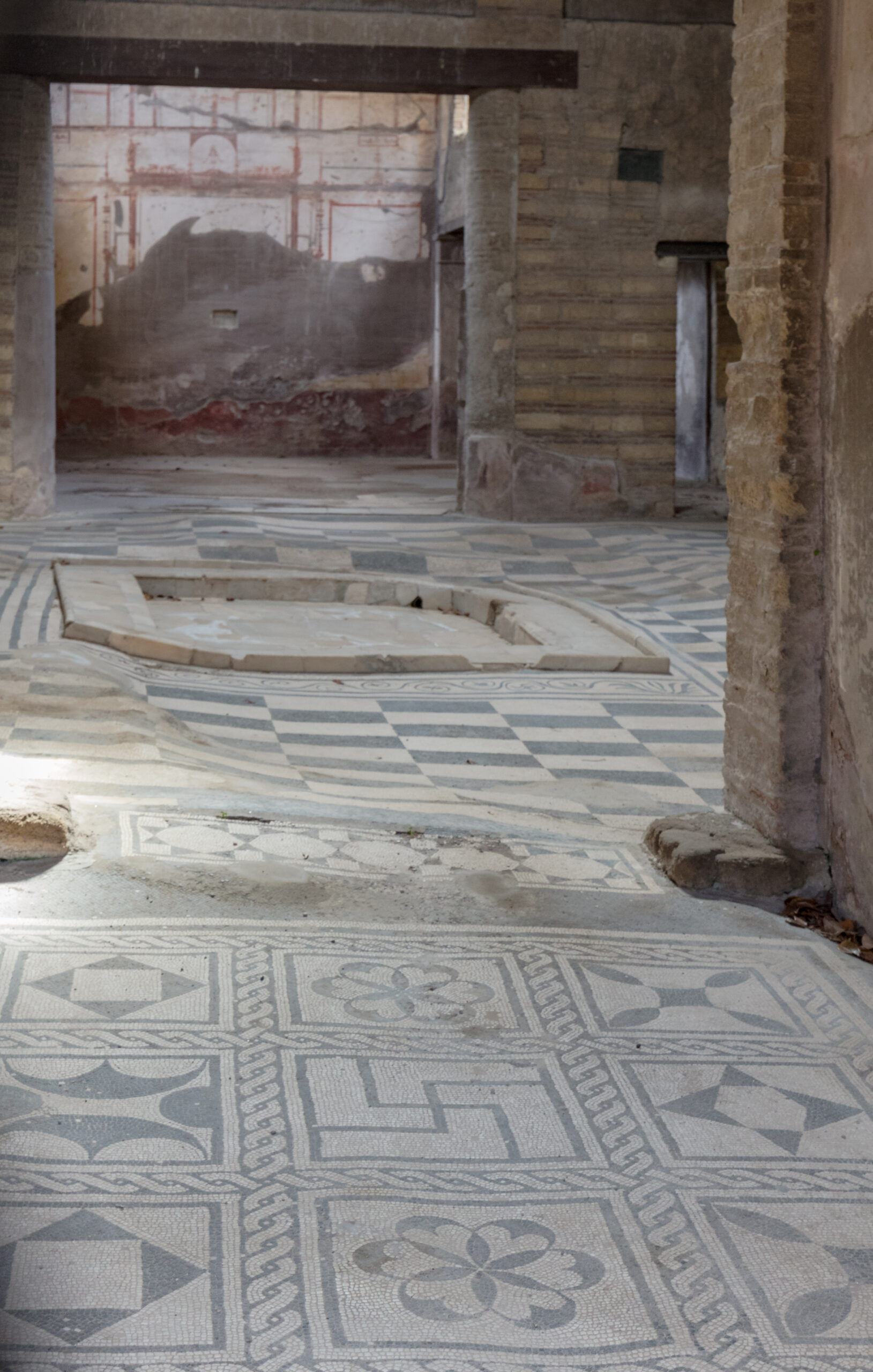

At Herculaneum, two houses have reopened after decades behind conservation barriers. They could hardly be more different. One is an opulent residence with a monumental hall, garden, stucco and a mosaic floor deformed by the weight of volcanic material. The other is a modest wattle-and-daub building with a shop below and living quarters above.
Together, the House with the Mosaic Atrium and the Wattle-and-Daub House bring visitors unusually close to the social range of a Roman city destroyed by the eruption of Vesuvius in 79 CE. Their reopening on November 5 is not only an expansion of the visitor route. It is a story about how fragile rooms are returned to public life without pretending that conservation is ever finished.
A floor remembers the eruption
The House with the Mosaic Atrium was a large seafront residence. Its survival is visible not as perfection but as pressure. Charred wooden elements remain, and the atrium’s mosaic floor bears the physical marks of the volcanic material that covered it for nearly two millennia.
The house takes its name from that floor, which can be seen from the monumental Oecus Aegyptius. Restored rooms open onto a garden and retain precious stucco work and finely decorated suspended ceilings. These details evoke wealth, but the distorted atrium refuses to let decoration float free of disaster. The architecture records both the life of the house and the force that interrupted it.
Herculaneum is exceptional because volcanic conditions preserved materials that commonly disappear from ancient sites. Wood, furnishings and upper stories can survive as evidence of how rooms were constructed and inhabited. The reopened houses turn that evidence into spatial experience: visitors can move through relationships between street, shop, garden, hall and domestic interior.
A first-floor view of ordinary life
The Wattle-and-Daub House offers a different register. It was a comparatively modest building, described by the park as a small apartment house, with a ground-floor shop and first-floor accommodation that still retains original furnishings.
For the first time at Herculaneum, visitors can enter the first floor of a house and look down along Cardo IV, the ancient road that led toward the sea. That change in height matters. Archaeological sites are often encountered as plans at ground level, their upper lives missing. A stair and an elevated view restore the vertical city: people lived above commerce, looked toward the road and occupied structures made from economical materials as well as marble and mosaic.
Putting the two homes into the same public route prevents Roman domestic life from being told only through elite rooms. The wealthy residence and the more modest dwelling do not cancel their differences. They sharpen them.
Twenty-five years of care behind one open door
The reopenings are part of the Domus Project, a program addressing six important residences whose roofs, exposure and ancient structures had developed serious conservation problems. The work continues a public-private partnership between the Herculaneum Archaeological Park and the Packard Humanities Institute that has operated for more than twenty-five years.
Other houses in the program returned to public access in March 2025 and July 2026. The park says work on decorative elements and furnishings will continue even after the safety and preservation standards required for reopening have been met. That point is essential. An open door is a milestone, not a declaration that the site has been repaired once and for all.
Archaeological conservation must hold several times at once. It cares for Roman fabric, the history of early excavations and restorations, present-day visitor safety and the future maintenance of structures exposed to weather. Each intervention leaves a record. The goal is not to erase those layers into an illusion of untouched antiquity, but to make the place stable and legible without silencing what happened to it.
Two homes, one city, an unfinished return
There is something cinematic in the reopening of a house after two thousand years, but the reality is slower than a discovery scene. It is made of drainage, roofs, scaffolding, monitoring, documentation and repeated decisions about what can safely be seen.
The House with the Mosaic Atrium and the Wattle-and-Daub House now allow visitors to meet Herculaneum from two social and architectural positions. One offers a garden framed by wealth and a floor bent by catastrophe. The other restores the upper level of a modest urban life.
What makes the story extraordinary is not only that these rooms survived. It is that survival has been treated as an ongoing relationship—between ancient materials, modern expertise and the public invited to enter again.